Showing posts with label sock yarn. Show all posts

Monday, October 31, 2011

No-Bull Book Review & Giveaway: The Knitter's Book of Socks, by Clara Parkes

When she's not taking photographs of the artfully-swirled cream in her cup of java mochalatta, Clara Parkes writes books. Really excellent books, as a matter of fact. Today's No-Bull Book Review examines her latest, The Knitter's Book of Socks: The Yarn Lover's Ultimate Guide to Creating Socks That Fit Well, Feel Great, and Last a Lifetime (Potter Craft 2011; MSRP $30, available as of the time of this writing for $17.85 via the link).

I first encountered Clara Parkes through her excellent newsletter, Knitter's Review, and the message boards that accompanied it. I have always loved Clara's in-depth yarn reviews, her emphasis on small-producer and single-breed wools, and her willingness to share her technical expertise though both her newsletter and message boards. Clara's first two books (The Knitter's Book of Yarn and The Knitter's Book of Wool) are wonderful, information-packed volumes that should be on every knitter's bookshelf. They also feature some lovely patterns, too. It's no surprise that The Knitter's Book of Socks will take its place next to them, as a must-read book for the sock knitter. Let's take a closer look at what's inside.

Knitter's Book of Socks begins with a brief introduction, in which Clara sets out her goal: to educate readers about "the art, science, and sheer pleasure of knitting socks from the yarn up." By using the specific sock yarn as starting point, Parkes hopes to prevent sock knitting disasters that might result from a bad combination of sock and yarn.

Stepping Stones, by Clara Parkes

Chapter 1 is titled "What a Sock Needs," and we learn in the introductory section that a sock yarn needs three qualities: elasticity, strength and absorption. Parkes walks the reader through each of these qualities, discussing what elasticity is and how to measure it; different aspects of strength, including strength to resist abrasion and tensile strength; and moisture management. She finishes with a nod to a fourth, more abstract factor: what I think of as the yarn's charisma -- whether the yarn feels good to wear and work with.


Hickory, by Jane Cochran

Chapter 2 covers the fibers that are used to create sock yarns, not only covering types of fiber (wool and other protein fibers, plant-derived fibers like cotton, synthetic and others) but also issues like blends, the fineness of the fibers and staple length.

Chapter 3 looks at specific types of yarn, instructing the reader about twist, singles vs. plies, even cable-spun and corespun yarns -- all excellent stuff that often is overlooked in discussions of yarn.

Chapter 4 gives the knitter some tips on how to make adjustments to a yarn to compensate for natural tendencies that can affect its suitability as a sock yarn. For example, Parkes gives some guidance on how to use your stitchwork to increase the elasticity of the socks (if you are working with a less-than-elastic yarn); how to improve the strength of a less-durable yarn; and discusses the use of wooly nylon as reinforcement.
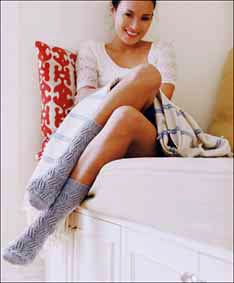

Veil of Rosebuds, by Anne Hanson

If your mind starts spinning from the vast amount of valuable information in the beginning chapters, you can always take a break and refer to Chapter 5, the patterns. Parkes presents a selection of 20 sock patterns from leading sock designers, including Cat Bhordi, Cookie A, Lucy Neatby, Nancy Bush and Ann Budd.


Buddleia by Marlaine Bird

There's a great variety of styles included, from stranded

Strago by Jared Flood

and eyelets

Prana, by Cirilia Rose

to cuffs

Lady Tryamour, by Sivia Harding

even unique multidirectional colorwork:

Percheron, by Kathryn Alexander

But of all the gorgeous patterns, my favorite is a lovely one called "Tutu," designed by Melissa Morgan-Oakes and knit up in Black Bunny Fibers Stella yarn:

Tutu, by MMO

The patterns feature charts (in color where appropriate); close-up shots to show off specific design features; notes to help the knitter with unusual techniques; and extensive descriptions that explain how the features of the specific design illustrate the technical information given in the beginning of the book. Sizing varies depending on the pattern; some of the more unusual designs are shown in one size only, but many include two or three different sizes.

The pattern section is followed by a "Resources" section detailing how to care for your socks; explanation of abbreviations and techniques; a chart showing foot size and how it relates to sock sizes; and a bibliography.

The book is hardcover; approximately 208 pages; with lots of photographs and inset boxes; and the mouth-watering photography is by Alexandra Grablewski.

When you really love yarn, especially sock yarn, like I do, it's a real treat to encounter a book as informative and easy to read as it is beautiful. The Knitter's Book of Socks is such a book, and thanks to the generosity of Potter Craft, I have a free copy of The Knitter's Book of Socks to give away. Leave a comment to this post by midnight, Wednesday, November 2. I will use the random number generator to pick a winner and announce it the next day. One comment per person, please! And makes sure you include an email or I can reach you through your Blogger comment login.

Monday, August 02, 2010

Bamberino, anyone?

I just uploaded around 30 skeins of Bamberino fingering weight yarn. I really like this base yarn; while it contains 20% bamboo fiber (what the feds want us to call "rayon" now), it retains the feel and bounce of the merino without seeming stiff. I also like that it doesn't have a stark white ply like some commercial sock yarns too.

I did a couple of batches in twos and threes of the same colorway, because I know that the Mythos pattern from Knitty.com was getting a lot of buzz, and it calls for 750-1500 yds of fingering weight yarn. Each Bamberino skeins has about 420 yds, so two would make the smallest and possibly second smallest size, while three skeins would get you through the next three sizes.


Blue Dolphins

This is one of my favorite batches, and I've listed 3 in the same dyelot. Or if you're more of a red person, there are 2 of these:


Strawberry Girl


Of course, there are also some lovely single skeins, like this one:

Little Princess

There are also a few batches of a blend of bamboo fiber/alpaca/wool in the roving category; it reminds me of marshmallows, it's so soft and fluffy. It's a bit hard to photograph because of the softness and sheen, but it will make some striking semisolid yarn...

Thank you for your support with my pancreatic cancer fundraiser. The pattern will be on sale through the end of the year, and your support means a great deal to me.

Monday, April 12, 2010

Update: more sparkly stuff

I spent last week with a slightly-sick kid (again) and recovering from all the hullaboo surrounding Easter. Yesterday Little Miss lost a tooth, blaming it on Elvis (she said he knocked it out by hitting her with a pillow) and then she tried to convince us that since other kids in her class get $20 from the Tooth Fairy (allegedly) she should, too. Nice try, Little Miss. Even though I think she looks adorable without the top tooth, she refused to smile except with her lips tightly clamped shut. (But she still looks cute...)


I also did a bunch of dyeing last week, including some Twist O'Silk sock yarn (superwash wool/bamboo/silk)


Thistle


Grassland

and some Stella, the sparkly fingering weight yarn (mix of wool, silk, nylon and silver):


Space Oddity


Krypton Sun

So if you're in the mood to treat yourself, go have a look!

Coming tomorrow, another book review...

Friday, February 19, 2010

BBF update: new silk-merino sock yarn & Tight Twist is back!

FYI: Just in time for your shopping pleasure, I updated the BBF site with some gorgeous hanks of a new base yarn, Softsilk Sock, which is 50% merino and 50% silk, superwash, fingering weight. Of course, you can make socks with it, but it would also be so lovely as a scarf or cowl, where it would brush gently against your skin and make your eyes look that exact shade of ice blue...


or gray


or cornflower


However, if you're thinking some serious stitchwork, you might also want to treat yourself to a skein or two of Tight Twist, the beloved wool/polyamide blend reminscent of the Serious German Sock Yarns like Opal or Trekking.


Some nice deep blue and red and green,


but also some nice multis, too. And if you purchase $25 or more, use the code "GROUNDHOG" for free shipping through February! Link to the shop is here.

Wednesday, February 03, 2010

Gitte's Socks

Allow me to introduce another pattern in the BBF line: Gitte's Socks.


They are knit in fingering weight yarn and feature a nice eyelet check pattern-- pretty but not excessively complicated. The sample socks are knit in BBF Bamboo Lite Sock (a base on backorder right now) but any fingering weight yarn in a solid or semi-solid would work, including Superwash Merino Classic, CashSock or Tight Twist Sock (which will be my next update).


One amusing anecdote: I did a photo shoot with Bridget as my foot model in Rittenhouse Square. (The photos I took weren't usable but this was entirely due to my skills as a photographer, rather than the beauty of Bridget's feet. The lovely photos you see here were taken by the uber-talented Laura Grutzeck.) We were snapping photos and Bridget was striking poses, and a woman walked by with her boyfriend and Bridget heard her ask, "Are they anybody?" We of course cackled at that. But we didn't pay her too much mind, because us Somebodies try to ignore the Little People as much as possible.


You can find Gitte's Socks on Ravelry here or Patternfish here. I'll be adding some hard copies to the BBF store soon, too.

Friday, January 29, 2010

New base yarn: Stella Sock

Yesterday, I posted a new base yarn on the BBF website. I've named it Stella Sock, and it's a luscious blend of 63% merino, 20% silk, 15% nylon and 2% silver. Yep - silver, so it's got a nice sparkle, just like Edward the vampire.


My first thought in dyeing it was that it would look spectacular with deep, saturated colors -- and it does --


but I also tried some more muted, subtle shades, and it looks great with those, too, but in a different way:


So check it out -- just scroll down to the bottom of the home page to see the entry. One of my sock clubs (Club A) received Stella as a special preview for their last shipment, so they can chime in since they've actually seen it and felt it.

Thursday, January 28, 2010

Blog Tour: Toe Up! by Chrissy Gardiner -- and giveaway!

I'm pleased to be a stop on Chrissy Gardiner's blog tour for her new book, Toe-Up! Patterns and Worksheets to Whip Your Sock Knitting Into Shape. You might recall that Chrissy was one of the designers who contributed to Knitting Socks With Handpainted Yarns, and she's the founder of Gardiner Yarn Works, where you can find all sorts of lovely handknitting patterns.


Chrissy has recently released her book devoted to toe-up sock patterns, so let's jump right in and have a look. We start with the introduction, in which Chrissy explains how she became a convert to toe-up sock knitting, almost despite herself. Originally a cuff-down sock knitter, Chrissy was asked to design some toe-up socks, then to teach toe-up sock knitting at a LYS. She discovered that her toe-up class was significantly more popular with knitters than the traditional, cuff-down class, and before she knew it, she was knitting most of her socks the toe-up way.

Reading Toe-Up is like taking a class with Chrissy, as she shares all sorts of tips and techniques with the reader. It's this wealth of technical information that is one of the greatest strengths of Toe-Up. For example, the first chapter is called "Getting Started," and contains basic information about the tools you'll need, a comparison of the three methods of sock knitting (dpns vs. magic loop vs. two circulars -- with some explanatory photographs), a section on gauge and how it relates to the kind of fabric you'll want for your socks, a discussion of yarn choices (with attention to color & fiber choices), fit and last, a few words on revising the patterns in the book.


The Dude Abides socks

The technical info continues with

  • Chapter Two, a discussion of cast-on methods. You'll find explanations of "Judy's Magic Cast-on," a Turkish cast-on, and a "backwards loop" cast on, again with photos to show you exactly how.
  • Chapter Three discusses toes from the perspective of the toe-up knitter, giving the knitter several specific options -- Non-shaped Round Toe, Shaped Round Toe, Anatomical Round Toe, Star Toe, and Short-Row Toe --again, including illustrations, with sample worksheets to explain how the number for each toe are calculated.
  • Chapter Four discusses heels from the perspective of the toe-up knitter, again laying out several options: a Short-row Heel, a Hybrid Heel (combining short-rows and slip stitches) and an Afterthought Heel (knit after the main part of the sock is complete). Again, photos are used to illustrate each version, and sample worksheets show how to calculate the numbers you'll need.
  • Chapter Five is devoted to finishing, in particular, methods of binding off the socks at the top while retaining enough stretch to make the top of the sock easy to put on and take off. You'll find explanations of a Yarn-Over Bind-off, a Sewn Bind-Off, and a P2tog Bind-off with photos; in addition, you'll find a brief discussion of how to weave in ends and how to care for your finished socks.
  • Chapter Six discusses what Gardiner calls "Advanced Techniques": how to read charts, how to work cables without a cable needle and, alternatively, how to use a locking stitch marker, how to convert patterns from top-down to toe-up style, and how to knit two socks at once.
That's a lot of technical information, and terrific background for knitters who want to go beyond simply reading and following patterns so that they understand why their toe-up socks are constructed in a particular way. It also gives the knitter the knowledge she needs to be able to tweak patterns to suit her own tastes.


Vortex socks

The technical chapters take up over forty pages in the book, but don't worry: there's a generous selection of patterns for you to work on. The patterns are divided into two general categories: "Family Socks" and "Fancy Socks." The Family Socks section contains seven patterns, designed in a wide range of sizes so that they can be made for just about any member of the family. The patterns also use a variety of yarn weights -- chunky to fingering-- so that you can stashbust, or knit thicker socks to wear with boots or in bed or around the house. Specifically, you'll find the following patterns in the Family section: the Snuggalicious Slipper Socks (chunky weight), a Mix-and-Match Sock Recipe (sport weight), Syncopated Rib Boot Socks (worsted weight), Old School Knee Highs (DK weight), Gull Wing socks (fingering weight, using a slip-stitch pattern), Sydney (fingering weight; ruffled anklets), and the pretty Fjordland Socks (fingering weight, with a textured color pattern).


Fjordland socks

The Fancy Socks chapter contains eight patterns, featuring more complex patterning. Two of them are knit in sportweight yarn and the remainder in fingering weight. Diamond Lucy features a textural diamond pattern; The Dude Abides, named after a sweater seen in The Big Lebowski, is colorwork in chocolate and a warm red-orange multicolor yarn; Candelabra Socks uses cables to create a twining pattern; the Vortex socks, use a swirl of cables in a very pretty pattern running the length of the sock; the Great Plains socks uses a combination of eyelets, twisted stitches and smocking to show off a slightly fuzzy yarn; Spring in Oregon features lots of vertical panels of texture; Peace Lily features a floral motif; and Sakura is a cherry tree motif with complex patterning on both the instep and leg.


Peace Lily socks

Finally, the last chapter contains blank worksheets corresponding to the various toe and heel styles demonstrated in Chapters Three and Four, so that the knitter can implement them in her own knitting. There is a glossary of techniques, with photographs demostrating skills like the Kitchener Stitch, provisional cast-ons, working through the back loop, and so on.

Other details about the book: it's paperback, color, approximately 160 pages. It's full of charts and worksheets; contains lots of clear photos to help with the more technical skills; the typeface and layout are clear and easy-to-read. If I had one druther, I'd like to see bigger photos of some of the sock designs, but I understand that big photos take up space, and this book is already jam-packed with technical info. I can understand trading off lots of photos for more technical information, particularly since the Internet makes posting additional photos of the designs quick and easy. (Indeed, if you search for the Toe-Up patterns on Ravelry, you'll find that Chrissy has thoughtfully posted multiple shots of each design to give you a better feel for how they look.) Interestingly, Toe-Up is self-published, but don't be freaked out by that; it's not the kind of black-and-white, devoid of style self-published books you might have found a few years ago. On-demand publishing and related developments in the industry have made it possible to produce extremely high quality books like this one, sidestepping the conventional publishing route. MSRP is $24.95, and you can order the book via Amazon through this link.

Old School Knee Highs

Now for the exciting part: due to Chrissy's generosity, I've got an extra copy of Toe-Up! to give away to one lucky reader. All you have to do is leave a comment indicating that you'd like the book, and I'll use a random number generator to pick a winner. You've got to leave your comment by midnight, Friday, January 29th, and I'll pick the winner on Saturday.

Thanks to Chrissy, for including GKIYH on her blog tour, and make sure you stop at Stitch Marker tomorrow, for the next stop along the tour. (You can find the complete blog tour schedule, along with other information about the book, here.)

Tuesday, November 10, 2009

BFL-apalooza at BBF

Today I've updated the Black Bunny Fibers shop with some great blue-faced leicester yarns and rovings. You'll find 100% superwash BFL sock yarn:

Red Light

Electric Navy


a terrific, tightly-twisted blend of 75% BFL and 25% nylon:


Patina


Cabbage Rose

some batches of superwash BFL roving:


Ribbon


and some non-superwash BFL roving:


Go get 'em while they last! (It's the last update before my big studio sale on Nov. 22d...)

Wednesday, September 23, 2009

A few quick notes

I'll consult with the husband and figure out an Open House date; probably in November, so we squeeze it in after Rhinebeck and before the holidays (that way you can justify it as necessary materials for holiday knitting). In the meantime:
  • Looking for Wollmeise? Raffle for 2 skeins to help a knitter (Miss Violet of Lime & Violet fame) in need here.
  • Brooklyn Tweed is coming to Loop next week: classes and a Stitch party. Details here.
  • A little bird told me that a good friend of GKIYH just inked her first book deal. Yes, I am a big tease. As soon as I can tell you more, I will....
  • Check out the Vogue Knitting Holiday issue preview; there's a great fair isle by Laura Grutzeck (under Color Vibes; lower left) and the issue also includes my breathless fangrll profile of Veronik Avery.
  • Update tomorrow on the BBF website, including sock flats, and 20+ skeins of a new base yarn, CashSock...