Showing posts with label blog tour. Show all posts

Monday, May 07, 2012

Meanwhile, on a yak farm (a GIVEAWAY!)

I have started several blog posts and ran out of steam before I could finish them and hit "publish." Just when I was about to try again, I remembered that I am scheduled to be a stop on a blog tour for a new pattern collection from Kristen Ohhdahl and Bijou Basin. Better yet, there's a giveaway involved!

Bijou Basin Ranch is a Colorado farm raising Tibetan yaks and turning the fiber into lovely yarns and fibers, including a line of knitting yarns. This April, BBR released its first pattern collection:  The Complements Collection by Kristin Ohmdahl.  (You may recognize Kristin from her knit and crochet patterns,books, and appearances on Knitting Daily TV.) The Complements Collections is available as a booklet (order from the BBR website for $12.95) or e-book (you can download it on Ravelry for $9.95). It contains thirteen patterns for accessories--some knit, some crochet.


The cover pattern is called the Apple Blossom Shawl, knit in 2 natural colors of fingering-weight yarn, with a bright handdyed color in a heavier weight as accent.  The booklet contains a second knit shawl pattern, as well as a sweet knit capelet:


Crocheters need not despair, for there is the Camellia Shawl for you:


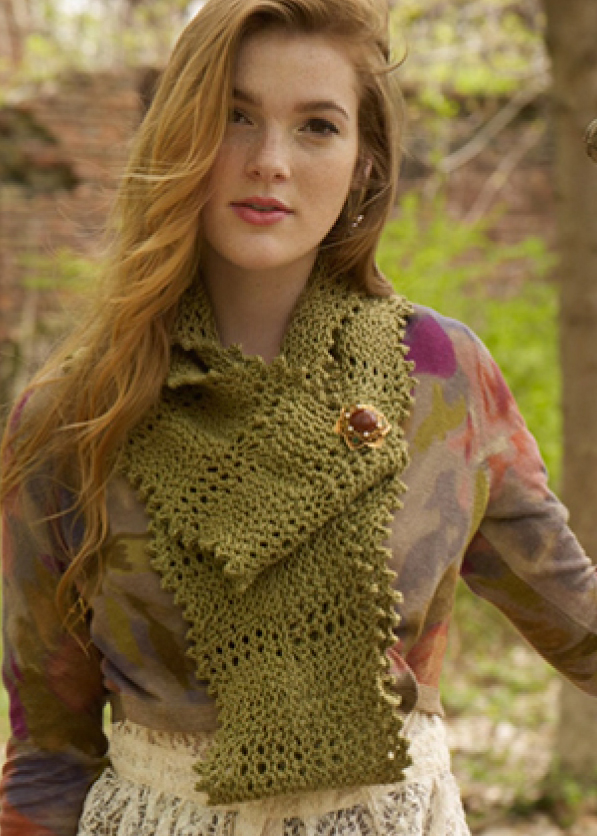
There are two patterns for "ascots," one knit and one crocheted (photo is of the latter):


For cold weather, knitters will find a unisex hat and wristers set (the only pattern for men; sorry, guys):


while crocheters can make a hat and matching scarf


or a set of wristers.


The ever-popular cowls also make an appearance, again one knit and one crocheted version (knit cowl shown).


With the exception of the cover pattern, all the patterns call for sportweight (Craft Yarn Council Category 2 -- fine) yarn and all are one size.  You'll find charts for the lace patterns and crochet stitches; no schematics since these are accessories. Best of all, each of the patterns uses no more than three skeins of yarn, so they're perfect stashbusters and excellent ways to use luxury fibers like BBF's yak blends.

Now that warmer weather is upon most of the U.S., cute accessory patterns like these are nice portable travel projects, too.  Bijou Basin Ranch was at Maryland Sheep and Wool; will be at Estes in Colorado; and you can find their full schedule of show and festival appearances here -- or visit their website for online ordering. Kristin's website is here; next stop on the blog tour, the talented Carol Feller here, on May 8th.

And now the best part:  THE GIVEAWAY!  Leave a comment to this blog post and Bijou Basin will give away a PDF version of The Complements Collection to one lucky commenter.  Leave your comment no later than midnight, Wednesday, May 9th, and make sure you include an email address in the comment or use a profile with an email attached -- no email, no valid entry -- and I will use a random generator to select a lucky winner. Woo-hoo!


Note: I received a free PDF version of this pattern booklet in order to write this review.


Wednesday, April 25, 2012

Blog Tour: California Revival Knits, by Stephannie Tallent

Hoo-boy. Barely recovered from my trip to Atlanta, in the throes of making sock monkey bike helmet covers for the middle school's Wizard of Oz production (don't ask),


it is the perfect time to take a break and look at a new book full of pretty things.  Today we are a stop on the blog tour for California Revival Knits, by Stephannie Tallent.  You may know Stephannie from her blog, Sunset Cat, or from her many designs appearing on Ravelry and elsewhere.  In California Revival Knits, published by Cooperative Press (digital/PDF available right now, for $16.95; digital plus preorder for print is 26.95 plus shipping), Stephannie presents a collection of designs inspired by a style of California architecture.
To me, California Revival can include Mission, Spanish Colonial or Spanish revival styles; at a certain point, unless you're a historical architectural scholar, the differences are very tiny. Regardless, all those styles feature stucco, red tile roofs, coved ceilings, tile tile and more tile (with Spanish, Moorish or Mexican influences) and wrought iron. 
Stephannie walks us through a visit to Adamson House, a preserved California Revival house in  Malibu and introduces us to some of the pottery companies that still create tile characteristic of the Revival style. For those interested in the design process, Stephannie ncludes an explanation of she began with a particular architectural style and turned it into a collection of knitting patterns, for example, using the rich colors of the characteristic Revival tile to create a palette for the items in the book.


I counted 16 patterns (although Ravelry says 14, probably due to variations, like mittens and fingerless mitts), all for adult women. Two of these are sweater patterns, this tile inspired pullover with beaded accents


and my favorite pattern in the book, the Wrought cardigan.


Both are sized from XS to 3XL (finished chest circumferences extending to 55-ish inches) and feature full schematics and color charts.

With the exception of the Catalina Star pillow


the remaining patterns are all accessories.  The Peacock Stole is lovely lace (there's a Peacock cowl, too)


knit in a sportweight yarn (the cowl is shown in laceweight and fingering weight).

Stephannie obviously has a "talent" for colorwork; the Stairstep Tam does a great job of taking the California Revival palette and translating it into stranded motifs.


There are several pair of mitts and mittens, including the pretty Quatrefoil Mitts, in harmonious shades of blue (love that kitteh, too)


as well as am intarsia mitten and cowl combo that probably qualify as The Mother of All Duplicate-Stitch Projects (they use intarsia and beads, too).


Sockknitters will enjoy two pair of socks, one colorwork (the Fringe socks) and one featuring twisted stitches, the Wrought Socks:


And speaking of twisted stitches, you'll find Wrought Mitts and Beret  to go along with the Wrought Cardigan and Socks.


Sock patterns come in three sizes, some of the mitts/mittens in 2 (others in one size fits all), and the others in one size fits all (except the sweaters, as noted above). Fingering weight yarn (category 1) is the most common category of yarn used, and interestingly, nearly all the yarns are handdyes, mostly from small producers.

To sum up:  Stephannie Tallent and Cooperative Press present a lovely collection of garments in California Revival Knits, with pretty photography, all the amenities like charts and schematics (for sweaters), and lots of beautiful detail.  I especially love the use of semisolid handdyed yarns, and the creative ways that Stephannie Talent used her love of a particular style of architecture as jumping-off point for a terrific collection of patterns.

Next stop on the blog tour: Yarn A-Go-Go.....on April 30th.


Friday, April 06, 2012

Blog Tour: Beyond Knit & Purl by Kate Atherly

Hmmm. It didn't seem like that long since I blogged last, but apparently, it's been a little while.  Nothing major going on here: getting lots of yarn dyed for the trunk show at Loop kept me busy for a while,then a sweater to finish for the lovely folks at Universal Yarns, and now I'm finishing up a week with the kids on spring break. I am glad that our lovely friends at Cooperative Press sent me a review copy of Beyond Knit and Purl: Take Your Knitting to the Next Level, by Kate Atherly.  I agreed to be today's stop on a blog tour, so let's take a look.

Kate Atherly has been teaching knitting for nearly a decade, and when teaching newbies, she was asked the same questions, over and over:

What’s easy to knit? What’s a good first project? Where can I find good patterns? And inevitably: I’m tired of scarves. What’s next? 
Her book is her answer to these questions, and more importantly, to address the big challenge that new knitters face:  the fact that "there’s a big gulf between knowing how to knit and purl and knowing how to choose and successfully work a pattern."

Spring Leaves Shawl (Chapter 10)

Her book begins by helping new knitters (and probably a lot of not-so-knitters) make sense of knitting patterns. Chapter 1 starts off with advice for how to select a knitting pattern. Atherly begins by explaining difficulty ratings; gives some tips for how to estimate pattern difficulty with a quick scan; covers the importance of checking for errata and updates; and includes a chart, setting out type of garment along with typical skills needed and how that translates into easy or hard.

Lace Bookmark (Chapter 10)

Chapter 2 walks you through pattern prep, touching on issues like sizing, ease, fiber selection, gauge, quantity of yarn to buy and needle size. Chapter 3 covers issues that arise when actually reading the pattern, including terminology, how to read pattern-speak, reading charts, and how to reverse shaping. Chapter 4 addresses some issues that your pattern might not cover, such as how to join a new ball of yarn, how to measure your progress, and even what to do if things don't seem to be going well. Chapter 5 then covers a few additional issues, like continental vs. English knitting; care of knitwear; and additional references for both technical advice and patterns.

Cat Toy (Chapter 7)

The next section of Beyond Knit & Purl cover very specific skills that a newbie knitter needs to master. Chapter 6 is devoted to shaping, showing various types of increases and decreases, along with photographs of how to work them and -- very helpful -- clear photos of what the increases and decreases look like knit into a swatch. The chapter ends with three basic projects designed to illustrate these techniques, including washcloth, scarf and baby sweater.

One-Piece Baby Sweater (Chapter 6)

Chapter 7 explains knitting in the round, again with lots of photographs showing how to hold the needles and join, how to work the first stitch, distributing stitches and troubleshooting. You can practice by working a kitty-cat toy, then progressing to a slouchy hat, wristwarmers, and double-layered mittens.

Slouchy Hat (Chapter 7)

Chapter 8 looks at socks, giving a structural overview; outlining top-down and toe-up approaches, and starting the knitter off with a mini-sock. Next up is a toe-up basic pattern, a tutorial on Judy's Magic Cast-on, a cuff-down basic and ribbed patterns, and a brief section on designing socks.

Bias Scarf (Chapter 6)


The next few chapters cover specific skills:

  • Chapter 9 covers cables, including how to  read cable patterns, charts, and includes a quickie pattern for a coffee cup cozy; the knitter can then progress to a chunky cable scarf  and hat, and cabled socks.  
  • Chapter 10 is lace: basic mesh and fishnet patterns, reading charts, gauge, lifelines, and blocking. The first project is a sweet lace bookmark, and then the knitter can practice her skills on a Crest o' the Wave scarf, and two triangular shawls.
  • Chapter 11 covers colorwork, from basic stripes to fair isle to intarsia. Projects begin with a cell phone cozy and include a candy-cane-themed Christmas stocking, a zigzag tam, and herringbone socks.
Houndstooth Socks (Chapter 11)


The book closes with the usuals -- glossary, bibliography and acknowledgements.  (You can purchase the book in print, digital or both forms here. The cost is $16.95 for the PDF version, and $26.95 (plus shipping) for both print and PDF version.)  There's a lot of good technical information in Beyond Knit & Purl, perfect for a knitter who's mastered the basic stitches but wants to learn more complex techniques without getting overwhelmed. The manageable projects will allow the less-experienced knitter to stretch her wings, again, without being overwhelmed and discouraged.

To learn more about the book and Kate, follow along with the blog tour:  next stop:  LeeLeetea.......on April 8th.

Saturday, January 14, 2012

No-Bull Book Review: Sweet Shawlettes by Jean Moss

I am very pleased to be part of the official book tour for Jean Moss's new book, Sweet Shawlettes: 25 Irresistible Patterns for Knitting Cowls, Capelets, and More (Taunton 2012).  Jean Moss is a British designer who has created garments for such well-known companies as Ralph Lauren, Laura Ashley and Benetton; she is the author of several previous books and she frequently teaches in the US and UK. Her latest book is devoted to those charming small shawls, cowls and other accessories that have become so popular. Let's take a No-Bull look.


The patterns are divided into four sections: Country, Couture, Folk and Vintage. Country begins with six patterns, ranging from a shawl with colorwork edging


to a necklace-like leaf cravat


and a buttoned tweedy cowl.


The Couture section includes an entrelac capelette


and a bulky twisted cabled scarf:


In the Folk section, you'll find a cowl with charming stranded colorwork:


as well as cables


and graceful stitchwork.


Vintage includes goodies like multicolored lace


oodles of ruffles


and a mohair-blend mantilla:


Perhaps because of the lighter color choices and the styling, many of these patterns look particularly suited for springtime. (I love the look of the apricot lace shawl over a summer dress, above). Clear, attractive photographs of the patterns, both close-up and overall, were skillfully done by Alexandra Grablewski.

The pattern section is followed by an appendix, with techniques, yarn information, and other reference information.

For those of you who like the numbers, you'll find four full-size shawls, four small shawls/scarves, two necklace-type scarves, five capelets, one hat with scarf tails to wrap, one longer cowl and eight shorter cowls and neckwarmers (some are loosely fitted while others sit closer to the neck). Yarn weights are all over the place:  3 fingering weight, 9 DK weight, 1 worsted, 1 denim yarn, 3 aran weight, 2 chunky weight, 3 in KidSilk Haze, and 3 polar/superchunky -- so no matter what's in your stash, you'll have choices. Most of the patterns come in one size, since they're accessories, but a few are given in multiple sizes. You'll find schematics and charts, too. Difficulty levels range from easy to experienced, again providing a good mix depending on your mood.

To sum up, you'll find a variety of styles, difficulty levels and yarn gauges in this book full of accessories, including scarves, cowls, shawls and capelets, as well as a few very decorative necklace-like pieces. It's well worth a look, particularly if you are looking for smaller projects that will help you use up stash. By the time spring rolls around, you'll have a new wardrobe full of accessories.

Next stop on the blog tour: Redshirt Knitting tomorrow. And you can find the full blog tour schedule here, on Jean Moss's website.


Monday, July 04, 2011

VK Live Blog Tour & Giveaway: Day 1

Happy 4th of July to all my American readers!

Today I am the first stop on a blog tour designed to introduce you to some of my fellow teachers who will be appearing at VK Live this September, in Los Angeles.


I am honored to be in the fine company of so many wonderful fiber folks. And having experienced how much fun the very first VK Live in New York was,


well, it's not an exaggeration to say that I cannot wait for the fun to start. Last year I got to stalk Melissa Morgan-Oakes; grab Franklin Habit's butt (WARNING: Do not try this. You will be sorry -- very sorry!); have dinner with Brooke Nico, the Koigu mom & daughter team, Kathy Merrick AND the Buffalo Gold duo.


I got to meet some of the best, most enthusiastic students one could ever hope to have in a class. I got see a little bit of New York (including a visit to Purl Soho) and a jam-packed marketplace. And I even got to meet some of my knitting heroes, like Meg Swansen!!! (I try not to overuse the exclamation points, but meeting Meg Swansen deserves three, in my book.)


So if you live anywhere near Los Angeles, or you can drive there or can trade in airplane miles to fly there, make your plans soon.

I have been asked specifically to tell you all a little bit about the classes that I will be teaching at VK Live in L.A. The class I will teach multiple times is called "Yarn Substitution Made Easy," and is rapidly becoming my most popular class. If you have struggled with how to substitute yarns in patterns, or if you have a stash and you need help in figuring out how to pick the right pattern to showcase the yarns you have, then this is the class for you. We talk all about weights and categories of yarn, gauge and how it relates to weights of yarn, fiber characteristics, tips for getting quantity right, and we also walk through a substitution or two of a real-world pattern, so you can see how everything fits together. This class is selling out fast, so grab a spot while you can.

The second class I'm teaching is called "Secrets of the Schematics." I recently wrote an article for Vogue Knitting on this topic, and I had trouble keeping to my word limit. There is just so much you can learn about a pattern by studying its schematic. We will take some examples of schematics, and I'll explain what everything means and why those numbers are so important. We'll talk about fit and how you can use the schematic to help you make your garments fit better. By the time we're done, you will never start knitting a sweater again without spending some time studying the schematic. And you will end up with garments that fit you better, and are more enjoyable to knit.

The last class I'm teaching is about a topic I absolutely love: self-striping and self-patterning yarns. I think that self-stripers and self-patterners are some of the most interesting and hypnotic yarns out there. But if you don't fully understand how they work, they can also be frustrating to work with. In this class, we will cover exactly how self-stripers and self-patternings are created, and how this affects the way they will knit up. We'll talk about tips for working with them and common pitfalls -- and how to avoid those pitfalls. You will end up with a great understanding of these yarns and why they work the way they do, and you will be empowered to use up all the fun Noro and Poems and Kaffe Fassett Colourscapes and WEBS Cold Spring and Opal and Regia in your stash.

It's kind of funny that I have ended up teaching knitting classes because I come from a long line of teachers -- my dad was a science teacher for 30+ years, my brother teaches junior high, my aunt is a third-grade teacher and I have lots of cousins who teach, too. When I was a kid, I actually wanted to be a teacher, and do you know what people told me? (I still can't believe they used to say this.) "You're too smart to be a teacher." Can you imagine?

So maybe it's fitting that I ended up a teacher in the end, and honestly, I really love teaching in a way I never imagined I would. I love seeing the light in someone's eyes when they get something. I love helping knitters understand their craft better so they can get better results and have more fun. I love that my students end up my friends on Facebook and Ravelry, and I can see all the cool things they work on. And I'm really grateful to the folks at Vogue (especially Trisha Malcolm) who gave me the chance to teach in New York, and again, in Los Angeles.

Before I get all weepy and maudlin, though, I have two announcements that will interest you. The first is that thanks to the kindness of Rabbitch, I will have Black Bunny Fibers yarns to sell at the Rabbitworks Fibre Studio booth at VK Live. So even if you can't take a class, you can come and see some of my lovely yarns (nd Rabbitch's, too) in person and scoop them up before they are all gone.

The second is that the folks at VK Live have very generously offered to give one of you readers a free class at the show! To win, just leave a comment here and make sure there is contact info available either in your comment or via your Blogger profile. I will use a random number generator to pick a lucky winner. Leave your comment by midnight, Wednesday, July 6th. I'll pick the winner the next day. Please note that I moderate comments due to spammers, so there may be a time lag between the time you leave your comment and the time it appears on the blog-- if you leave a second comment, I'll delete it since it's one comment/entry per person.

And for your blog-reading pleasure, here's the list of other fabulous fiber folks participating in the blog tour this week:

5 July -- http://www.knitgrrl.com -- Knitgrrl (Shannon Okey)
6 July -- http://lornaslaces.blogspot.com - Lorna's Laces blog (Beth Casey)
7 July -- http://knittyblog.com/ -- Knittyblog (Amy Singer )
8 July -- http://www.indigirl.com -- Indigirl (Amy Swenson)
9 July -- http://www.bricoleurknits.com -- Bricoleur Knits (Cirilia Rose)

Hope I see you in L.A.!

Friday, July 01, 2011

Blog Tour and Giveaway: Teach Yourself Circular Knitting Visually

I am always excited to participate in a blog tour, but when the author of the book is a personal friend, that makes it even more of a pleasure. Today we are taking part in Melissa Morgan-Oakes' blog tour for her new book, Teach Yourself VISUALLY Circular Knitting (Wiley 2011; MSRP $21.99; available for $14.95 via the link). So sit back and enjoy as I review this book for your reading and knitting pleasure.


For a while now, knitters have debated the merits of knitting flat pieces versus knitting items or parts of items in the round. There's no need for that debate here; suffice it to say that knitting in the round presents some terrific advantages, including speed (never having to purl, avoiding seam-sewing), structural advantages (e.g. socks without a seam to irritate your foot), and convenience. But some knitters can find it hard to envision exactly how to do all these magical things in the round. For those knitters and newer folks who haven't yet learned about knitting in the round, there is Teach Yourself Visually Circular Knitting.

TYVCK is a paperback, a whopping 245 pages, and full-color throughout. This is intended to be an instructional book rather than "just" a selection of patterns, and so the majority of those 245 pages are devoted to technical stuff. Let's take a chapter-by-chapter look:

Chapter 1 starts with the basics, with a good introductory section explaining what circular knitting is and the pros and cons of using this method. I especially like that each "pro" or "con" has a photograph next to it, showing you exactly what the pro or con is -- if you weren't sure what "jogs on horizontal stripes" are, and why this is a disadvantage, for example, there is a handy-dandy photograph showing you. The section continues by considering different needle options (again, lots of great technical stuff, including a discussion of needle materials, interchangeble needes, joins and tips); yarn recommendation for beginners to circular knitting; and a look at other tools the knitter might need.


Example of technical instruction (showing jogs in stripes)

Chapter 2 takes a look at different circular knitting methods: double-pointed needles, one circular needle, the "Magic Loop" method, and two circulars. The section also includes how to cast on and bind off in the round. There's even a chart in the back which compares different circular knitting methods, including tips on when to use them and for which items.

Chapter 3 is really fabulous: it anticipates common problems that arise when learning to knit in the round, showing exactly what the problems look like and how to fix them. So if you end up with the dreaded mobius cast-on, or a gap at the join, MMO shows you how to fix this (in some cases giving several alternate solutions). There's also info on joining new yarn while knitting int he round (including the dreaded "spit splice"); working charts in the round; avoiding jogs in stripes; working stranded and other color designs in the round; even how to make fake seams.

Adult cable sweater (from the Advanced Projects section)

The projects begin with Chapter 4, and they are helpfully grouped by difficulty. Chapter 4 presents three "starter" projects for beginning, including an earwarmer, double-thick potholders and fingerless mitts.


Fingerless mitts (from the Starter Projects section)

Chapter 5 gets the knitter ready for beginning a more substantial project. "Planning a Project" walks the knitter through choosing the proper size, picking out yarn, selecting a stitch pattern, swatching and the ever-important gauge.

Chapter 6 picks up with some simple projects: a circular cowl, (I like that MMO gives variations so you can make a stockinette one to start, then make one in a pattern stitch once you get more comfortable with the technique); hats for kids; and hats for grown-ups.

Chapter 7, "Intermediate Projects", presents a felted tote bag, mittens sized for the whole family, and a basic sock pattern (again sized kids to adult).

Chapter 8 are the advanced projects, including a baby cardigan/hat/booties set, a child's striped pullover and an adult pullover with a center cable motif.


Baby set (from the Advanced Projects section)

I didn't really expect to see a section on steeks, but darn if Chapter 9 isn't devoted to them. For the ace student, if knitting in the round isn't enough, MMO shows you the usefulness of steeks: knitting a garment in the round and then cutting a seam in it. (Usually this is used to knit a cardigan in the round, with the seam becoming the front opening, with buttonbands added.) What is brilliant about this section is that it features a "starter" steek project -- a shawl that is knit as a parallelogram and then steeked. Why bother? Well, it's a great way to practice a steek on a garment that won't take as long to knit. Do your first steek on a one-color shawl, and then when you knit a gorgeous Dale cardigan in colorwork, you'll know what you're doing when it comes time to cut into it.


Steeked Shawl

I also didn't expect to see a mini-stitch dictionary in the back of the book, but there is one (with lots of photos, natch), and there's one last section that illustrates basic knitting techniques.


Example of instruction (this one showing twists in a cast-on)

Summing up, then, TYVCK is a fabulous resource for knitters who would like to learn how to knit in the round, or for knitters who have a general idea how to do it but aren't proficient or would like a better understanding of the technique. I suspect that even some quite proficient in-the-round knitters would pick up a thing or two from this comprehensive resource. Best of all, I like the fact that this book (and the entire "Teach Yourself Visually" series) acknowledges the reality that different people have different learning styles. Some people like to see something illustrated in a photograph while others are better with verbal descriptions. Luckily for knitters, MMO's new book does a great job with both.

And exciting news: MMO and Wiley Books have generously provided not only a review copy for me to paw through, but a second copy for me to give away to one of you lucky readers. It is even autographed by Her Nibs, MMO herself. To win, leave a comment below by midnight July 4th. I will use a random number generator to select a comment and the commenter will receive this copy. One entry per customer, please, and make sure there's a way for me to contact you either via your Blogger profile or in the comment. (FYI: due to spammers, I have to moderate comments, so don't worry if it doesn't appear immediately.)

And continue with the MMO Blog Tour tomorrow, July 2, chez Sunset Cat, and gaze adoringly at Stefanni and her Tonkinese cats.