Showing posts with label book reviews. Show all posts

Monday, December 19, 2011

2011 Retrospective: Best Books of the Year

It's that time again: the end of the year, when I take a moment to look back over the past year in the dog-eat-dog world of yarn.  Let's start our retrospective with a look at some notable knitting books published in 2011.

We start off with Clara Parkes' excellent The Knitter's Book of Socks: The Yarn Lover's Ultimate Guide to Creating Socks That Fit Well, Feel Great, and Last a Lifetime (Potter Craft), the third in her "Knitter's Book" series. Clara does a great job explaining the technical requirements of a good sock yarn, then presents a beautiful selection of sock patterns from top designers, including Melissa Morgan-Oakes, Cat Bhordi and Ann Budd.


While we're on the topic of socks, Barb Brown's Knitting Knee-Highs: Sock Styles from Classic to Contemporary (Krause) presents a knockout selection of patterns for knee-highs (with pattern variations showing the socks in ankle- and/or crew-length, too).  Lots of beautiful stranded knitting, texture, cables, and lace make for a lovely collection for the sock-knitter. Sock knitters will also want to check out Ann Budd's Sock Knitting Master Class: Innovative Techniques + Patterns from Top Designers (Interweave).

Did someone say lace?  Three standout lace books made their debut this year, each with its own sensibility.  Wendy Johnson's Wendy Knits Lace: Essential Techniques and Patterns for Irresistible Everyday Lace (Potter Craft) presents clear technical instructions for the beginner, and a terrific selection of patterns using fingering-weight and heavier yarns.  The talented Teva Durham presented her own lace collection with a trendier edge; in  Loop-d-Loop Lace: More Than 30 Novel Lace Designs for Knitters (STC) she riffs on standard lace techniques and creates some really interesting and gorgeous garments.  I haven't seen The Haapsalu Scarf yet, but based on Siiri Reiman and Aime Edasi's previous book on Haapsalu shawls, I feel confident this one's just as good.


I'm a big fan of Connie Chang Chinchio, and her first book Textured Stitches: Knitted Sweaters and Accessories with Smart Details (Interweave) is hot off the presses. I like the way Connie combines classic, elegant silhouettes with interesting details, and you'll find some great, wearable and stylish choices here. Wendy Bernard's second book, Custom Knits 2: More Top-Down and Improvisational Techniques (STC), presents another good-looking collection of sweaters knit in the round from the top down, along with technical information to help adapt patterns for a more customized fit.


Noro fans, rejoice:  two gorgeous books devoted to all-Noro designs were published this year by Sixth and Spring.  Knit Noro: 30 Designs in Living Color contained a mix of items from sweaters to accessories, and  Knit Noro: Accessories: 30 Colorful Little Knits is devoted entirely to smaller items. Both contain terrific selections of patterns that make the most of Noro's self-striping and vivid color combinations, and both are elegant enough to serve as coffee table books.

It was a dream of Elizabeth Zimmerman's to publish a book devoted to garter stitch. Even though EZ is no longer with us, her daughter Meg Swanson was able to compile a selection of patterns in garter stitch from Elizabeth's notes.  Knit One Knit All (Schoolhouse Press) contains the kind of creative and fun projects that EZ is known for. Meg Swanson and Amy Detjen also have a book on stranded knitting that has just gone on sale, and although I haven't seen it yet, I expect it to also be a winner.

Knitters hungry for technical instruction had some great choices, including Extreme Double Knitting by Alasdair Post-Quinn (Cooperative Press), which explores in great detail the technique of double-knitting; Judy Becker's Beyond Toes: Knitting Adventures With Judy's Magic Cast-On uses Judy's Magic Cast-on as a jumping point for designs; and Mary Jane Mucklestone's 200 Fair Isle Motifs: A Knitter's Directory (Interweave), provides a comprehensive collection of traditional fair isle motifs. Back in print: Alice Starmore's Alice Starmore's Charts for Color Knitting: New and Expanded Edition (Dover).

For newer knitters, Melissa Morgan-Oakes' Teach Yourself Visually: Circular Knitting (Wiley) provides plenty of photographs and step-by-step instruction on how to knit tubes rather than flat pieces. Once you've been knitting for a while, it's easy to forget how confusing knitting in the round can seem to a newbie, so this book would be extremely helpful for a relatively new knitter.

Last but not least is Anna Hrachovec's Teeny-Tiny Mochimochi: More Than 40 Itty-Bitty Minis to Knit, Wear, and Give (Potter Craft), a whimsical collection of tiny little knitted objects -- everything from volcanoes to robots to armadillos.


With all the concern about the longevity of traditional publishing, it was good to see a strong crop of knitting books released during the past year (and I've only mentioned a handful of the ones that were publishedin 2011). I was happy to see that treasured old titles are being reprinted and in some cases updated (in addition to some of the Alice Starmore titles, look for Principles of Knitting by June Hemmons Hiatt in early 2012, and a revised edition of Folk Socks by Nancy Bush is expected out any minute now).  There seems to be a growing trend of creating knitting books tailored to a specific yarn, such as the Noro and Cascade books, and the renewed emphasis on techniques is also encouraging.

Next up: a look at yarns we said hello and good-bye to this year.....


Tuesday, November 29, 2011

No-Bull Book Review & Giveaway: Stashbuster Knits, by Melissa Leapman

Melissa Leapman is one of the veterans of the knitting industry: she seems to work tirelessly, teaching, writing books and publishing patterns.  Having met her in person, I can also tell you that she is funny and down-to-earth and fun. I was delighted to receive a review copy of her latest book, Stashbuster Knits: Tips, Tricks, and 21 Beautiful Projects for Using Your Favorite Leftover Yarn. Let's subject it to the No-Bull Book Review treatment.


Stashbuster Knits (Potter Craft) is a paperback book, 144 pages, approximately 9 x 9 inches. MSRP is $19.99; available for $13.59 as of the time of this writing through the link above.  In the introduction, Leapman good-naturedly (and accurately) describes the typical knitter's stash:
Some of this treasured collection consists of one or two extra balls of yarn purchased "just in case." Much of it is just partial balls--precious bits and pieces left over from completed projects. Then there are those times a single ball of this or that lands in the stash because it's something you are curious to try out, or perhps it was an irresistible bargain, happily discovered in a hidden sale bin.  And who can resist picking up yarn as a souvenir from vacations and business trips?
Leapman cannily notes that although we love our stash, we also find it guilt-provoking because we know "there's just so much potential in there, if only we could figure out what to do with it."  But first, she cautions, we need to know what in our stash, and be able to retrieve it.  Accordingly, part 1 of the book is devoted to stash organization.


Puzzle Play

Leapman begins by suggesting that the knitter aggregate her entire stash, then sort it. She uses a four-category system:  super fine/fine yarns (lace through sport weight); lightweight (DK); medium (worsted and aran weight); and bulky/super bulky (heaveir than aran weight). She helpfully includes the wraps per inch calculation, for balls of yarn that have lost their wrapper, and then includes a chart which gives rough yarn equivalents (e.g. 2 strands of super fine yarn equal 1 strand of light yarn). She gives tips for how to inventory stash and how to store it (with anti-moth tips). After some tips for what to do if you have too much stash, she covers some basic color theory, giving advice on how to combine colors, how to create a "magic ball" and other methods for randomly (or not so randomly) combining colors. Last topic covered is matching project to yarn, considering amount, laundering care and yarn weight/gauge.


Cables and Colors

Part Two is the project section, organized by yarn weight.  The first section, devoted to lace-, fingering/sock and sportweight yarns, contains 5 projects, the Boho Bangles (best for using up small quantities of leftover yarn), a striped market bag, a cowl,


Fire and Ice Cozy Cowl

a bias striped scarf and a baby kimono with zigzag stripes on the body and a geometric stripe on the sleeves.

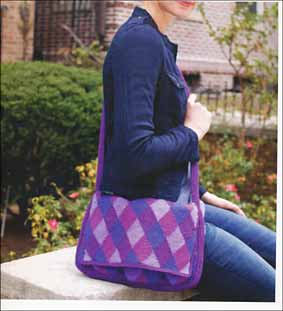
The section on lightweight yarns (dk weight) includes the Harlequin bag,


Harlequin

striped mittens, a kid's rollneck sweater done in stripes, a ripple stitch shawl, and an intarsia sweater for men.


Sea of Blue

Worsted weight projects consist of an afghan done in multiple colors shaped like jigsaw puzzle pieces,
a tote bag, a cabled yoke sweater, a circular-shaped medallion jacket


Roundabout

a multicolored linen stitch wrap, and a fair isle-style men's vest.


Strathaven

Bulky and superbulky projects include a slouchy beret,


Urban Knitster Slouch Hat

a textured cap, a cropped cardigan, a zipped and hooded vest, and a throw.


Bravissimo Throw

Following the patterns is a brief refresher course on topics like how to join a new ball of yarn, how to make bobbles, intarsia, provisional cast-ons, methods of increasing and decreasing stitches, and finishing techniques.  A helpful section also gives the basics of reading charts.

One thing that is especially helpful, and appears throughout the pattern section, are little boxes with tips and suggestions for customizing the patterns.  For example, the sample garment for the men's sweater is done in a blue colorway, but photos are given of two alternate colorways, one in browns, another in neutrals.


For knitters who are nervous about selecting colors, or who aren't good at imagining different color combinations together, this is a great help.  Other boxes include tips on yardage (noting, for example, that colors used for one part of a sweater will require more yardage than colors used later in the pattern), ideas for tweaking size or style, and suggestions for how to best use scrap yarn in that design.

As one might expect, you'll find all the amenities that Potter Craft books are known for:  color charts, schematics, clear photographs, close-ups of design details. and an easy-to-read layout.  We've already covered the weight of the yarns used (everything under the sun).  Sizing is generous; men's sweaters run from around a 43-inch finished chest to 61 to 64-inch finished chest, andwomen's sweaters go from around 34 to 35-inch finished bust through 3X, around 48 to 55-inch finished bust.  The baby kimono is sized for 6/12/18/24 months, mittens are adult women's/men's; the child's sweater runs 2/4/6/8/10, and the rest of the items are primarily one size items (e.g. bags, throw, scarf).

Project count goes like this:

  • 2 throws/blankets
  • 3 women's sweaters
  • 2 men's sweaters
  • 2 hats
  • 1 pair of mittens
  • 3 bags
  • 1 cowl & 1 scarf
  • 1 bangle cover
  • 2 shawls/stoles
  • 1 baby's sweater
  • 1 kid's sweater

Summing up, Melissa Leapman presents a versatile collection of good-looking patterns designed to use small amounts of yarn and other leftovers from the knitter's stash. There's a little bit of something for everyone in this book, and the technical information on organizing stash and combining colors will be helpful for knitters who feel overwhelmed by their odds and ends. And thanks to the generosity of Potter Craft, I've got a copy of Stashbuster Knits to give away.  Leave a comment (one per person, please) no later than midnight, Thursday, December 1st and I'll draw a random winner the next morning.  Make sure you include an email address or some other way I can get in touch with you or I'll pick another name.  (I moderate comments, so if your comment doesn't show up instantly, please be patient!)


Tuesday, July 19, 2011

No-Bull Book Review: Knit Noro (Trisha Malcolm ed.)

It is with great pleasure that I write today's Book Review. I've been a fan of self-striping yarns since the time I first saw one, and I am particularly fond of the ones created by Eisaku Noro. I understand that Noro yarns seem to trigger a love-'em-or-hate-'em response, but even if you aren't crazy about Noro self-stripers -- I personally love the vividness of the colors, the homespun texture and the wild color combos -- there are plenty of other self-stripers out there now that do similar things.

Our friends at Sixth & Spring have presented Noro lovers, and indeed, all fans of self-stripers, with a great gift by publishing Knit Noro: 30 Designs in Living Color (MSRP $24.95, available for $15.67 via the link).


What I like so much about this book is the combination of irresistible patterns that take advantage of the colors and striping tendencies of Noro yarn, and the terrific production values of the book. So let's take a closer look.

Knit Noro is a hardcover book, approximately9 by 12 inches, and 144 pages. From the minute you open the book, you are greeted with luscious color. The endpapers are a vintage-feeling floral print; the table of contents, title page and other pages aren't printed on a plain white background but are white type on more gorgeous photos; and every pattern is photographed at least 3 or 4 times in its individual pattern section. It seems like photographer Rose Callahan was able to record every nuance of color and texture from the Noro yarns in the photographs in this book. Also it's worth a shout-out to Sarah Liebowitz for the lovely styling in the photographs.


Striped Shawl (Tanis Gray)


The book features 30 patterns which are all shown as women's patterns, although a few of the accessories, like the Chevron Scarf, could be worn by men (perhaps with some color alterations). The patterns are pretty evenly divided between sweaters and accessories, with a few afghans/throws thrown in for good measure. And wisely, editor Trisha Malcolm let the color take center stage. (As my husband breathlessly told me when he opened the box containing my copy, "Each project gets its own two-page spread: FULL BLEED!")


Rainbow Knee-highs (Barb Brown)


It's hard to pick out favorites in the book since there is a wide variety in terms of techniques used, difficulty level and style -- and all of the patterns are simply luscious. So I'm just going to highlight a handful of the designs; you can see photos of all the designs at KFI's website here. The cover design is a belted kimono style cardigan that showcases the Noro stripes by creating a dramatic V in the back.


Belted Cardigan Vest (Theresa Schabes)

I like the way the Block Cardigan uses a solid color (in Cash Iroha) for cuffs and buttonbands, and also to create some framing around the component pieces of the sweater.


Block Cardigan (Peggy Forester)


Some of the patterns allow the yarn to stripe as it wants to,


Leaf Lace Socks (Judy Sumner)

while others deliberately alternate two different colorways (or start at different places in the color repeat) to create contrast.

Chevron Scarf (Cheryl Kubat)

This fair isle design, done in Noro sock yarn, is exquisite.


Fair Isle Cardigan (Mary Scott Huff)

I was happy to see some different techniques featured, like Rosemary Drysdale's entrelac scarf:


Entrelac Scarf (Rosemary Drysdale)

modular knitting, as in this throw:


Modular Afghan (Anna-Beth Meyer-Graham)

and stranded colorwork, including my own stranded chullo-style cap:


Fair Isle Cap (me!)

There's even a felted project:


Felted Cloche (Tina Whitmore)

The sweaters tend toward those styled as vests or sleeveless layering pieces,


Sideways Stripe Vest (Cheryl Murray)

and again, here the yarn's striping tendencies along with multidirectional knitting and other cleverness create interesting effects:


Modular Vest (Linda Cyr)

For my statisticians, here is your breakdown of the patterns:
  • 4 hats
  • 4 cardigans
  • 1 pullover

Trinity Stitch Sweater (Valentina Devine)

  • 5 scarves and 1 gaiter
  • 2 pairs of socks (one crew-length, one knee-high)
  • 1 pair of gloves & 1 pair of wristwarmers
  • 3 afghans/throws
  • 6 vests
  • 1 sleeveless tunic
  • 2 shawls/wraps


Fair Isle Cap (me!)

I am really happy to note that there are some nice expanded size ranges for many of the sweaters (well into the 40s and in some cases 50-some inch finished chests) and of course the accessories and throws are one-size fits all. You'll find schematics for the patterns that need them. The yarns used are Noro's Kureyon and Silk Garden (both worsted-ish weight), and Silk Garden Sock and Taiyo (both fingering weight).


Cabled Cap (Faina Goberstein)

So for the terrific patterns, the juicy color photography, and the overall fun factor, I give Knit Noro two self-striping thumbs up. I am not giving away any secrets when I tell you that the book has been so enthusiastically received that there is a second Noro-themed book coming in January...