At some point or another in their knitting evolution, every knitter starts to play with the technique of knitting sweaters in the round. The siren call of “no seams to sew” is just too tempting, especially if you find that finishing doesn’t appeal to you the way that knitting does. But I’ve seen a lot of knitters complain that knitting sweaters in the round feels limiting: yes, you can do yokes and raglans very easily, but if your personal style is less traditional and more trendy, you may want more options or lack the technical knowledge to create, say, set-in sleeves. So it was with great curiosity that I opened up
French Girl Knits: Innovative Techniques, Romantic Details, and Feminine Designs
, by Kristeen Griffin-Grimes (Interweave Press 2009; available for $16.47 through the link at the time of this writing), a book which strives to construct knit-in-the-round sweaters with a very distinctive style and custom fit.
Griffin-Grimes explains in the introduction to her book how time spent in France molded her sensibility:
The French were masters of an art that had nothing to do with money and everything to do with an appreciation of the small lovely moments in life. . . . After days spent trying to capture that illusive French aesthetic on film and notepad, I returned home deeply inspired to infuse my life with all things beautiful. This soon translated into a rejuvenated interest in the needle arts and the luscious fibers that had begun to appear in the marketplace.
Griffin-Grimes describes her aim in writing French Girl Knits as threefold: a desire to capture that French sensibility, to create beautiful garments with exceptional details, and to use seamless construction for ease of knitting and custom fit. A tall order, indeed.
The book is divided into four chapters: La Boutique Parisienne, Enfant Sauvage, La Créatrice and Dans La Rue. So let’s help ourselves to a croissant, a creamy Camembert or a glass of French white (hell, let’s have all three), and look at each in turn.
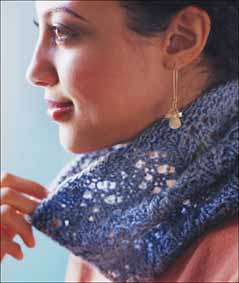
Chapter 1 -- La Boutique Parisienne – is subtitled “Romantic and Vintage Inspired,” and the designs, in the author’s words, attempt “to capture the feminine silhouette and color palette of a bygone era with designs that will let you fashion graceful, figure-enhancing garments.” Four garments are featured, Satine (an ethereal tunic-length tank, with lacy stitches, knit in a mohair-silk blend); Sophia, a cardigan knit with an openwork stitch pattern and a cabled edging, in a cotton blend yarn (it's the cover sweater); Anjou, another lacy tunic but with short sleeves and a tie hem detail;

and Paloma, a cap-sleeve top knit in a linen-merino blend, with more openwork and a ribbon neckline.
Chapter 2 is called “Enfant Sauvage” (which roughly translates as “wild child”) and is subtitled “Rustic with a gypsy edge.” Griffin-Grimes describes this look as “rustic, yet refined, casual yet elegant – the look is approachable and wearable with sculptural stitch elements and cables and tints from the natural dyepot or straight-from-the-sheep colorways.” Nadine is a tunic-length tank with lace panels running vertically, knit in an organic bamboo/cotton blend;

Wrenna is a short-sleeve cardigan knit in chunky wool, with an arrowhead motif, nearly portrait-style collar and leather lacings;

Stella is a jacket with long, flute-like sleeves and scalloped edging, knit with short rows and biasing panels, knit in one strand of aran-weight wool blend and a strand of Kid Silk Haze; Cybèle, a vest or tank that laces up the front, with horizontal cables;

and Ondine, a wrap-style skirt, slighted felted, with appliqués.
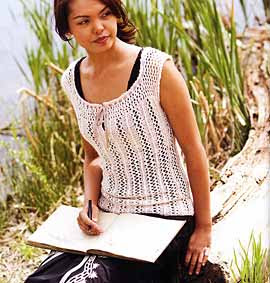
La Créatrice (“the creator”) is subtitled “Innovative and unconventional.” The garments in this chapter seek to celebrate the creative process, mistakes and all. Thus we have Delphine, a barely-cap-sleeve top knit in an alpaca/silk blend, with eyelets and a scoop-neck with a ribbon closure;
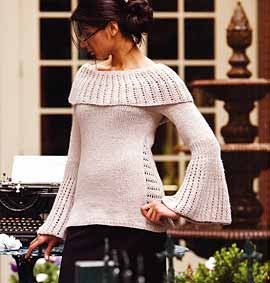
Niobe, a round-neck pullover with bell sleeves and openwork at cuffs and hem and running down the sleeves (I wish this one were knit in a lighter-colored yarn and/or photographed a bit more clearly so the openwork detailing is more visible);

Celeste, a long, lacy mohair jacket with lots of drape;

and Simone, a cowl-necked sweater with fluted sleeves and eyelet ribbing.
The last chapter, “Dans La Rue” (“in the street”), with the subtitle “Streetwear with style,” is devoted to less structured, more casual styles, intended to be worn with jeans or even to top a basic black dress. Viola is a short-sleeved, button-front top, knit in Kid Silk Haze, with contrasting ruffles at neckline and cuffs; Martine is a short-sleeved hoodie with slip-stitch colorwork at cuff and neckline;

Louisa is another lacy tunic with a scoop-neck and ribbon edging; Véronique (ahem, is that name spelled properly? Not in my book. . .) is a sheer, drapey shrug; Bijou is a cotton cardigan with a buckle in front, constructed in halves, from sleeve cuff to body (it’s a bit more complicated than that, but you get the idea).
You’ve heard me say it over and over: for a pattern book to be a sensible and useful addition to your knitting library, you have to like the patterns in it, and this is largely a function of taste. So in order to know if French Girl Knits is for you, you need to decide if the patterns appeal to you. (It seems to me that the more distinctive a designer’s style, the more important it is for the potential purchaser to think about this, and Griffin-Grimes certainly has a very distinctive style – romantic, feminine, lacy, sheer – that may not appeal to everyone, lovely as it is.)
Leaving you to ponder the “to your taste” issue, I shall turn to a look at the nuts and bolts, and here French Girl Knits scores high. Paperback, approximately 159 pages, color throughout. Karla Baker’s interior design -- muted backgrounds of sage, gray, beige and maroon, little filigree-type trim and accents (forgive me for not knowing more about the technical terms for book design!) – perfectly suits the dreamy photography, adorned with dress forms, gold-framed mirrors, fuzzy streetscapes and green fields. I like that there is some diversity in the models, including (how to delicately phrase this?) a woman who would qualify for AARP membership and a model of Asian heritage. You’ll find schematics and charts; notes to help with the more unconventional methods of construction; and inset boxes that discuss helpful technical skills like how to improve fit, how to graft mohair yarn, and yarn substitution. Especially noteworthy are two- to three-page inserts in each of the chapters discussing the method of construction: top-down seamless set-in sleeve construction, side-to-side seamless construction, top-down seamless raglan construction and bottom-up seamless set-in sleeve construction.
All 18 garments are for women, and break down as:
- 1 skirt
- 1 shrug
- 2 jackets
- 4 short-sleeved cardigans
- 4 short-sleeved pullovers
- 3 tank tunics (if I had one quibble, I’d say one or two lacy tunics was enough)
- 1 vest or corset
- 2 long-sleeved pullovers
Gauges and yarns are all over the place. About 7 of the garments are done in worsted weight yarns; another six use Rowan’s Kid Silk Haze (or KSH Aura or Night, variations thereof), which is hard to peg since it can be knit at many different gauges; one is done in laceweight; two sportweight; two chunky; even a combination of an aran-weight plus a strand of Kid Silk Haze. The fiber selection is luxurious, including such wonderful fibers as the aforementioned KSH, Elsebeth Lavold Baby Llama; The Fiber Company’s Terra (merino/baby alpaca/silk – Hi, Courtney & Kate!); Blue Sky Alpacas alpaca/silk blend; and other gorgeous stuff (although if you are affected by the struggling economy, knitting full-sized garments in these luxury yarns may not fit into your budget). If substituting, you’ll have to look at the regular weight of the yarn and swatch, swatch, swatch, as most of the garments use lacy or other stitch patterns that may alter gauge to something atypical for that yarn. Size ranges go from early 30s (e.g. finished chest of 31 inches or 33 inches) to 40s (finished chest of anywhere from 41 or 43 inches to 48 inches) – so super-plus knitters be forewarned; you’ll want to check sizes before investing. Nothing in the 50- or 60-inch range here.
Just about all of the garments are designed to be knitted with a minimum of seam-sewing. There's lots of knitting in the round, but some of the patterns do require grafting, so the tradeoff for achieving some of the lovely effects is that you'll have to do some Kitchener-stitching sometimes. You'll find raglan and yokes, but also some set-in sleeves and some garments knit sideways. Not all of these patterns will be easy for novice knitters, but the fearless knitter will find some interesting techniques to try.
I vivdly remember seeing Griffin-Grimes’ booth for the first time at the June 2006 TNNA meeting. I was struck by the charming look of her designs: romantic but not too fussy, lots of lace stitch patterns and accents, and, of course, the ease of constructing so many garments circularly. It’s gratifying to see that her book fulfills the promise of that exciting beginning. It will be fun to see what’s next for this talented French Girl.

 was released this past summer. I am rather behind in my book reviews (well, okay, I'm behind in just about everything) but I didn't want to let this one pass without giving you all a look -- it's such a pretty book with gorgeous patterns in it.