Think of the challenge facing poor Robin Melanson. People have been knitting mittens and gloves for hundreds (thousands?) of years. In the past year, at least three books with "mittens" in the title have been released. And the design of handgear is largely constrained by the odd shape of the human hand: narrow at the wrist, abruptly widening for the palm, thumb sticking out on one side, fingers of different lengths. How do you reinvent the mitten or glove when faced with such challenges?
Luckily, Robin was up to the task, as you'll see in today's No Bull Book Review of
Knitting New Mittens and Gloves: Warm and Adorn Your Hands in 28 Innovative Ways
(Stewart Tabori & Chang 2008).
Knitting New Mittens & Gloves is part of a series of books seeking to put a different spin on a traditional genre of knitwear. (
Knitting New Scarves: 27 Distinctly Modern Designs
, released last year, was the first.) The books are on the smaller side and paperback (most STC books are quite a bit bigger and hardcover), a good size and weight for slipping into a knitting bag without being so small that they restrict content. MSRP is $21.95 but you can score it for just under fifteen bucks at the time of this writing by clicking on the link above.

Melanson grew up in Canada and credits harsh North Atlantic winters for her love of gloves and mittens -- a necessity when you live on the coast. She has filled the book with 27 or so patterns for mittens, gloves, fingerless gloves and armwarmers -- basically every possible permutation that will fit on a human hand or arm. For the statisticians among you, I counted 2 pair of armwarmers (meaning tubes that fit on the arm without extending onto the wrist and hand); 1 handwarmer (something more than a tube but less than a mitten); 6 gloves; 9 mittens (one of them is a "flip-top" style, to make it easy to do things like use keys without taking the whole thing off); and 10 fingerless styles, plus two additional fingerless versions that are given as variations on a regular mitten or glove design. Sorry, crocheters: all the designs are knitted.
Gauges are all over the map: the thickest yarn I saw knit at just under 3 sts per inch, and there are a few patterns using fingering weight in the 7 to 8 sts per inch range; you'll find several patterns knitting at 5 sts per inch and several more at 5.5 per inch, but there's something for just about any yarn in your stash. Melanson doesn't stick to traditional pure wool, either; you'll find lots of wools, of course, but also cotton, a silk/viscose blend, silk/seacell, alpaca blends, mohair blends, and so on. Some of the yarns are crunchy or tweedy in texture, while others are variegated, fuzzy, or thick-n-thin. Melanson does a good job of matching the various types of yarn to the patterns, keeping in mind the texture, fuzziness, elasticity, and so on. Considering that mittens and gloves don't take much in the way of yardage, there are plenty of patterns here to help blow through some of those orphaned skeins in your stash.
So what are the patterns like?
Well, just as Melanson includes lots of fibers and gauges, she also includes lots of different styles. You'll find traditional styles, like this classic pair of gloves, worked in Jamieson's Shetland Spindrift, with a fair isle stranded design at the wrist. Melanson was inspired by Celtic motifs in creating the band, which she describes as resembling a golden bracelet on the wrist (she has a degree in Celtic studies, and its influence can be seen in many of her designs).

These Norwegian mittens are also inspired by traditional stranded work and have a traditional shape, but the dash of electric lime gives them a modern spin (and if you don't like modern spins, or electric lime, easy enough to pick a different color for that design element).

If you are looking for less traditional, you'll have choices, too:

These mittens, called "Sheltie," at first glance seem odd: why wear mittens that are more holes than fabric? But take a closer look, and you'll find a soft, mohair layer underneath (it's white, and maybe a different-colored background in the photo would help make this more clear). The two layers help to insulate the hands more, in addition to creating a funky mesh look. Not my usual style, but clever and looks great. I'm having fun imagining all sorts of color combinations, too (a really bright mohair underlayer with a neutral overlay? a solid color underlayer with a multi overlay?).
Again, this doesn't happen to be my personal style, but these gloves, called "Blackthorn" after the tree that produces sloe berries (sloe gin, anyone?), invoke a Robin Hood kind of feel, with the lacing on the back of the hand.

These armwarmers combine a Latvian-type braid as edging with motifs inspired by medieval tapestries.

And there are plenty more good-looking patterns, like these gloves with a ruffled cuff

these striking cream gloves, with a long cuff to show off the German twisted stitch pattern:

beaded fingerless gloves, using Mountain Colors Bearfoot yarn (anybody wanna make 'em in some Black Bunny?)

and these mittens featuring cables and bobbles:

I especially like that most of the patterns involve something more than just a plain pair of mittens -- e.g., stranded design, beading, cables, traveling stitches -- to make them more challenging and more interesting.
As far as the production quality, this is a paperback book, with around 144 pages. It is color throughout, including all color photos (lovely work by Tyllie Barbosa) and color charts for the stranded knitting. Each mitten or glove is shown in a full-page photo to give an overview of its appearance, and most patterns also include a close-up of a specific design element. (And several of the patterns are shown in different variations, i.e., a long cuff and a short cuff, using different colors and yarns, to give you a feel for how you might want to individualize them.) Personally, I found the pattern type to be a wee bit small for me; however, I am not too proud to admit that this may be a function of forty-plus-year-old eyes. There are no schematics since they are mittens/gloves/armwarmers. Sizing varies; more than half are written for one size, an average woman's hand (around 7.5 to 8 inches circumference). Two are written for a wide range of sizes from child through men's. The rest are given in various permutations of two or three sizes (e.g. small child, medium child, woman; or women's small/women's medium-large).
It's also worth noting that no pages are wasted on how-to-knit instructions. The back, however, features some material that might be helpful to newer knitters who know the basics but will appreciate tips on how to select yarns; types of needles; beading basics; blocking (something we don't always think of for accessories like mittens); some alternate cast-ons; embroidery basics; how to make I-cord; and so on. I especially liked the index to projects by yarn weight. If you've got some, say, DK-weight yarn in your stash, one glance and you can figure out which patterns are written for that gauge.
So I give a mitten-covered thumbs-up to
Knitting New Mittens and Gloves. It's a nice blend of the classic and the funky, it features interesting and sometimes challenging designs, and it will help you burn through your stash while having a lot of fun. (And if you like to knit holiday gifts, I'm thinking you could check a lot of different folks off your list with the variety and quantity of patterns in this book.) When you consider you are getting over 25 patterns, plus variations, for less than fifteen bucks, I'd say it's a bargain.
And speaking of bargains, it has come to my attention that Stewart, Tabori and Chang, the publisher of Knitting New Mittens and Gloves, is offering a
free mitten pattern from the book here. The Alternating Current Mittens are knit in a bulky yarn, in both mitten and fingerless form, and STC is suggesting that if you download the pattern, you might consider making an extra pair for a person in need. (In fact, if you are so inclined, you can mail them to me and I will add them to our knitting for homeless vets charity drive that is still on-going.)

 (Sixth & Spring Books 2010) (MSRP $17.95; available via the link for $12.21 at the time of the writing). This is such a handy little book that I wanted to get a book review in, even though I'm a teensy bit late.


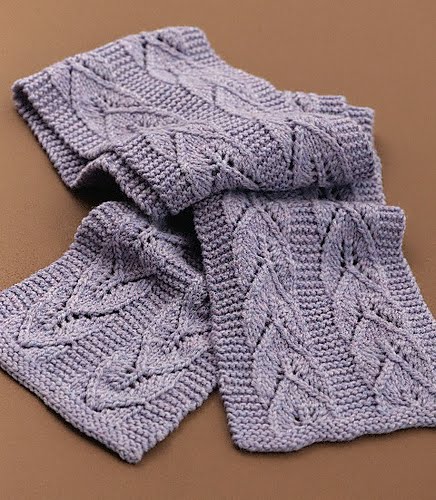
 Mitered Scarf by Amy Polcyn
 Spotted Fair Isle Mittens by Cheryl Murray


 Striped Graduated Scarf by Jean Suzuki


