
 (STC 2004). This fall, she has written a sequel, called (appropriately enough) More Last-Minute Knitted Gifts
 (Stewart Tabori & Chang 2010; MSRP $27.50; available as of this writing via the link for $18.15). Let's take a No-Bull peek inside...
More Last-Minute Knitted Gifts is, like its predecessor, a hardback book, full of gorgeous color photos by Anna Williams. Like its predecessor, it contains a selection of projects organized by how much time the project takes to knit (approximately, of course). And like its predecessor, you'll find projects that, generally speaking, are approachable rather than complex, the basic made beautiful by being knit in gorgeous natural yarns like Koigu, Spud & Chloe and Jade Sapphire.

Entrelac Baby Blanket
Hoverson begins with a few introductory notes. She sets out what is essentially the mission statement of the book: "[T]here is nothing more satisfying than creating something beautiful and thoughtful without having to labor over it for an extended period of time." She suggests that knitters use yarn choice as a means to personalize the gift for its recipient, briefly discussing color, fiber, texture and embellishment as ways to do so. The last chapter of the book covers ways to wrap your handknit (and other!) gifts -- using a simple premade pouch, opting for a simple box then using strand after strand of leftover yarn, using buttons on gift tags and as part of the wrapping.

In between these sections are the patterns, a total of 30 (not counting variations). First up are "Less-than-two-hour gifts," six projects that are quick to knit and are certainly good choices for less experienced knitters. You'll find a coffee-cup sleeve; a holiday ornament; a pointy elf hat (conveniently sized for the whole family, so that Mom and Dad can wear an elf cap, too); a pyramid-shaped sachet holder; a seed-stich bracelet with button closure; and a linen-stitch bookmark.

Reusable Coffee-Cup Sleeve
Next are the "Two-to-four-hour gifts," again six of them. These items are a teeny bit more complex than those in the prior chapter, but still fall on the basic side: knitted baskets, a small scarf with an opening for one end to pull through, itty-bitty baby socks; a baby bonnet; a chunky lace scarf; ribbed hats sized for every member of the family.

Big Lace Scarf
The "Four-to-six-hour gifts" -- once again, six projects -- may take a bit longer than previous chapters, but are still pretty basic in skill level: fingerless gloves knit sideways, a set of simple coasters, a stuffed toy house with embellishment; mittens with a brioche-stitch cuff; a seat cushion made of I-cord in bulky yarn; a charming baby cardigan.
Easy Baby Cardigan
"Six-to-eight-hour gifts" features a simple beret; a child's vest with duplicate-stitch initial on the front; fingerless gloves shown in a plain and cabled version; a floaty scarf, knit in the round with mohair yarn; a baby blanket knit from the center out, with colorful nesting squares; and a simple roll-neck pullover sized for the whole family and knit in the round.
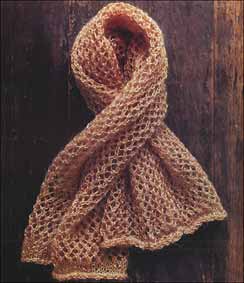
Very Pretty Lace Scarf
My favorite projects are definitely found in the "More-than-eight-hour gifts" chapter (you guessed it -- six projects total). The yoke-neck cardigan knit in a delicate shade of Koigu is one of those simple-yet-elegant patterns that beautifully matches the subtle color variations of semi-solid Koigu with clean lines and just enough detailing in the yoke without overwhelming the yarn.
Leah's Lovely Cardigan (designed by Leah Mitchell)
(If I ever have time to knit myself something again, this is at the top of the list.) The trio of cowl patterns combine ribbed patterns with elegant cashmere yarn and the men's zip-up vest is classic enough for a man's taste (although it would look great on women, too). The first pattern in the chapter, an entrelac baby blanket featuring bright colors of Lobster Pot bulky yarn, cheerfully reminds me of geometric quilt motifs. The chapter is rounded out by ribbed toe-up socks and another colorful blanket (this one much larger than baby-sized), knit with vivid stripes in the middle.

Bright Stripes Blanket
For those of you who like statistics, of the 30 patterns, I counted approximately 8 home items; three kid's items; five baby items; one men's garment; three items sized for the whole family; and the remainder (approximately ten items) for women. Of the women's items, the breakdown looks like this:- one sweater (the Koigu cardigan)
- three scarf patterns and the cowl (three variations of it)
- two fingerless gloves (one with 2 variations) & one pair of mittens
- one bracelet
- one beret.
 Leah's Lovely Cardigan
Sideways Fingerless Gloves
As usual, the book is beautifully produced, with clear and elegant photography by Anna Williams and all the amenities we usually find in a STC book: schematics where necessary, charts where necessary, close-up photos of some of the embellishments & design details; photos that show off stitch patterns as well as give the overall look of an item; a section with how-tos for skills like duplicate stitch.
If I had any quibble with the book, it might be that the projects seem a little too basic but it's hard to tell if that is predominantly a function of me being

Huggable House
In sum, then, we've got another good-looking book from our friends at STC, filled with gorgeously-photographed, do-able patterns just in time for you to whip out a few for holiday gifts. These patterns beg to be knit in some of the gorgeous yarns in your stash, so bring on the cashmeres, the handpaints, the uber-soft cottons and the exotic alpacas. After all, there are only 70-some days until Christmas!


 ), cartoonist, designer, raconteur and all-around bon vivant,
 by Gwen Bortner (XRX Inc. 2010), one of two new books devoted to the topic (Rosemary Drysdale's
  , is scheduled for an early November release). XRX was kind enough to supply me with a review copy of this book, which is hot off the presses, and has a MSRP of $19.99 (available for $13.57 as of this writing through the link above).


 by David Grann, was an interesting look at a British explorer named Percy Fawcett who made extensive trips mapping the Amazon of South America. Fawcett was a colorful character, and at the age of 57 -- a bit old for the physical hardships of trekking into the jungle in 1925 -- he began what would be his last expedition: a search for a lost city of gold that he was convinced lay hidden in the rainforest. Fawcett sent bulletins updating his family (and the public) on his progress, but then one day, the bulletins stopped coming. Fawcett was such a larger-than-life figure and had survived many dangerous treks before, so it was some time before his family and friends began to truly worry. He was never seen again, and exactly what happened to him remained a mystery.
 by Cornelia Funke. I love reading and rereading children's books and had never read any of this series, so I decided to give it a go. "Inkheart" tells the story of a book repairer who is able to read books to life. By reading a book aloud, a character in the book may appear in the real world, or an inanimate object from the story may appear. The book repairer and his daughter embark on a series of adventurers when a villain from a book who has been released into the world seeks out the book repairer, wanting him to call forth riches and other powerful things by reading them out of books. I really enjoyed the book, and am giving it to my kid for his to-read list; in the meantime, I'll probably tackle the sequel (Inkspell) at some point soon.
 by Charles Todd. Regular readers know that I've read pretty much every book in Charles Todd's Ian Rutledge series of mystery novels, set in post-WWI England. Todd has begun a second series featuring a woman detective named Bess Crawford. I scored a free review copy of this book from Amazon Vine, and very much enjoyed this police procedural. Bess Crawford is a nurse on the front lines of France in WWI; while on leave, she sees a woman involved in an emotional scene at a train station. A week later, she sees the woman's photo in the newspaper; the woman has been murdered. It turns out that Bess has a more personal connection to the victim; Bess nursed the victim's husband on the battlefield, where he clutched a photo of his wife while in hospital. A quick read and although maybe not quite as intense as the Rutledge series, it was nice to enjoy a somewhat less angst-y read (although given the WWI setting, it isn't exactly Carnivale).
 . This is a fascinating read, full of colorful characters with a real breadth of imagination. Gaiman creates a parallel world that exists in the underground of London -- the underground meaning "under the ground," in tunnels and sewers, but also in the London Underground as in the subway. Once again, I heartily enjoyed the book. Gaiman has amazing creativity in creating this underground world; I loved the numerous puns he created from various Tube station names, as well as his very direct and engaging style of writing.
 , by Elizabeth Strout, won the Pultizer Prize for fiction, and I know Ms. Bridget Clancy enjoyed reading it a while back. This is another book that bridges the novel form with short stories, but it does so beautifully. Each story focuses on a different period of time, in which the main character, Olive Kitteridge, appears, either as a main character or occasionally as a minor character. Either way, we see a new side of Olive and learn more about what makes her tick. At the beginning of the book, I wasn't sure I liked Olive very much, but the book was so well-written that it kept drawing me back to read another chapter. By the end, I'd found that Olive had grown on me. Definitely worth checking out.
 by S.E. Hinton. Oddly, I'd never read the book, so I decided to give it a go and read it along with my kid's class. I dutifully read the first few chapters in tandem with him, but got quickly sucked into the story and ended up finishing the rest of it all in one night. The book is about a group of "greasers" in the 1960s who are picked on by the "socs" (the preppy rich kids), but it really touches on a lot of things -- adolescent yearning, family ties, bullying, social class, appearances vs. substance, what is heroism, the essential unfairness of life -- and I was shocked to learn that the author was only around sixteen years old when she wrote it. While the slang and certain aspects of the book feel a little dated (had to explain to my kid what a drive-in movie was!), the book still manages to have a lot to say.
 by Reginald Hill, is the second Dalziel and Pascoe mystery in the venerable British police procedural series. Again, I liked the book but didn't love it; I suspect the series will continue to grow on me and since it's so well-regarded, I'm going to continue on as soon as I can find No. 3. This particular murder mystery takes place at a college in England. When a statue is dug up to be moved as part of a construction project, the old corpse of a former headmistress is discovered underneath it. The book was written in the early 70s and does feel a bit dated with its look at the 70s counterculture.


 -- see my recent book review


 , the bestselling memoir by Jeanette Walls. This was a difficult book for me to read. Walls describes a childhood in which individualism and eccentricity cross over into abuse, neglect and chaos. Rex Walls' alcoholism and eccentricity caused him to lose job after job. Rose Mary Walls fancied herself an artist and although she was certified to teach, refused to do so most of the time -- even when her children were starving and clad in rags -- simply because she didn't want to. The Walls siblings were used to moving in the middle of the night, piling into whatever wreck of a car they had so Mom and Dad could avoid bill collectors, or a bench warrant.
 by Barbara Cleverly, another Joe Sandilands mystery set in 1920s London. Lots of nightclubs and flappers and British nobles and stiff martinis as Joe Sandilands -- back from India -- solves the murder of a pillar of society who is found dead in her hotel suite.
 by Peter Robinson, is the latest entry in his Inspector Banks series of mysteries set in Yorkshire. In this installment, Inspector Banks is away on vacation when the action starts, and his able sidekick Annie Cabot gets to take over. While the case lacked some of the mystery and complexity of past Banks novels, it was still an enjoyable read if you like the characters. This was an Amazon Vine pick that I scored for free.
 by Audrey Niffennegger was the second book that was recommended to me. It's the story of Henry, a man who travels back and forth in time to different parts of his life. During each episode of time travel, the current Henry meets the Henry of whatever time he's traveled to. Much of the book revolves around Henry's love for his wife Clare. It took me a little while to get drawn into the story; the beginning is a bit jarring and the frequent chronological shifts were hard for me to get used to. Overall,I enjoyed the book more than I expected to, although it was a bit melodramatic and breathless at times. Several of the plot elements were a bit too clever by half, particularly Henry's death and several scenes involving his daughter. I probably would have liked the book more if I'd seen fewer gushing reviews of it. I wasn't terribly impressed with the quality of the writing: the strength of the book lies more in the originality of the plot rather than the skill of the writer.
 by Barry Maitland was another Kolla and Brock mystery set in London. Another enjoyable read for fans of that series.
 by Neil Gaiman. The last book that has been recommended to me; I resisted because I am a bit leery of a lot of fantasy fiction -- so much of it seems like a bad Star Trek episode. This book appeared on Elvis's summer reading list as a possible choice, and after he enjoyed it, I decided to give it a go. I was knocked out by how much I enjoyed it. The story sounds odd -- an orphaned toddler is "adopted" by the residents of a graveyard -- but Gaiman's imagination and skill made this enjoyable and exciting reading. There is a certain timelessness to this book that I think will make it a classic. I might even pick up one of Gaiman's other novels....


