I have to confess that I wasn't quite sure what "knitting for peace" was before reading
Knitting for Peace, by Betty Christiansen (Stewart Tabori & Chang). Was it making afghans with intarsia peace symbols? Knitting protest signs with slogans added in duplicate stitch? Was it simply a serene state of mind?
No, no and no. The knitting in
Knitting for Peace is what most knitters I know call "charity knitting" -- knitting for groups that distribute the items to people who are in need of them. I suppose some people aren't crazy about the phrase "charity knitting," since "charity" seems to have developed a not-entirely-nice context, a ring of condescension or "let them eat
cake Red Heart." Whatever the reason, this book chooses to call it "knitting for peace."
Now I know that there are knitters out there who just don't like the whole "knitting for charity/peace" movement. Some of them resist the notion that anyone who knits or crochets has some kind of moral obligation to craft for others, particular others they don't know. (Do stamp collectors have groups where they, um, donate stamps to charity? Do scrappers make homeless people albums so they can remember all the warm fuzzy times in the shelter?) Some don't mind the idea of knitting for charitable organizations but they dislike talking about it, feeling that good works are best done quietly and anonymously. Still others question the utility of such groups; "I'd be more inclined to knit for a charity," one knitter told me, "if I was sure the recipients really wanted the stuff they were given."* But obviously there are many other knitters who enjoy the fellowship that these groups provide, who get motivated by sharing patterns and talking with others and playing "show and tell" with finished items. So recognizing that people in the first three categories might not be interested in the subject matter of this book, and recognizing that people in the last category will, let's talk turkey.
My first impression of
Knitting for Peace was how the size (about 8 1/2 inches square) and the feel of the binding reminded me of a photo album or journal. Probably this was deliberately done to evoke a rosy, intimate glow. The second thing I noticed -- and this is a very tough one to overcome -- is that from a typeface standpoint,
Knitting for Peace is one of the most difficult knitting books I've ever tried to read. The print is, to put it bluntly, microscopic.

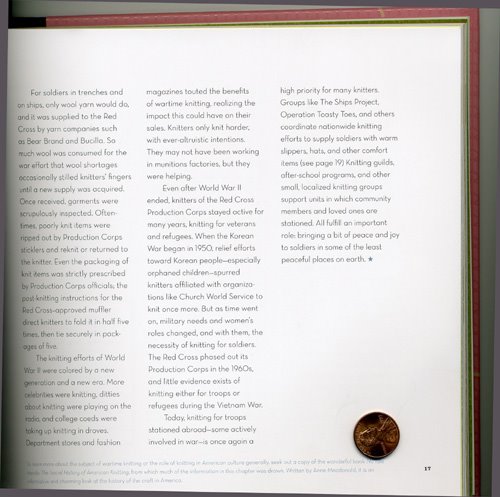
Check out that footnote: I defy anyone except Superman to read that sucker without a magnifying glass or the zoom function on their monitor. It makes the words on the penny look big.
Unfortunately, two stylistic choices make reading the teeny text even more challenging: the ink isn't black but rather a lighter shade of gray, and many of the pages are not white but are colored. (Heavens, do I mean "pages of color"?) I have decent vision and don't regularly wear glasses, but I struggled to read this book in the evening, sitting right next to a good reading lamp. This is a real shame, because I think a lot of readers are going to find the optometric strain an insurmountable challenge to this book.
On to content.
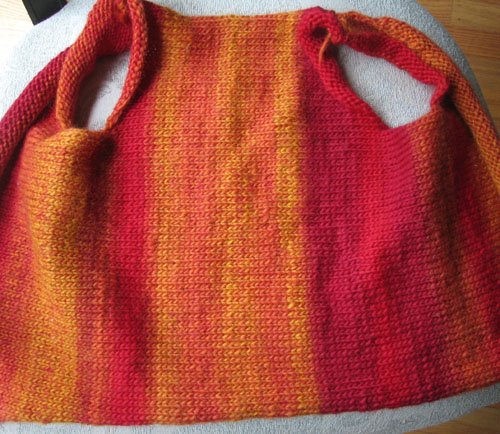
The first chapter of the book, called "Peace and War," is devoted to wartime knitting, beginning with an historical overview of American knitters contributing to various war efforts. The author then highlights several organizations whose knitting mission is loosely themed around war: organizations that provide knitted socks for soldiers stationed overseas, a woman who uses tiny knit sweaters to create an installation piece memorializing the number of American casualties in Iraq, even a group which stages knit-ins to protest globalization. The chapter ends with a pattern for a felted messenger bag; though it's a perfectly serviceable pattern, it seems a bit out of place since there isn't any logical connection between knitting a bag for oneself and knitting for peace (at least not that I could discern).
The second chapter is called "Knitting on Earth," and looks at organizations that try to benefit needy or impoverished citizens across the world. It was an interesting choice to include two knitting-related businesses, Peace Fleece and Lantern Moon, due to their outreach-oriented business philosophies. (Peace Fleece sells yarn that is made by blending American wool with Russian wool, as well buttons and knitting needles produced by overseas artisans. Lantern Moon seeks to provide economic opportunities for Vietnamese women and their families by selling handmade needles, baskets and other accessories.) In addition, organizations like Afghans for Afghans, which provides warm clothing for Afghani citizens, and RwandaKnits, which seeks to create economic opportunities for African women by teaching them knitting skills, are profiled. Patterns for an Afghans for Afghans approved vest and a pair of socks made from Peace Fleece are included, as well as contact information and requirements for these organizations.
"Peace at Home" profiles such diverse organizations as prison-knitting programs, knitting chemo caps, knitting for native american elders, prayer shawl ministries, knitting snuggles for shelter animals and knitting for the homeless. Appropriate patterns, e.g., a prayer shawl, an afghan, a chemo cap, are included.
The next chapter is "Peace for Kids" -- highlighting, you guessed it, organizations that benefit children, such as preemie knitting and Caps for Kids. You can see where this is going, I'm sure.
The last chapter is "Knit for Peace," and provides some tips for finding charitable knitting groups either via Internet or locally. A basic mitten pattern and rolled-brim cap pattern are provided in this chapter. And I am pleased to say that there is no how-to-knit section in this book (at last!).
This is a perfectly nice book, and it is devoted to a topic that is near and dear to many (but not all) knitter's hearts. It is very much designed to whet the knitter's appetite for charity knitting and to provide some basic tips for how to get started. That's fine as far as it goes. You wouldn't buy this book for the patterns (and I mean no disrespect to the author); the patterns presented are extremely basic and a quick internet search would yield you free versions (in some cases, identical versions) of them. While the historical background of charity knitting is interesting and nicely written, reading
No Idle Hands and a few on-line or magazine articles about charity knitting would net you most of the same information. And when it comes to specifications for the charities themselves, a conscientious charity knitter would want to check the organization's website anyway, to make sure that (s)he is following the most up-to-date requirements for the group, in case needs change. Perhaps the best result of the book is that some worthwhile organizations will get some publicity and some donations to further their work. Is that enough to convince you to buy the book? You'll have to decide.
*A propos of this, I can tell you that some charitable groups who collect knitted and crocheted items are regularly given items that do not comply with their specified guidelines, like scores of lacy pink hats for (mostly male) soldiers, or lightweight cotton caps that won't help in an extremely cold climate where all-wool items are requested. To add insult to injury, the donors sometimes say things like "Well, beggars can't be choosers," or "they should be happy with anything we give them." Real charitable, huh?