A warm, Go-Knit-In-Your-Hat welcome to Donna Druchunas, author of the newly-released Arctic Lace.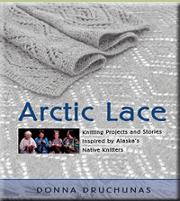 Donna is my first-ever guest blogger, and she's going to talk about that spectacular fiber, qiviut. Thanks, Donna!Knitting and Spinning with Qiviut by Donna Druchunas
Thanks for having me as a guest on your blog! I've been talking a lot about my inspiration for
Arctic Lace and my research in Alaska during this tour. But today I'd like to talk about knitting and spinning with qiviut.
KnittingQiviut yarn comes only in fine weights. Sport weight is the heaviest I have ever seen on the market, and cobweb, or extra-fine lace weight is the thinnest. Because the fiber is so warm -- often said to be 8 times warmer than sheep's wool -- you wouldn't want a heavier yarn anyway. Qiviut blooms when washed, and gets a halo that reminds me of mohair, and it feels a lot like mohair to wear. That is, it's lightweight and warm. Unlike mohair, qiviut is never scratchy. When washed, qiviut
develops a furry texture that gets more exaggerated over time but, in my experience, does not pill. Because of the furry halo that develops, you can often knit qiviut at a looser gauge than you would other yarns of the same girth.
There are two main types of qiviut yarn on the market today. The first is 100% qiviut. Most of this is very loosely spun, and it has little or no elasticity. It does not stretch as you knit with it, and it does not draw in after knitting. This makes it very nice for lace projects that will be blocked to have a soft drape. But it does not work well for ribbing, as it will not hold its shape. It can even stretch out over time, the way cotton does. I have run into a couple of tightly spun qiviut yarns that seem to hold their shape better than the loosely spun
yarns, but these are hard to find.
The second common type of qiviut yarn is a blend with merino and silk. There may be as much as 75% qiviut in this yarn, or as little as 45%. The yarn with the least amount of qiviut and the most amount of wool will have more elasticity during knitting and will hold its shape better for ribbing and fitted garments or accessories.
Before you start knitting anything with qiviut, which costs about $70US per ounce, you should swatch your pattern stitches with a less expensive yarn. If you are knitting lace, I always suggest working a swatch in sport or worsted weight wool on size 5 or 7 needles. This will let you concentrate on learning the stitch pattern before you start working with the fine yarn and small needles. If you are a new
lace knitter, you might want to make a second swatch with inexpensive lace weight yarn before starting to work with the qiviut as well.
This doesn't mean you can skip making a qiviut swatch, however. Because the yarn has such an unusual hand and texture, and because it blooms, you may find you need to use larger or smaller needles than usual. I haven't found any hard-and-fast rule for this. Some knitters find that their stitches look very sloppy and the fabric has no body at all when they knit qiviut with needles that are too large. Other knitters find that the fabric is too dense after it is washed when they knit with smaller needles. You may get the same stitch gauge with several needle sizes, but a different row gauge or a different appearance to your stitches. I suggest you try 3 different size needles before casting on for a project. For regular lace weight qiviut, I suggest US sizes 1, 2, and 3 for testing. (Go up or down as appropriate if you are working with sportweight or cobweb yarn.) Cast on 16 or 20 stitches, and knit 1 inch with the smallest needle you want to try, then work a garter
ridge. Don't cast off, but change needle sizes and knit 1 inch in each size, going up one size after each garter ridge. Wash and block the swatch in the same way you will dress the finished project, and then decide what size needle you want to use.
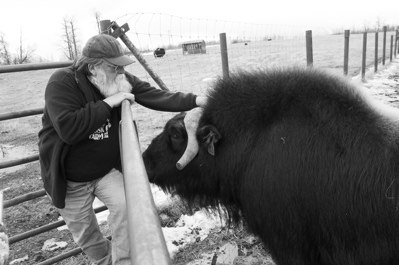
SpinningQiviut is the under down of the musk ox that sheds naturally every spring. The animals also grow coarse guard hair that does not shed, and continues to grow throughout their lives, sometimes reaching down to their ankles at a length of 2 feet. There are a few captive herds of musk oxen that are combed each year for fiber collection. The
Musk Ox Farm in Palmer, Alaska, sells all of its fiber to the
Oomingmak knitter's co-op in Anchorage. The
Large Animal Research Station in Fairbanks combs their research herd and saves some of the best fiber for hand spinners. (Check out their website for a great photo of a musk ox being combed!) A few other small farms may sometimes have clean spinning fiber available.
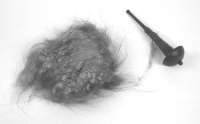
Most other fiber comes from wild herds in Canada, where Inuit hunters take the animals for meat and sell the hides or fiber to yarn companies. Sometimes you can find raw qiviut for sale, but it usually is from shorn hides and contains a LOT of guard hairs. The long guard hairs are not difficult to remove, because the fiber is not greasy. But the sheer quantity of guard hair makes preparing raw qiviut for
spinning and arduous task. If you do buy raw qiviut, you can use the guard hair to spin a sturdy yarn for knitting or weaving rugs or other hard-wearing accessories.
When spinning knitting yarns, the same considerations should be taken into account as when purchasing millspun yarn. 100% qiviut has little give and almost no memory, while blends with wool are much more elastic and will hold their shape better in fitted items. Remember that qiviut is incredibly warm, and don't be tempted to spin lofty, bulky yarn. It'll be so hot, you'll never be able to wear anything made from it.
Normally you do not need to card qiviut or clean it in any way after you remove the guard hair. Any stray plant matter or flecks of skin and dander will fall out as you are spinning. If you are blending the fiber with wool, you can card it by hand or you can try using a drum carder with an extra fine carding cloth. I've never carded qiviut. The only spinning I've done is directly from the raw fiber, and I haven't had the need to process the fiber in any way.
For more information on spinning with qiviut, try to get a copy of the Summer 1993 issue of Spin-Off magazine. It contains several articles on spinning qiviut and musk ox guard hairs.
Caring for QiviutQiviut fibers do not have protruding scales like wool. That makes the fiber incredibly soft and also makes it resistant to felting. I have had people tell me that they have washed qiviut items in the washing machine with hot water. Oh my! While I don't doubt them, I would treat my qiviut items with more care. I hand wash them, or soak them in the washing machine with no-rinse wool washing soap, and then gently squeeze out the excess water. If I'm washing a lace item, I will block
it each time I wash it. Other items, I leave to dry flat, being careful not to stretch any areas of ribbing out of shape.
For sources of qiviut yarn and fiber, see the appendix in
Arctic Lace or
Sheep To Shawl.