Friday, March 26, 2010

No-Bull Book Review: Toe-Up Socks for Everybody

If you liked Wendy Johnson's first book of toe-up sock patterns, you're going to love her second book, Toe-Up Socks for Every Body: Adventurous Lace, Cables, and Colorwork from Wendy Knits (PotterCraft; MSRP $22.99) which officially went on sale this week. Wendy was kind enough to send me a copy in advance of her visit to Loop in Philadelphia this weekend, so let's give it the No-Bull Book Review treatment.


Toe-Up Socks is a paperback, about 144 pages, full-color (I probably don't have to say that anymore; gone are the days when pattern books were not printed in color), with sturdy fold-in covers. I counted 21 separate patterns in the table of contents, although a few of the patterns have variations that will expand their usefulness (for example, the Wrought Iron Socks come in both knee-high and regular sock form).

The book begins with a one-page introduction, in which Wendy explains how her previous book provided all the basics for beginning toe-up sock knitting, whereas this book is designed, as Wendy puts it, to challenge the knitter to step outside her comfort zone and play with more adventurous techniques. Accordingly, you won't find extensive how-to-knit-socks directions or even plain-vanilla sock patterns; the book assumes you know how to knit a basic toe-up sock and builds from there. There is, however, a section addressing some general toe-up sock information, briefly discussing yarn choice, types of needles, how to read charts, and some tips on how to design your own socks. (There's also an appendix with additional technical info, which I discuss later.)

Rosebud Socks

The patterns are divided into three sections, based on the type of technique explored: lace, cables and colorwork. Each section begins with an introduction to the technique, a handy list of patterns along with their difficulty level (instead of just rating them easy/medium/hard, the ratings also include the specific techniques used in the sock to better help you judge the difficulty), some illustrations of some of the relevant stitches or techniques, and a brief discussion of what types of yarn work best. Very helpful, all of it.
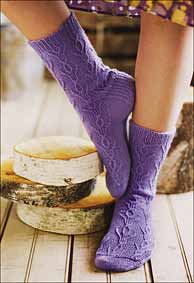
Tiptoe Through the Tulips Socks

Now let's get to the good stuff: the sock patterns.

The first section, Lace Socks, contains seven patterns, including the Rosebud Socks (I believe these are shown on the front cover on the left), the Laurel Socks, the Bouquet Socks, the Crocus Socks, and the Victory Socks.

Victory Socks

All of these are mid-calf socks (the traditional length). The Belle Epoque Socks come in a thigh-high version as well as a kneesock version, and the Dainty Anklets feature a sweet turn-down cuff.

The next section is devoted to cables and twisted stitches; you'll find seven patterns in this section, too. The Heart-to-Heart Socks, Tiptoe Through the Tulips Socks, Manly Aran socks, Diamonds and Cables Socks,


Diamonds & Cables Socks

Bob and Weave Socks, and Basket Case Socks are all mid-calf, and the Wrought Iron Socks come in mid-calf and knee length.


Wrought-Iron Socks

The Colorwork sectioncontains the last seven patterns: Sneaky Argyle Socks, Stjarnblommesocker,

Stjarnblommesocker

Critter Socks, Sanquhar Socks, Norwegian Rose Socks,


Norwegian Rose Socks

Fair Isle Socks and the Hot Stuff! Socks, which, interestingly enough, were inspired by a similar motif as the Flamethrower Socks from Knitting Socks in Handpainted Yarns. (Simmer down, though, Wendy's socks were knit before KSIHY was released, without her ever having seen it, so this constitutes one of those "great minds think alike" moments.)

Hot Stuff! Socks

As with its predecessor, this book is beautifully made. The photography, by Alexandra Grablewski, is gorgeous, letting the socks take center stage and showing off the details of their stitch patterns. Each sock is shown from multiple angles, with well-lit close-ups to enable the knitter to get a very clear sense of the design details and the way the sock looks overall -- a very important and sometimes overlooked aspect of knitting books. Charts accompany the patterns, in color where necessary.


Dainty Anklets

About the socks themselves: well, obviously, they are all written from the toe-up, for two circular needles. They are all written for fingering weight yarn, shown in solid or nearly-solid yarns, with gauge usually at 8 sts per inch (a few are slightly tighter, at 8.25 or 8.5 sts per inch). Sizing is variable, which makes sense based on the intricate patterning of the socks; often the type of stitch pattern or its repeat will dictate how feasible it is to do multiple sizes and where exactly they fall measurement-wise. (One of the advantages about knitting socks is that they have a bit more flexibility in fit than, say, a sweater.) Two of the socks come in one size (around 8 inches or so circumference); two socks come in a circumference of 5/6/7 inches; one pair comes in a larger 9/10 inch circumference (the Manly Aran Socks); and the rest have two to four sizes given, raning from 6 to 8 or 9 inches circumference.

Last, the book contains an appendix with some additional technical information: an overview of different needle techniques (two circ vs. one long circ vs. dpn); how to do cast-ons (especially important since these will create the toes of the socks); some heel techniques; and bind-offs.

Fair Isle Socks

It doesn't surprise me at all that I give Toe-Up Socks for Every Body two sock-loving thumbs up. It's a lovely book full of gorgeous sock patterns that take advantage of more adventurous techniques, like lace, cable and twisted stitches, and colorwork. It's beautifully photographed and produced. And it's written by an experienced teacher and designer who will be appearing in Philadelphia this very weekend. Yes, you can pick up a copy and get it signed by Wendy Johnson this weekend at Loop! Go here for details.

Tuesday, March 23, 2010

Amy Butler yarn line from Rowan

Check it out: if you are an Amy Butler fan (she is a fabric designer/quilter), Rowan is introducing a new line of yarns designed by Amy, called Belle Organic. Looks like it comes in two weights, DK and aran, and the yarn is a 50% organic wool/50% organic cotton blend. Yum! (Just don't discontinue regular old Wool-Cotton, hear me, Rowan???) There's a brief blurb on Rowan's website here.

Sneak peek: Vévé's new book!


Go here for a sneak peek at Véronik's new book, Knitting 24/7: 30 Projects to Knit, Wear, and Enjoy, On the Go and Around the Clock -- coming soon!

Sunday, March 21, 2010

Parental pride

Forgive me for bragging, but for those of you not on Facebook, I have to tell you about what Elvis did this weekend. This weekend he participated in the countywide spelling bee, the competition that feeds directly into the national one in Washington in June. My kid, who is only in sixth grade, went 28 rounds, sticking it out against seventh- and eighth-graders, many of whom had participated in the competition before.


He spelled all sorts of crazy words correctly, including "tithe" (round 2) and "knish" and "cedilla" and "langlauf" (whatever that is) and he made it all the way to the end. He went toe-to-toe with an eighth-grader and ended up in second place.


I am so proud of him. I am so proud of his intelligence, his guts, his poise and how damn cool he is. Well done, Elvis.

Wednesday, March 17, 2010

On being Irish

I grew up in a small city in northeastern Pennsylvania. For many years, Wilkes-Barre's major industry was coal mining. It was a dangerous job and if you survived 'til retirement age, you had only a slow, choking death from black lung disease to look forward to. Since the mines consumed the lives of so many men, there was a constant stream of immigrants entering the Wyoming Valley to keep the anthracite flowing.

Most of the immigrants came from Europe. As disaster struck a particular country, hundreds of of its poorest citizens would come to the Wyoming Valley looking for mining jobs. Irishmen, Italians, Poles, Russians, Germans, Czechs, Lithuanians, and many other countries sent huddled masses yearning to breathe free. Immigrants tended to stick together, so that all of the men from one village or region would live in the same neighborhood, maintaining as much of their home culture as they could.

When I grew up in the 1960s and 70s, ethnicity was still felt very strongly in Wilkes-Barre. Kids would ask each other "What are you?" meaning "From which poor European country did your ancestors come?" and the answer would be "Polish!" "Italian!" "Irish!" "Lithuanian" or whatever it happened to be (except for my high school calculus teacher Miss Owens, who if she heard someone ask "What are you" would snap "You're American!"). There was an immediacy and an importance to one's ethnic identity that probably came from being second- or third-generation Americans in a geographically insular place.

My father had a keen sense of his Polishness and even though he had a smidge of German blood in him, he always identified himself as a Polish-American. He was always very proud of his Polish heritage and never hesitated to tell people about the famous Poles who'd contributed to society: Copernicus, Kosciusko, Madame Curie, Chopin. (We were probably the only people on our block to have a framed photograph of Copernicus in our basement rec room. I am not joking.) My mom, whose father's family was Lithuanian, and whose mother's family was a mishmash of things, having not been part of the coal-miner-immigrant waves of the late 19th and early 20th centuries, never seemed to care that much about what she was, although she could tell you she was Pennsylvania Dutch, English and French, as well as Lithuanian. So when my brother and I were asked "What are you?" we usually answered "Polish." When people would go all faux-Irish on St. Patrick's Day and ask me why I wasn't wearing green, I'd say "Because I'm not Irish."

Except now I'm not so sure.

When I started tracing my family's genealogy, I discovered that my grandmother had a grandmother named Susan Kinney. Her father was Daniel Kinney and her mother was Mary Freeman. "Kinney" is a Gaelic name, and is cited as being Scottish, Welsh and/or Irish in origin. "Freeman" could be many things -- German, Anglo-Saxon or an Anglicized version of a French, German or Irish name.

It can be tricky in genealogy to make assumptions about where a family came from based on name alone. (Consider the story, probably a tall tale, of the Jew named Sean Ferguson, allegedly because when asked his name at Ellis Island, the frazzled man answered “Shoyn fargesn," meaning "I've forgotten.") Until I find more information on two people forgotten by history -- Daniel P. Kinney, born around 1814 in New Jersey, and Mary I. Freeman, born around 1822 in Salem Township, PA -- I won't know for sure whether I need to put on an Aran sweater, a kilt or maybe even the red dragon of Wales. Whatever it is, I hope it doesn't clash with my


Polish eagle sweatshirt.

Monday, March 15, 2010

Cross one off the knitting bucket list. . .

With two simultaneous deadlines last week, I didn't have much time for blogging. And I don't think I've mentioned here the exciting news that the Spring/Summer Vogue Knitting is out, complete with a sweater I designed inside:


Vogue Knitting Spring/Summer 2010, photo by Paul Amato
Yarn Information: Tahki Yarns/Tahki•Stacy Charles Rain
For sizes: Small (Medium, Large, 1X, 2X)
Amounts: 14 (16,19,20,23) balls in #5 green

I particularly like this issue of VK because it has so much lace and textural stitches. (There's also a lovely cardigan by Kathy Merrick knitted in Rowan KidSilkHaze, yum).

In case you haven't discovered it yet, Vogue has a very cool feature on their website called "VK360". You can watch a video of every garment in the issue, shown against a plain background, with shots from every angle and close-ups of the stitch pattern and design features. If you are someone who has a hard time envisioning items from a magazine in a different context, this feature is a great help. The models are pretty much unstyled -- in many of the videos, you can't even see their faces or hair. So if you find the fashion-forward hair or makeup in many layouts to be distracting, you should check out VK 360. (It plays music during the videos, so if you're taking a sanity break at work, best to turn off the sound.)

Wednesday, March 10, 2010

CashSock in sweater quantities....

Just updated the BBF shop with a large batch of CashSock -- single skeins in great colors


and some batches of 2 skeins for shawls


and even a couple of batches of 4 or 5 skeins for sweaters and large shawls...


The update is live....so check it out here.


I've been trying to meet some other deadlines, so that's all I got.

Thursday, March 04, 2010

Introducing: the Emmett Socks

Another BBF sock pattern debuts: behold the Emmett socks.


To paraphrase a line from a dreadful soap commercial, they are manly, yes, but the ladies will like them, too. They feature a classic cable rib pattern with a lot of stretch. The pattern is sized for unisex adult S/M/L and there is a lot of flexibility in fit due to the ribbing. There is a lot of room in between sizes because of that stretch, which means it will fit feet of many different sizes.


I like these socks a lot because they take advantage of a stitch pattern that is relatively easy to work and to memorize, but create a really good-looking end product that is suitable for men and women. (In case you're wondering, these socks were named after one of my great-grandfathers, who ended up marrying a woman named "Emma" -- isn't that cute?)


You can download the pattern via Patternfish here or via Ravelry here. Hard copies will be available at the BBF on-line shop in time for my next update. (And since it's a huge update of CashSock, you can try it out with a brand-new skein of yarn! I've got lots of great colors, including some spring-ier shades and some richer ones.)

Super shout-out of thanks to Laura Grutzeck, for her awesome photography both here and of Gitte's Socks.

Tuesday, March 02, 2010

January & February 2010 Book Report

One of my Christmas presents was a Kindle. I know so many people with Kindles (and now some who have Nooks) who love them, and so my lovely husband sprung for one. It is really fun and convenient, especially if you are a fast reader like me, and can't bear to be without a book you are in the middle of. I don't anticipate giving up print books, though; I like the idea of holding a real book, especially ones I'll want to re-read, too much to ever give up that pleasure. (I also love the way that books smell; they haven't figured out how to imitate that smell with e-books.) However, I have been having fun reading on the Kindle. I especially like the way that you can use it to mark quotes from books that you want to remember, and then the quotes are collated in a separate place for you.

So without further ado, here's what I read the first two months of 2010: some in E-book form, others in paper form.

The Monster in the Box by Ruth Rendell. Advertised as "the last Inspector Wexford novel" in a long and excellent series by Rendell, I found this a bit of a let-down. If you've ever read Curtain-- the last Hercule Poirot mystery (which I believe Agatha Christie held back so it could be published after her death), you may see some vague similarities: Wexford tries to prove that a nasty bit of goods named Eric Targo is an opportunistic serial killer who instigates other people into committing crimes, and who has avoided detection for years. This one was a bit slower than most Wexford books, with less action and a lot of reminiscing. Not bad, but not the series' best.

Woman with Birthmark by Hakan Nesser. A taut thriller/murder mystery involving the death of a series of men who don't seem to have anything in common -- until an astute detective figures out that they all did their compulsory military service together in the 1960s. Inspector Von Veeteren has to figure out which of the men in the unit will be targeted by the killer next, and who is holding a grudge against them. A quick read; spare, suspenseful and well done.

The Blood-Dimmed Tide by Rennie Airth. I read the first and third installments in this mystery series last year, and finally got the chance to read the middle one. Rennie Airth is a good writer but slo-o-w when it comes to putting out sequels; there was a gap of several years between each. His retired detective, turned gentleman farmer, is entangled in the investigation when a local girl is brutally murdered. Investigators determine that a sociopathic serial killer is on the loose...

Closing Time: A Memoir by Joe Queenan. I've liked Joe Queenan's writing for a while, although it's so acerbic that I tend to savor it in small amounts, like spicy food. But I really came to appreciate all that Queenan has accomplished, as a writer and as a man, as I read Closing Time. It's a memoir describing Queenan's childhood and coming-of-age in 1950s & 60s Philadelphia. As a resident of Philly for almost twenty years, I got a kick out of reading about a Philadelphia I never knew (and comparing his recollections with those of my father-in-law, who is a contemporary of Queenan). It just so happened that I read this book shortly after my father's death, and one of the central focuses of the book is Queenan's difficult relationship with his alcoholic father. It was oddly comforting to read about Queenan's experiences and to have that "a-ha!" moment when you realize that you aren't alone in some of the emotions you feel as the child of an alcoholic. If Queenan sounds harsh with regard to his father -- and at times he does -- he had good reason to feel that way; he unflinchingly describes the emotional and physical brutality that he and his sisters suffered at the hands of their father.

Inspired by the ubiquitous discussion of The Catcher in the Rye by J.D. Salinger, I decided to finally read this classic of 20th century literature. I wasn't sure what to expect, having been told by various folks that they loved it, that they hated it, that I was too old for it, that Holden was a "whiny bitch," and just about every other reaction you can imagine. It didn't take long to read it, but I felt ambivalent about the book right up until the end. I easily understood why it was considered groundbreaking, but it wasn't until I was about twenty or thirty pages from the end that something clicked and Holden became real to me. I'm glad I read it, even if it now seems a tinge dated, and I found myself laughing out loud at some parts, underlining lines that I thought were especially good, and occasionally wincing at Holden's painful experiences in the world.


It's time to honor the life of an author who openly despised all of us


Jericho's Fall, by Stephen Carter, was one of the free selections I received from the Amazon Vine program. Carter is a well-regarded law professor at Yale, and, interestingly, writes fiction in his spare time. His earlier books had gotten pretty good reviews, and he's certainly a brilliant guy, so I figured I'd give this one a try. Alas, I hated it. The main character is a woman who travels across the country, to a remote Colorado town, to see her former lover, who has a terminal illness. It was hard for me to suspend my disbelief from the get-go, however. Rebecca's willingness to drop everything in her life (including her young daughter) to return to Colorado is hard to swallow, and she struck me as too much of a Lifetime TV Movie character: strong, beautiful, supposedly brilliant, but not so smart when it comes to jeopardizing her emotional and physical well-being by hanging out with a Svengali-like man from her past. Her lover, the "Jericho" of the title, is a former CIA director and adviser to presidents, and part of the tension in the book is whether he has, in fact, lost his mental faculties due to his terminal illness, whether he was/is insane all along, whether his daughters (who are taking care of him in his final days) are sane, whether operatives from the US or foreign countries are really after him to prevent him from revealing juicy state secrets, etc. etc. I bailed about 100 pages in when picking the book up seemed like a chore more than a pleasure.

Tears of Pearl by Tasha Alexander, another Amazon freebie, is a very lightweight historical mystery set in Victorian-era Constantinople. The lead character is Lady something-or-other (Emily?) who is on her honeymoon with her hunky husband; said hunky husband has a suitably mysterious career as a sort of spy-slash-detective working for the British government. A half-British, half-Turkish harem girl is murdered, and Lady Emily & her husband are asked to find out who did it. Good beach reading; glamorous locales, lots of silk skirts & horseback rides in the moonlight, a not-terribly-taxing-but-entertaining mystery.

Death Comes for the Archbishop by Willa Cather. Tom & I have a friend who is an English professor who has studied Willa Cather extensively, and she was aghast to realize I had never read any of her works. I started out with this book, and was charmed by it. The book is really more of a character study and a study of place, as it follows the career of two missionaries sent to establish a Catholic diocese in the southwest territories during the 1800s. Having lived in Arizona for a year and traveled around a bit in the southwest, I found the descriptions of place to be fascinating. The characters were beautifully drawn, and Cather writes with a direct but lyrical style. I'll definitely read more of Cather; in fact, My Antonia is already in the pile of unread books by my bed.

Still Waters by Nigel McCreary. I was lent this by a friend who also enjoys mysteries and I honestly didn't realize how gruesome some of the details were until I finished the first chapter. (I think I actually yelped aloud on the Stairmaster.) This was an engrossing, if very creepy, read, a decent mystery but not for the faint-hearted. The murderer is an older woman whose M.O.isto befriend lonely elderly women, insinuating herself into their lives, then poisoning them and keeping all their money and property. The main detective is a man suffering from a bizarre neural condition in which he experiences sounds as a kind of taste (synesthesia). He has been out on medical leave because even ambient noise causes him to experience a variety of strange, and sometimes very unpleasant, taste sensations; it sounds weird, but the author does a good job of describing how awful the condition is. The detective returns from medical leave to try to solve this case.

The Chalk Circle Man by Fred Vargas (who's actually a she): We take a break from Scandanavian and British detectives just long enough to try out a French commissaire. Commissaire Adamsberg seems unconventional to his colleagues, but no one can argue with his success rate in solving crimes. In the first of the series (also lent to me by a pal), he is troubled by the strange actions of a mysterious person drawing chalk circles around random objects on Paris sidewalks. No one else in the police force seems very concerned, but Adamsberg is convinced that the circles are a precursor to murder -- and he turns out to be right. Very French, a little quirky, and very enjoyable.

All My Enemies by Barry Maitland. Another good lend from a friend; this is one in a British series featuring detectives Brock and Kolla. Brock and Kolla are called in to solve the murder of a young woman stabbed to death in her home. The detectives try to determine if the murder is part of a larger series of deaths, and connect it -- along with the deaths of at least one other woman -- to an amateur theater group.

That's the round-up for 2010; as always, I enjoy hearing from you, whether it's to give your opinions on any of the books I've read, or to suggest books for me to add to my "to-read" list.

Now I am preparing a very large update for BBF chock-full of CashSock yarn (even a few batches of sweater quantity!!) so I must get back to work.

Thursday, February 25, 2010

West coast friends....

if you are going to Stitches West, please stop by the booth of Crafting For The Peanut Gallery/Rabbitworks, where you will not only find beautiful handmade wooden lovelies like darning eggs and lazy kates, and the initimable Rabbitch and her handpainted yarns, but you will also find a small batch of Black Bunny Fibers yarns and patterns. Look for Booth 1242 and give them a big hug from me.

This week has gotten away from me, and not especially in a good way. Tuesday was the two-month anniversary of my dad's death, which still seems surreal to me, and we're getting smacked with more snow tonight and tomorrow. I'm feeling out of sorts, so I'll sign off now.

P.S. For Philadelphia area knitters, Clara Parkes' visit to Loop has been POSTPONED due to bad weather. (Thanks, J.!!)

Friday, February 19, 2010

BBF update: new silk-merino sock yarn & Tight Twist is back!

FYI: Just in time for your shopping pleasure, I updated the BBF site with some gorgeous hanks of a new base yarn, Softsilk Sock, which is 50% merino and 50% silk, superwash, fingering weight. Of course, you can make socks with it, but it would also be so lovely as a scarf or cowl, where it would brush gently against your skin and make your eyes look that exact shade of ice blue...


or gray


or cornflower


However, if you're thinking some serious stitchwork, you might also want to treat yourself to a skein or two of Tight Twist, the beloved wool/polyamide blend reminscent of the Serious German Sock Yarns like Opal or Trekking.


Some nice deep blue and red and green,


but also some nice multis, too. And if you purchase $25 or more, use the code "GROUNDHOG" for free shipping through February! Link to the shop is here.

Thursday, February 18, 2010

Homework time (or why Mommy needs Xanax)

This is how Little Miss does her homework.

Little Miss gets out all her papers and spreads them all over the living room floor.

Me: Do you want to work at your desk? or on the dining room table?
Little Miss: NO! I'm doing it here.
Me: Okay.

Little Miss: [whining] I don't know how to doooo this problemmmmm....
Me: Don't whine; just ask for help.
Little Miss: MOMMY I NEED HELP WITH THIS PROBLEM! [disgusted sigh]
Me: Okay, bring it over and quit yelling.
Little Miss: Why do I have to bring it over???
Me: Because you want me to help you with it?
Little Miss: Why can't I just READ it to you, Mommy?
Me: Okay.
Little Miss: I have to divide 8 dollars up among five people. But 8 doesn't divide by 5. WHAT A STUPID PROBLEM.
Me: Why don't you think about turning the 8 dollars into coins, instead? How many dimes are in a dollar?
Little Miss: EVERYONE knows there are ten. I'm NOT a dummo, Mom.
Me: Okay, so if you had 8 dollars, you could have 8 one-dollar bills OR you could have 80 dimes.
Little Miss: I'm NOT supposed to have 80 dollars. I'm supposed to have 8.
Me: I know, but I'm turning the 8 dollars into dimes. You would have ten dimes for each dollar, so 10 x 8 = 80.
Little Miss: WHAT ARE YOU, A STUPIDIO? I'm supposed to DIVIDE, not MULTIPLY.
Me: Did you just call me stupid?
Little Miss: [murms]
Me: You aren't allowed to call me stupid. If you don't want me to help, I won't.
Little Miss: But how am I going to divide EIGHT DOLLARS FOR FIVE PEOPLE????
Me: Why don't you try dividing 80 dimes among five people?
Little Miss: That's NOT the way I'm supposed to do the problem, Mom. Sheesh.
Me: Well, if you know how to do the problem, why are you asking me for help? Just do it.
Little Miss: BUT EIGHT DOESN"T DIVIDE INTO FIVE!!!!!! ARE YOU STUPID, MOMMY?
Me: Go to your room. Your father can help you with your homework.

[Snit ensues. Little Miss retreats to her room. An hour later, Tom comes home.]

Little Miss (sweet as pie): Mommy wouldn't help me with my homework. Will you?
Me (from other room): Did you tell Daddy how you called me stupid when I tried to help and then had a snit when I told you to go to your room?
Tom: Oh really?
Little Miss (ignoring the peanut gallery): I have eight dollars and I have to divide it up among five people.
Tom: Why don't you turn it into 80 dimes? Then you can divide the 80 dimes among the five people. You can start by giving each person ten dimes. Then you have 30 left. What's 30 divided by 5?
Little Miss: 6?
Tom: Right.
Little Miss: So each person gets 10 plus 6 dimes?
Tom: Right. That's $1.60.
Little Miss: I KNOW, DADDY. DO YOU THINK I'M A DUMMO?

Wednesday, February 17, 2010

The new KnitScene

If you haven't seen the new KnitScene, I am pleased to report that in addition to all sorts of pretty things like the Helleborus Yoke and several pretty shawls (including one by Philly's own Kate Gagnon Osborn), you'll find two hats designed by me.

The Ribby Toque is knit in a heavy worsted (Zara Plus was used for the sample, which is a great yarn with beautiful stitch definition, like its skinnier sibling Zara)


and the Picot Cloche features a picot edge and eyelets through which you thread a ribbon -- lots of freedom to be creative in the combination of ribbon and yarn you pick, although the yarn that was used for the sample, Rowan Lima, is an absolutely luscious chainette tape made mostly of alpaca):


Both are great projects for less experienced knitters, and experienced knitters could whip one out while watching the Olympics one night.

Monday, February 15, 2010

Once again...

it's time to celebrate Speranza'a. For those of you new to the blog, here's the original explanation that I wrote a few years ago:

A couple of years ago, my kids got a Sesame Street DVD called Elmo's Happy Holidays. It's very cute, and covers Christmas, Hannukah, Eid and Kwanzaa, explaining the basic idea behind the holidays and showing real kids and their families celebrating them. My kids have watched this DVD over and over (and over). Somehow they got the idea that we should create and celebrate our own family holiday. Since their last name, like my husband's, is "Speranza," the obscure festival of Speranza'a was born.

Each winter, when the days are gray and cold and it seems like spring will never come, it is time for Speranza'a. (Technically speaking, it begins on the first Monday after Valentine's Day.) Each person in the family gets their own day. Monday is Tom's, mine is Tuesday, and so on, and the sixth and final day is for Charcoal [-- and any guests fortunate enough to be invited.] The person whose day it is gets to pick what we are having for dinner. Candles are lit and the person whose day it is gets to make a wish and blow out the candles. After dinner, we dance in the living room.

We are still working out some of the finer details; for example, someday I will have to take the kids to one of those paint-your-own pottery places so we can make special candleholders (a spenorah?). We still need to work on the Six Principles of Speranza'a: so far we've got the Principles of Irony, Gluttony and Magnetism, but I think they need tweaking.

But all silliness aside, it is sweet and surprising to see how much this family tradition means to my kids. They've been talking about it for weeks. They talk about what they are going to pick for their dinner (Elvis picked turkey breast; N. is opting for shells in tomato sauce; G. will probably ask for bacon and popcorn) and they are thrilled when it's their turn to make a wish and blow out the candles. From the parents' perspective, it is heartwarming to feel like we are making some special memories with our kids. I have little daydreams about them coming over when they are grownups, still celebrating this made-up holiday with us as we all grow older.

So from my family to yours, we wish you a happy Speranza'a!

Thursday, February 11, 2010

We're still here....

even though we got hit with a one-two punch from Mother Nature. Around two feet over the weekend, and close to another two feet over the course of the last 36 hours.


While this has created certain logistical difficulties, we still have power and cable and internet, and God knows I've got plenty of yarn, so I am not complaining one bit.


Monday, February 08, 2010

No-Bull Book Review: Color by Kristin, by Kristin Nicholas

We just had a weekend full of snow, and more is forecasted for mid-week. So while everything is white outside, it is the perfect time to drown oneself inside with color. In other words, it's the perfect day to review Kristin Nicholas's new book.


Whenever I run into Kristin Nicholas, I always get a huge smile on my face. She is one of the most genuine and nicest people you'll ever find in the knitting world, and she is incredibly talented. Kristin paints, she designs embroidery as well as knitwear, illustrates, is a photographer, has a great kid and raises sheep and cats on her farm. (I suspect she's one of those people who would excel at anything she tried her hand at, whether an artistic endeavor, construction work, neurosurgery, macrame...) So when I heard Kristin had a new book out, I was all over it like a donkey on a waffle. (I regret to confess that I've been meaning to do this book review for weeks -- weeks, I tell you! -- but, sigh, you know how it goes with me.)

Color by Kristin: How to Design Your Own Beautiful Knits (Sixth & Spring 2009; MSRP $24.95, available at the time of this writing for $16.47 via the link), was released this November, and it is a feast for the eyes, teeming with color and inspiration. It's a hardback book, about 172 pages long, and (obvy, as the young kids say) full-color. One thing that I do love about the book is how very jam-packed with color it is: the end papers are photographs of swatches, there are close-ups of knitwear all over the place, there are lots of photographs of colorful yarn and nature and collages and all sorts of pretty things, many of them taken on Kristin's farm.


Cuffed Mittens & Socks

The book begins with Kristin's introduction, called "A Life in Color." In it, she describes her fascination with color, tracing her involvement with textiles beginning with sewing, progressing through studying textile design, serving as Creative Director of Classic Elite Yarns, and currently running a sheep farm in Western Massachusetts. Kristin describes how she likes to mix up colors "with wild abandon," as she puts in, adding embroidery to the stranded designs she favors.


Child's Zip-Up Cardigan

Chapter 1 is a brief introduction to Kristin's interpretation of color theory. I say "Kristen's interpretation" because I think that different people like to work with color in different ways. For example, Kristin tends not to work with white or black, even as accents, because she feels "they make things stagnant." She presents, instead, a loosely-structured color wheel (with yarn pompoms instead of swatches or chips) and explains the difference between complementary, analogous and tertiary color combinations. If you are looking for traditional color theory, this isn't the place for you; what makes Kristin's style unique is that she is guided not by strict principles but by intuition and inspiration. Her approach to color "theory" is more an attempt to give the reader a very basic understanding of the general rules, and let the reader play with color herself. Accordingly, she includes a page showing the importance of swatching, with five swatches of the same motif knit in different color combinations. I love illustrations like this, that bring home in a visually arresting way how the same motif or stitch pattern can look vastly different depending on color choice. (Swatches are also included for alternate colorways in some of the patterns, a great way for a timid knitter to envision different color combinations.) Kristin ends this chapter by urging the reader to explore color, keeping track of color combinations that appeal and working with color on a regular basis.


On-the-Go Knitter's Tote

Chapter 2 contains general instructions for two-color stranded knitting. This chapter discusses a little about the background of stranded knitting; emphasizes the importance of gauge; gives tips on how to knit with two yarns, floats, and so on; discusses working in the round, including steeking, following charts, increasing while keeping the pattern correct, and centering a pattern repeat; and ends with an explanation of working duplicate stitch. The chapter concludes with two projects allowing the knitter to practice two-stranded color knitting; the projects are simple and involve no shaping, but will enable the knitter to practice reading charts, working with two strands of yarn, and other helpful skills.

Chapter 3 is devoted to designing with stranded knitting, using charts to ease the knitter into creating her own designs. This is a brief section, intended for an adventurous knitter who wants to plunge in and experiment with her own designs and motifs.

The book then turns to Kristin's patterns, well over twenty of them. The patterns consist of a combination of items for kids, women and the home. They're presented sequentially, rather than broken down into chapters, so I've grouped them myself.


Norwegian Dreams Pullover

We'll start with women's sweaters; you'll find the Hen Party Pullover, a yoke-sweater with colorwork around hem and cuffs; and the Norwegian Dreams pullover (above), both highly-patterned and very colorful. You'll also find the wild "Over the top Shawl," featuring lots of color and pattern; and the Southwest-Style Sleeved Wrap, a kind of ruana with sleeves sewn in (the boxy shape is a great palette for color design, while the sleeves enable the garment to stay on better than a wrap would).


Southwest-Style Sleeved Wrap

Women's accessories are a great place to experiment with bright colors and wild combinations, and those with more conservative style might feel more comfortable starting with smaller objects before plunging into a full-size garment. Great starting points are the charming Bloomsbury Gauntlets, the Mad For Plaid Mittens (sized for the whole family); the Extra-Long Scarf (designed for using up yarn odds and ends); the Last-Minute Mittens and Hat combo; and a cute set of cuffed mittens with matching socks (shown near the top of this post).

Best Friends Pullovers

Using bright color combinations is a perfect way to design for kids. For babies, there is the Many Hearts Baby Afghan, consisting of blocks which are then joined so that a border can be knit on; Kristin suggests that several knitters can each knit a block and then present the blanket as a joint gift; the Child's Zip-up Cardigan (shown toward the top of this post); the Scrap-Yarn Scarf; and the charming Best Friends Pullovers, two coordinating sweaters using different designs to reflect the differing personalities of best friends. In adult and child's sizes are the Greek-antique-inspired Family of Slipper Socks; and the Mother-Daughter Mittens,


Mother-Daughter Mittens

as well as the Mad for Plaid mittens mentioned above.

Rounding out the patterns are the home dec and bags: the On-the-Go Knitter's Tote, with lining and leather handles (above); a cover for a French press; a felted laptop cozy; a cylinder-shaped bolster;


Pompom Bolster

the Marrakesh Market Pillows, a set of four pillow covers in different sizes (some of them are shown with the bolster, above); a huge ottoman cover; and a sweet teapot cozy.


Lazy Daisy Tea Pot Cozy

When it comes to yarn and gauge, all the projects are knit in Julia, the worsted-weight, wool/mohair/alpaca yarn that Kristin created and which is produced by Nashua Handknits. (You can see that Kristin designed the palette, as it is full of the vivid colors she favors.) Sizing for most of the items isn't a big deal; all the home dec-type items and many of the accessories, like the scarves, are not dependent on the knitter's size. The women's sweaters run from the smallest size of around 36-inch finished bust to the largest size of a 52-inch finished bust -- generous sizing. The child's sizes run from around a 24-inch finished chest to a 36-inch finished chest. The handgear varies; some are sized, others are one-size-fits most.

After the pattern section, there are more goodies: a series of different edgings with directions; a set of colorwork charts with repeats of different stitch numbers, which allows the knitter both to substitute different motifs into the existing patterns, and to experiment with her own designs; and instructions on a few basic skills (like Kitchener stitch) and embroidery stitches.

I really enjoyed looking through this book, and not just because I adore Kristin Nicholas as a person. Of course, I love the use of color and the way that sources of inspiration -- flowers, swatches, color combinations -- are placed throughout. I like the way that alternate color palettes and charts are provided to let the knitter riff on the designs, making them her own. I like the way that the stranded knitting projects in this book will help introduce knitters scared of super-skinny yarns to experience the pleasure of making colorful stranded projects.

But what struck me the most about the book was how unique, and uniquely American, Kristin's style is. She uses a fresh and bright color palette based in large part on the countryside of her New England farm; she takes Scandinavian-style stranded knitting and gives it her own spin, using thicker yarns and different color combinations, and adding embroidery; she is inspired by all sorts of ethnic textiles and traditions -- you can see the influence of Greek and Turkish textiles in some of her patterns, the bold color combinations are reminiscent of African and Carribean cloth, the symmetry and borders and two-color motifs of Fair Isle knitting -- and like the proverbial melting pot, she mixes them all together and creates something new and striking.

Maybe Kristin's bold color combinations aren't for you, or maybe you prefer to work with skinnier yarns or make more tailored garments, or maybe muted colors and lots of neutrals are your thing. That's great. But there is certainly something for you to take from Kristin's work no matter what you prefer to knit for yourself: her sense of adventure, her willingness to play with color to see where it takes you, the boldness of unexpected combinations, and in the most general sense, the courage to trust one's own instincts when it comes to artistic pursuits.

Wednesday, February 03, 2010

Gitte's Socks

Allow me to introduce another pattern in the BBF line: Gitte's Socks.


They are knit in fingering weight yarn and feature a nice eyelet check pattern-- pretty but not excessively complicated. The sample socks are knit in BBF Bamboo Lite Sock (a base on backorder right now) but any fingering weight yarn in a solid or semi-solid would work, including Superwash Merino Classic, CashSock or Tight Twist Sock (which will be my next update).


One amusing anecdote: I did a photo shoot with Bridget as my foot model in Rittenhouse Square. (The photos I took weren't usable but this was entirely due to my skills as a photographer, rather than the beauty of Bridget's feet. The lovely photos you see here were taken by the uber-talented Laura Grutzeck.) We were snapping photos and Bridget was striking poses, and a woman walked by with her boyfriend and Bridget heard her ask, "Are they anybody?" We of course cackled at that. But we didn't pay her too much mind, because us Somebodies try to ignore the Little People as much as possible.


You can find Gitte's Socks on Ravelry here or Patternfish here. I'll be adding some hard copies to the BBF store soon, too.

Monday, February 01, 2010

Knitigation

You know nothing gets my former-lawyer juices flowing like a knitting-related lawsuit. I just found out that at the end of 2009, Cascade Yarns (maker of such well-loved products as Cascade 220) has filed a federal lawsuit against Crafts Americana Group, Inc. (a/k/a "Knit Picks").

From a lawyer's standpoint, the Cascade v. KnitPicks lawsuit is interesting because it involves an area of the law that is just beginning to evolve. You're no doubt familiar with the way that an internet search (using a search engine like Google or Yahoo) works: you go to the search bar, type in what you're looking for, and the search engine gives you results. The results usually appear in a numbered list. You may also have noticed that in addition to the numbered search results, you also get a bunch of ads at the top of the screen and along the side(s).

I'm going to oversimplify a bit, but a search engine generates these two kinds of search results -- the list of results (sometimes called the "organic" results) and the paid ads that go with them, in two different ways. The organic search results are derived by the search engine using some complicated method of searching the web for words and phrases, applying a formula or algorithm, and then generating a list of what the search engine thinks are the most relevant results. The search engines are very careful to keep secret the exact formulas that they use to calculate their organic search results.

But the paid ads that you see (sometimes called "Sponsored Links" or something like that), along the top or side of the screen, are different. For the paid ads, search engines like Google let advertisers pick words that the advertiser wants to trigger its ad; whenever the ad is clicked on by a user, the advertiser has to pay a specified amount (sometimes this is called "pay per click" advertising). The search engines may use a kind of auction to dole out the ads; the advertiser who agrees to pay the most per-click will get the ad space and the top ranking. So if I sell a brand of hay for people to feed to their pet rabbits, my company might bid on words or phrases like "house rabbit", "pet bunny", "bunny food" and "rabbit hay." If I bid enough, then whenever someone does a search for any of those terms, the search engine will display my ads along the top or side, accompanying the actual search results. If the searcher then sees my ad and clicks on it, I pay a certain amount for that click.

The idea behind all this is simple. I want to identify only the people who are interested in my type of product (in my example, I want to find people who own pet bunny rabbits and are looking for hay to feed to them). Targeting search terms is a shorthand way to narrow down the huge number of internet users to those who seem interested in what I am selling. That way I can pay only for advertising to those people. It's a way of targeting my advertising dollars to the places where I think they will do the most good.*

How does all this relate to the Cascade v. KnitPicks lawsuit?

Well, Cascade is alleging that KnitPicks bid on "Cascade Yarns", "Cascade 220" and/or "220 Superwash" -- three phrases that are trademarks of Cascade -- so that when someone types in a search for, say, "Cascade 220", a KnitPicks ad would show up at the top or on the side, with a heading that says "Cascade Yarn" or something like that. (see Paragraph 17 of the Complaint) But KnitPicks does not sell Cascade Yarn -- it only sells its own brands of yarn. Cascade is alleging that KnitPicks is improperly using Cascade's trademarked phrases to get consumers to go to KnitPicks' website (where Cascade Yarn is NOT sold), or to "free ride" off Cascade's alleged reputation for quality, or to create confusion in the customer's mind. (Paragraphs 18-26 of the Complaint)

Think about this from the consumer's perspective. Say you want to purchase Happy Brand Hay for your pet bunny. You don't know where you can buy it. So you go to Google and type in "Happy Brand Hay." At the top of the page, above your numbered search results, you see an ad that says "Happy Brand Hay ON SALE". You click on the ad, thinking you'll find a deal on the brand of hay you want to purchase. How would you feel if you ended up at an online shop that didn't even sell Happy Brand Hay, but sold other competing brands? Would you be irked, because you really wanted Happy Brand, and this advertiser didn't even sell it? Would you not care if you found an alternative to Happy Brand that was cheaper or seemed better? Would you go back to the search engine and do research on Happy Brand vs. the other brand you encountered, pleased that you now can compare two products to see which is better for you?

Now think about it from the pet shop's perspective. If you sell hay for pet rabbits, you might be interested in reaching out to anyone who has manifested an interest in buying rabbit hay on line. You might not care if they appear to be interested in a brand of hay you don't carry; once you get them to your website, you may feel that your prices, or your selection, or your free shipping, or your fabulous interactive web design, will get that consumer to buy one of the hay brands you do sell. Pay-per-click bidding on any and every brand name of rabbit hay may seem like a sensible way to target your ads.

Now think about it from the Happy Brand Hay perspective. You've spent a lot of time and money building up your brand name. You've gone out of your way to produce very high quality hay. You honestly believe your hay is the best hay on the market. You've invested in advertising and research about what kinds of hay are best. Now a company that doesn't even sell your hay is reaching out to people who have searched for your own brand of hay. That company wants to pull those people over to its website and sell them another brand of hay. Do you think this is unfair? Do you think it might confuse consumers who are looking for your hay?

In other words, like so many things in life, this legal issue is complicated .

One of the things that is fascinating from a legal standpoint about this lawsuit is that it involves a brand-new area of the law. The internet hasn't been around that long, and it's created all sorts of new fact situations that the law hasn't caught up with yet. This pay-per-click advertising using key words that are trademarked is one of those relatively untested situations. Intellectual property attorneys will be watching this case to see whether the court creates any new precedents. There have been other cases brought using similar legal theories; you can read more about some of them here.

If you'd like to read the complaint in full, you can go here. I did some vigorous searching but could not find any record of a response filed by KnitPicks/Crafts Americana.

Feel free to discuss amongst yourselves, but please don't trash either litigant in the comments. And if I've mangled the explanation of pay-per-click advertising, feel free to correct me. Don't forget: play nice.


*Another way that advertisers target their advertising is by bidding on certain specific product names that they sell. So if I am a pet store and I sell Happy Brand Hay, a delightful blend of dried grasses for pet bunnies to nibble on, I might pay a search engine to show my pet store ad every time someone searches for Happy Hay. That way, my ad will end up being displayed to people who have shown an interest in one of the products that I carry. If you search for Happy Hay, and you see my ad, and you click on it, you might end up purchasing it from me, instead of another Happy Hay retailer.