Saturday, January 14, 2012

No-Bull Book Review: Sweet Shawlettes by Jean Moss

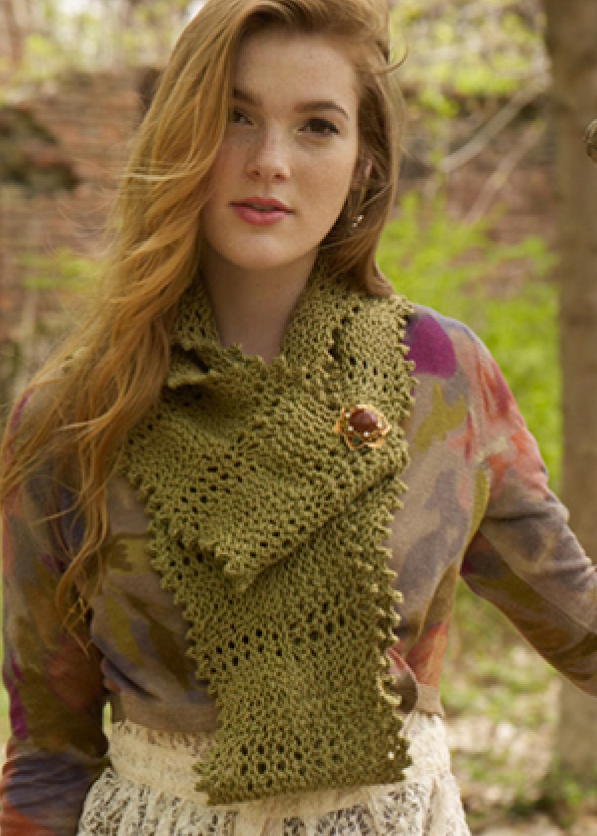
I am very pleased to be part of the official book tour for Jean Moss's new book, Sweet Shawlettes: 25 Irresistible Patterns for Knitting Cowls, Capelets, and More (Taunton 2012).  Jean Moss is a British designer who has created garments for such well-known companies as Ralph Lauren, Laura Ashley and Benetton; she is the author of several previous books and she frequently teaches in the US and UK. Her latest book is devoted to those charming small shawls, cowls and other accessories that have become so popular. Let's take a No-Bull look.


The patterns are divided into four sections: Country, Couture, Folk and Vintage. Country begins with six patterns, ranging from a shawl with colorwork edging


to a necklace-like leaf cravat


and a buttoned tweedy cowl.


The Couture section includes an entrelac capelette


and a bulky twisted cabled scarf:


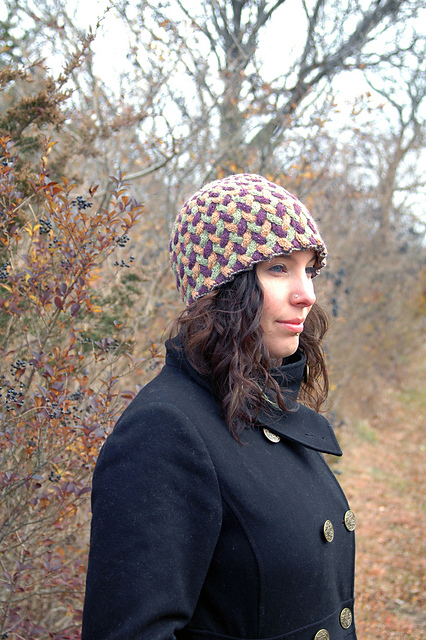
In the Folk section, you'll find a cowl with charming stranded colorwork:


as well as cables


and graceful stitchwork.


Vintage includes goodies like multicolored lace


oodles of ruffles


and a mohair-blend mantilla:


Perhaps because of the lighter color choices and the styling, many of these patterns look particularly suited for springtime. (I love the look of the apricot lace shawl over a summer dress, above). Clear, attractive photographs of the patterns, both close-up and overall, were skillfully done by Alexandra Grablewski.

The pattern section is followed by an appendix, with techniques, yarn information, and other reference information.

For those of you who like the numbers, you'll find four full-size shawls, four small shawls/scarves, two necklace-type scarves, five capelets, one hat with scarf tails to wrap, one longer cowl and eight shorter cowls and neckwarmers (some are loosely fitted while others sit closer to the neck). Yarn weights are all over the place:  3 fingering weight, 9 DK weight, 1 worsted, 1 denim yarn, 3 aran weight, 2 chunky weight, 3 in KidSilk Haze, and 3 polar/superchunky -- so no matter what's in your stash, you'll have choices. Most of the patterns come in one size, since they're accessories, but a few are given in multiple sizes. You'll find schematics and charts, too. Difficulty levels range from easy to experienced, again providing a good mix depending on your mood.

To sum up, you'll find a variety of styles, difficulty levels and yarn gauges in this book full of accessories, including scarves, cowls, shawls and capelets, as well as a few very decorative necklace-like pieces. It's well worth a look, particularly if you are looking for smaller projects that will help you use up stash. By the time spring rolls around, you'll have a new wardrobe full of accessories.

Next stop on the blog tour: Redshirt Knitting tomorrow. And you can find the full blog tour schedule here, on Jean Moss's website.


Wednesday, January 11, 2012

New York State of Mind

Thanks to everyone for your robust response to my Summer Search raffle. I am finalizing the list of prizes and getting ready to post a link to a page which will contain all the information about prizes, and how to enter.

In the meantime, I'm packing my bags for another trip to New York City for Vogue Knitting Live! I've had such fun teaching at the first and second shows, and I expect the third will be just as great.


As of this morning there were only a few seats left in my Yarn Substitution Made Easy class on Monday, and my Socknitters' Seminar still has some spots. There's going to be all sorts of wonderful stuff going on, from fashion shows to free talks to skill-builder demos. I'll be attending the banquet Saturday evening, too. Booksignings, yarn tastings, raffles....all sorts of exciting stuff, not to mention a terrific group of vendors at the marketplace. I hope to see you there!


Thursday, January 05, 2012

Are you in?

About two years ago, Mr. Go-Knit-In-Your-Hat got involved with a wonderful organization in Philadelphia called Summer Search.  The program is part of a national organization that is designed to find high school students from disadvantaged backgrounds and help nurture them so that they graduate high school, continue on to college and become productive members of the community.  There are a lot of great things about the Summer Search program, but one thing I really like is the way it tries to make a difference one kid at a time, with lots of coaching, mentoring and follow-up.


Summer Search starts by getting referrals from teachers and principals -- people who see kids at school every day.  They identify students who demonstrate potential for reflection, altruism and performance -- and part of the reason for Summer Search's success is the difficulty of the screening process.  It's a rigorous screening, and these kids come from backgrounds so unlike most of ours that we can't imagine the kind of things they face on a day-to-day basis (parents who have died or are otherwise out of the picture, abuse, neglect, poverty, crime and violence in their neighborhoods, and so on). 


Once they enter the program, students participate in four aspects of the Summer Search program.
  • Each student is assigned a mentor and meets with their mentor for weekly sessions. The mentor helps coach the student, give them insight into their behavior, help them with any problems they are having, and generally gives emotional support. A big emphasis is placed on helping the student to be accountable for their actions.
  • Each student gets a scholarship to take two trips, one in the summer before the junior year, and one in the summer before the senior year. These trips are designed to build the student's confidence in his/her abilities, to show them the broader world out there (a lot of these kids have never been outside Philadelphia -- some have never been outside the particular neighborhood where they grew up, let alone left the city or state) and help the student gain valuable experience. Past trips have included participating in Outward Bound, community service trips to the Dominican Republic, study abroad programs in China, and other amazing experiences.
  • Each student gets help in applying to colleges, including individualized help with the admissions forms and financial aid counseling. Over 90 percent are the first in their family to go to college, so things like paperwork and deadlines, that might not be a big deal when you're used to them, prove much more difficult for Summer Search kids.
  • Each student participates in a host of "alumni" services, like helping them with networking events, providing internships and finding mentors for them. They also receive continued mentoring through the first two years of college.  You might not realize it, but the first two years of college are critical for Summer Search kids.  They are away from home for the first time, feeling isolated and overwhelmed as so many college freshmen do, but they also don't have tons of financial support or sometimes emotional support.  They may get calls from family members saying "You need to quit school and get a job" or they may have trouble getting used to the new workload that college demands.  The mentoring process really helps these kids keep their eyes on the prize:  a college degree that will help them break out of the endless cycle of poverty.
The results are phenomenal.  Consider some of the statistics.  The U.S. Department of Labor says that only half of low-income students graduate from high school; a whopping 99.6 percent of Summer Search participants do. If you look at low-income ninth-graders, only 11 percent of them are statistically going to complete a four-year college degree -- eleven percent!  But 85 percent of Summer Search participants in post-high-school educational programs are on-track to graduate.

All of these statistics are kind of bland, though, compared to the experience of actually meeting a Summer Search participant. Tom and I have been at various events and part of the program is that Summer Search participants and their parents are expected to help pay it forward by telling their stories in person and in print.  These kids are so bright, so enthusiastic, and so proud of what they've accomplished. Their parents tell stories that will make you cry, admitting how difficult it was to let their children go to other states or countries, how much they missed them, but how proud they are of all their child has achieved.

Sounds pretty amazing, no?

Here's where you can help, even in a small way.  Right now, I am organizing a Go-Knit-In-Your-Hat fundraiser to benefit Summer Search Philadelphia. I'm still figuring out the exact logistics, but the general idea is that anyone who contributes to Summer Search Philadelphia will be entered in a type of raffle to win fabulous, fiber-y prizes.  (I will post a separate blog post entry explaining the procedure later in the month.)

I would really like to raise some cash to help out this amazing program, so I need your help.  Right now, I'm looking for prizes.  I will, of course, include some fabu Black Bunny Fibers prizes -- probably a spinner's basket full of handdyed roving, and a knitter's basket with yarn and patterns -- and I will also offer up one of my author's advance copies of my new book, personally autographed for you....perhaps I will even offer to do a custom dye job for someone and create a colorway based on the winner's preferences.

But those of you who read my blog who are in the business, might I prevail upon you to offer up a donation of something to use as a prize?  Perhaps if you are a yarn company, you might offer up a prize consisting of some of your fine yarns?  I will sing your praises forever.  If you are a designer, you might offer up a signed copy of your latest book, or a collection of your patterns in paper or PDF form. If you are a publishing company perhaps you might show your appreciation for my unceasing dedication to book reviews by offering a book or selection of fiber-related titles. You can leave a comment if you're sure I can track you down, or leave your email or use the sidebar to contact me.

Thanks in advance.


Saturday, December 31, 2011

I'm ready for 2012....I think!

Since I managed to cap off 2011 by catching a stomach bug from one of my kids -- a nasty one that's left me feeling exhausted and still a little queasy nearly a week later -- I've had some time to mull over the past year. (One thing I've noticed that is a sure sign of impending senility is the way in which, when I go to look back over a year that's ending, I find myself hopelessly confused about whether things actually happened in that year, or whether they happened two or three or even more years ago.  Something about having kids has irrevocably skewed my sense of time. I wondered for a minute whether 2011 was the year that Michael Jackson died, and was horrified to realize it was 2009 -- two years ago.  WTF, people?)

One very convenient thing about writing a blog is the ability to go back over one's posts and get some verbal snapshots of what was going on at my life at different points in time.  So I looked over the blog posts I've written in the past year to help put my wonky mental time line into perspective.  In retrospect, 2011 was an incredibly eventful year for me, and when I step back and think about what happened in the wider world, it was a pretty eventful year period.  I hate to resort to the cliched "it was the best of times, it was the worst of times," although the sheer number of wonderful and awful things that happened makes it tempting.  On the awful side, in addition to some personal stuff I won't go into here, consider:

  • the March earthquake, tsunami and nuclear crisis that devastated Japan
  • all too many senseless acts of violence, from Rep. Gabby Giffords to the kids in Norway to the nameless victims we don't hear about who are lost every day
  • Hurricane Irene's effects on so much of the country (and our week-long power outage)
  • my mom's near-miss as the Susquehanna River came a strand of laceweight away from flooding my hometown
  • the ten-year anniversary of 9/11, a sobering reminder of the evil that can live in our world
  • the frustrating, forget-about-who-sent-you-to-Washington state of American politics, and the gobsmackingly pathetic road show that the Republican primary season has become
  • the infuriating revelations about accused pedophile Jerry Sandusky, and Penn State's alleged complicity in concealing his crimes, a story that makes Pennsylvania taxpayers like me particularly livid since Penn State is a state-funded university
  •  the continuing economic turmoil in this country and elsewhere
  • the loss of friends, family and loved ones, famous (Elizabeth Taylor), infamous (Christopher Hitchens) and not famous (Beverly, Goat-Boy), but who will be missed all the same.

On the good side, consider how happy Satan is, having called home three of his favorite sons in 2011:  Osama Bin-Laden, Muammar Ghadaffi and Kim Jong Il. (Delaware folks might also add Tom Capano to that list; I'd nearly forgotten that that murdering bastard died in prison this September.)  Remember the Arab Spring, affecting Tunisia, Egypt, Libya, Syria; the Occupy movement, which if nothing else began a badly-needed conversation about the role of money in American politics; the official end of Don't Ask/Don't Tell; the continued acceptance of gay marriage and its legalization in New York; and the withdrawal of US troops from Iraq.

At the top of the list for us was a new cousin. After a heartbreakingly difficult pregnancy, lovely Lily was born in January to my godson and his lovely wife.  This photo is a few months old but she is healthy and gorgeous and showing no ill effects from her prematurity.  Hurrah!


I was extremely fortunate in my professional life this year. I started off 2011 by getting to participate in the very first VK Live in New York City and it was fabulous.  (I'm happy that I get to start 2012 off with VK Live -- and there are still spaces available in my Monday classes -- go here for details.) Indeed, ramping up my teaching schedule was one of the most notable aspects of this year for me, and I greatly enjoyed teaching in local yarn shops like Loop & Gosh Yarn It!; smaller knitting shows like the Midwest Fiber & Folk Art Fair; and big shows like VK Live in New York and Los Angeles, and Stitches East in Hartford, CT.


I had a lot of fun dyeing and designing, and although I managed to crank out a respectable number of designs in various publications, and do some more technical articles, too, much of the year was subsumed by the process of working on my third book. I could not be happier with the way it's coming along and I can't wait to be able to tell you and show you more about it in the coming months.  Publication date is set for October 2nd.

And one last creative note, 2011 was the year I totally lost my head over quilting, finishing a whopping six quilts, and assorted other sewing projects.  (Once I started knitting for a living, I had to find a new hobby.)

As the year ticks away, though, the most cherished memories I have from 2011 are the times I spent with the people I love.  Whether it was a raucous night at a Phillies Stitch-n-Pitch, a quiet summer stay with the kids at my mom's, a fiber event that had me surrounded by my people, a ribald Facebook chat, or a mellow night with my husband and kids (and bunny), the times I'll try to never to forget are those. And I consider myself extremely lucky to have met so many beautiful new people who have become friends.

We are all healthy and here, with a roof over our heads and food on the table and way more in the way of material and non-material blessings than most people in this sad world can imagine.  For that I consider myself unaccountably fortunate.

Happy New Year, everyone!


Thursday, December 29, 2011

2011 Retrospective: Overall

Well, we've talked about specific yarns and we've talked about specific books. What were the overall trends in knitting in 2011?  What else in the last year helped shape our knitting (and spinning and crochet) world?

Overall trends

For most people, the economy was still an issue when it comes to hobbies, although there seemed to be a bit less anxiety about financial issues toward the end of the year.  Handdyed yarns were still strong -- and at the top of the competitive market, MadelineTosh's saturation in the market was unbelievable. We saw continued interest in  organic yarns and renewable fibers; most of the big yarn companies continued to produce at least one new yarn with recycled fiber content in it.  We saw continued interest in single breed yarns and rare or endangered breed preservation (as in the Campaign for Wool). We saw renewed interest in novelty yarns, especially self-rufflers, and this helped push sales for these one-skein, one-hour projects. We also saw companies building off established yarn brands they already produced, whether to add yarns with the same name in different weights (like Cascade adding different weights to its 220 line, or Berroco adding to its Vintage and Blackstone Tweed lines), cooperating with publishers to create brand-specific books (Noro and Cascade 220 come to mind) or add magazines (Interweave began Knit.wear and added special issues like Jane Austen Knits, and Koigu Magazine hit the shelves).


In terms of patterns, the cowl (a.k.a. neckwarmer, neck cozy, loop scarf) was huge. Quick to knit, with a relatively small amount of yarn, the cowl was a great way for knitters to try out a new yarn or use a new stitch pattern with a minimum of investment, while avoiding issues of fit.  (Cowls are also great for people who aren't good at draping or tying scarves.)   There was still interest in sock knitting, but less of a frenzy in that regard, and knitters (aided by designers like Stephen West and Brooklyn Tweed) continued to explore using fingering weight yarn for other things, like shawls, scarves and fingerless mitts.

Pebble Neckwarmer

I mentioned in my books post how there was a continued interest in lace knitting; we also saw continued interest in fair isle and cables, although no one technique dominated. Technical books put out by both mainstream publishes and the indie press helped give knitters instruction and confidence (I forgot to mention JC Briar's excellent little book on charts, for example).

One of the most interesting and exciting trends we say in 2011 was the resurgence of the knitting show. Stitches has been the granddaddy of the knitting show, having now expanded to East, West, Midwest and South venues; but this year Vogue Knitting burst onto the show scene with VK Live, premiering in New York City in January.  A second show took place in Los Angeles in September. Interweave premiered its Knitting Lab in November, and a second Sock Summit was held in July in Portland, OR.  UK Knit Nation had its second event in London, as well.


What does this burst of shows say about the industry? Lots of good things. It's a way for knitters to bring on-line connections to real life. It's a way for knitters to learn more about the craft they love so much. It's a way to rekindle enthusiasm for knitting if you've been doing it a while, and to grab hold of the energy that seems to emanate from these sorts of knit-centric occasions. Overall, the fact that so many people are willing to travel, stay over and commit a weekend (or more) to a show indicates their commitment to the craft: an excellent thing.

2011 was a mixed bag for local yarn shops. We lost way too many this past year, including Ewe and I in the Philly 'burbs and Woodland Woolworks in Oregon, which makes me sad, and a few changed hands, but we also saw the entry of some new yarn shops to help offset the losses. PDF patterns continue to be huge (for example, we saw Dale of Norway enter the PDF market by beginning to sell patterns on Patternfish) and LYSs now have to not only be educated about the patterns that they sell, but also about the hot patterns that are sold on-online, so that when knitters walk into the shop with a PDF printout looking for yarn, the LYS can help them find a suitable choice. In a clever move, the Ravelry folks premiered a yarn shop sales service, in which designers can agree to let yarn shops sell Ravelry PDF patterns through their shops.

Goodbyes

We lost some terrific fiber people in 2011, including Judy Sumner (author of Knitted Socks East and West);

Jean Leinhauser (author of many books on crochet, and founder of Leisure Arts and the American School of Needlework); Erica Wilson, who is known mainly for her needlepoint designs but also wrote a knitting book; and Joan Vass, longtime knitwear designer. We also lost some less well-known  but just as treasured fiber folks, like Sue Nelson, who was greatly loved by her colleagues at XRX; Steve Harder, a.k.a Goat Boy, who deeply loved the goats he bred and was a fixture at shows on the eastern seaboard; and Beverly Johnson, a Philadelphia-area knitter who was like a ray of sunshine (well, if a ray of sunshine never went anywhere without her cute little doggie).  Rest in peace to all.

Current events


Although it's tempting for non-knitters to envision knitting as a solitary activity, knitters proved time and time again that they were in touch with the wider world. When Japan was struck by a horrific earthquake and tsunami in March, knitters jumped in with efforts to help. Fundraisers auctioned off knitting supplies, books and finished objects, and big companies and small designers alike donated proceeds from their profits to the Red Cross and other relief organizations. Crafters also began creating items to send to the Japanese natural disaster victims, including quilts, knitted socks and blankets.

On a brighter note, inspired by the royal wedding of Prince William and Kate Middleton, knitters could recreate the wedding party in knitted form, courtesy of Brit Fiona Goble.  Knit Your Own Royal Wedding included directions for knitting all the major participants, even including a corgi!


Knitters were right in the forefront of technology, too, with many knitters using their iPads for crafty pursuits.  The large display of the iPad's screen was perfect for showing off photos of finished products, and knitting-related apps -- from a gauge measuring device to magazine subscriptions to inventorying yarn and needles -- started appearing at the App Store.

It's hard to encapsulate a whole year's worth of activity in a few blog posts, so I apologize in advance if I've inadvertently missed anything.  As usual, feel free to chime in with comments to share your impressions of 2011. It was an eventful year, and like most, full of good and bad.  Best wishes to all my readers for a wonderful 2012!


Special note: I'll be appearing on the WEBS podcast, Ready Set Knit, this Saturday, as Kathy Elkins and I take our own look at 2011 in the fiber world.  The podcast will air Saturday, December 31st -- go here for details.


Thursday, December 22, 2011

2011 Retrospective: The year in yarn

As 2011 draws to a close, let's take a look back at yarn:  what new yarns charmed us? what old yarns did we say good-bye to? what trends seemed to be peaking and what trends seemed to be revving up?

Let's get the bad news over with first. This past year, we bid a sad good-bye to Rowan Calmer, a cotton/acrylic blend that was a workhorse yarn for those sensitive to wool and those living in warmer climates. I don't know why Rowan discontinued this versatile yarn, but damn, it makes me sad.


We also lost Mission Falls this past year. Mission Falls 1824 wool was a great and well-priced yarn in a lovely palette.  Its cotton sister was soft, plush and cozy, and came in a similar palettte.  Also getting out of the knitting yarn business:  JCA/Reynolds, although they continue to sell their needlework lines.  That means bye-bye to Whiskey and Soft Sea Wool, although Lopi is now being distributed by Westminster Fibers.

Another yarn I was sad to see discontinued was Nashua's Julia, a wool/mohair/alpaca blend created by the lovely and incredibly talented Kristin Nicholas.  The palette of colors for Julia was wonderful, created for mixing and using together, and we'll miss the way Kristin combined those colors to produce gorgeous colorwork garments.  (I am sure, however, that she will end up designing beauteous things in other yarns, but still....)


Just after the fall fiber season closed, the Sanguine Gryphon partnership announced that they would be splitting, reforming two separate dyeing companies: The Verdant Gryphon & Cephalopod Yarns.  Hand Jive Yarns and Kitchen Sink Dyeworks (Mercedes Tarasovich-Clark's dyeing business) also are hanging up their dyepots to pursue other fiber ventures.

When it comes to the new stuff, some of my favorite designer-led yarn companies released new yarns:  Veronik Avery's St-Denis line released Sommet, a luscious baby alpaca that can be substituted for Nordique in St-Denis patterns.


Quince & Co. had a limited-edition set of natural yarn colors in some of their most popular base yarns, and recently introduced fingering-weight Finch in all-American wool, along with organic linen Sparrow.  Brooklyn Tweed gave us Loft, a fingering-weight tweedy wool in a versatile palette of colors that blend beautifully.

Our friends at Westminster Fibers have done some reorganizing. Nashua Handknits has been discontinued as a brand, but some of the yarns, like Creative Focus Worsted, have been folded into the Rowan line.  In addition, Schachenmayr yarns are now being sold under the name SMC and SMC Select.  I saw some of these yarns at TNNA and they are quite lovely (there's a line of Extra Fine Merino yarns that are especially nice).

Lion Brand Yarns premiered a line of Martha Stewart branded yarns, and I was kind of surprised to see some novelty yarns in the mix, like a glittery eyelash yarn and a really bulky roving encased in thread.  There are more traditional yarns in the line, too, like a pure merino and a merino/alpaca/acrylic blend.


Lorna's Laces introduced Solemate, a blend of superwash merino, nylon and a fiber called Outlast, which is designed to help adjust to the wearer's body temperature; Solemate has proved so popular that a sportweight version is coming soon.

When it comes to yarn trends, the first things that comes to mind are the ruffle yarns -- they were everywhere at the fall shows. Even Rowan came out with Kidsilk Creation, a kind of mesh knit in Kidsilk Haze that allows the knitter or crocheter to quickly create ruffled scarves.

Handpaints were still popular, although the craze seems to be slowing down a bit. I think that the focus of knitters has contineud to move away from wildly colored multicolored yarns to more muted colorways and semi-solid/solid colors.  Apart from handpaints, we saw a lot of chainette yarns, like Rowan's Lima and Debbie Bliss Paloma, and generally speaking, alpaca seemed to be in a lot of yarn blends, adding its distinctive halo and soft hand.

Those are my impressions of 2011: the year in yarn.  What did I miss?  Did you discover a brand-new yarn that you loved? Did you say good-bye to a discontinued yarn that I didn't mention?  Speak now or forever hold your peace.....

Monday, December 19, 2011

2011 Retrospective: Best Books of the Year

It's that time again: the end of the year, when I take a moment to look back over the past year in the dog-eat-dog world of yarn.  Let's start our retrospective with a look at some notable knitting books published in 2011.

We start off with Clara Parkes' excellent The Knitter's Book of Socks: The Yarn Lover's Ultimate Guide to Creating Socks That Fit Well, Feel Great, and Last a Lifetime (Potter Craft), the third in her "Knitter's Book" series. Clara does a great job explaining the technical requirements of a good sock yarn, then presents a beautiful selection of sock patterns from top designers, including Melissa Morgan-Oakes, Cat Bhordi and Ann Budd.


While we're on the topic of socks, Barb Brown's Knitting Knee-Highs: Sock Styles from Classic to Contemporary (Krause) presents a knockout selection of patterns for knee-highs (with pattern variations showing the socks in ankle- and/or crew-length, too).  Lots of beautiful stranded knitting, texture, cables, and lace make for a lovely collection for the sock-knitter. Sock knitters will also want to check out Ann Budd's Sock Knitting Master Class: Innovative Techniques + Patterns from Top Designers (Interweave).

Did someone say lace?  Three standout lace books made their debut this year, each with its own sensibility.  Wendy Johnson's Wendy Knits Lace: Essential Techniques and Patterns for Irresistible Everyday Lace (Potter Craft) presents clear technical instructions for the beginner, and a terrific selection of patterns using fingering-weight and heavier yarns.  The talented Teva Durham presented her own lace collection with a trendier edge; in  Loop-d-Loop Lace: More Than 30 Novel Lace Designs for Knitters (STC) she riffs on standard lace techniques and creates some really interesting and gorgeous garments.  I haven't seen The Haapsalu Scarf yet, but based on Siiri Reiman and Aime Edasi's previous book on Haapsalu shawls, I feel confident this one's just as good.


I'm a big fan of Connie Chang Chinchio, and her first book Textured Stitches: Knitted Sweaters and Accessories with Smart Details (Interweave) is hot off the presses. I like the way Connie combines classic, elegant silhouettes with interesting details, and you'll find some great, wearable and stylish choices here. Wendy Bernard's second book, Custom Knits 2: More Top-Down and Improvisational Techniques (STC), presents another good-looking collection of sweaters knit in the round from the top down, along with technical information to help adapt patterns for a more customized fit.


Noro fans, rejoice:  two gorgeous books devoted to all-Noro designs were published this year by Sixth and Spring.  Knit Noro: 30 Designs in Living Color contained a mix of items from sweaters to accessories, and  Knit Noro: Accessories: 30 Colorful Little Knits is devoted entirely to smaller items. Both contain terrific selections of patterns that make the most of Noro's self-striping and vivid color combinations, and both are elegant enough to serve as coffee table books.

It was a dream of Elizabeth Zimmerman's to publish a book devoted to garter stitch. Even though EZ is no longer with us, her daughter Meg Swanson was able to compile a selection of patterns in garter stitch from Elizabeth's notes.  Knit One Knit All (Schoolhouse Press) contains the kind of creative and fun projects that EZ is known for. Meg Swanson and Amy Detjen also have a book on stranded knitting that has just gone on sale, and although I haven't seen it yet, I expect it to also be a winner.

Knitters hungry for technical instruction had some great choices, including Extreme Double Knitting by Alasdair Post-Quinn (Cooperative Press), which explores in great detail the technique of double-knitting; Judy Becker's Beyond Toes: Knitting Adventures With Judy's Magic Cast-On uses Judy's Magic Cast-on as a jumping point for designs; and Mary Jane Mucklestone's 200 Fair Isle Motifs: A Knitter's Directory (Interweave), provides a comprehensive collection of traditional fair isle motifs. Back in print: Alice Starmore's Alice Starmore's Charts for Color Knitting: New and Expanded Edition (Dover).

For newer knitters, Melissa Morgan-Oakes' Teach Yourself Visually: Circular Knitting (Wiley) provides plenty of photographs and step-by-step instruction on how to knit tubes rather than flat pieces. Once you've been knitting for a while, it's easy to forget how confusing knitting in the round can seem to a newbie, so this book would be extremely helpful for a relatively new knitter.

Last but not least is Anna Hrachovec's Teeny-Tiny Mochimochi: More Than 40 Itty-Bitty Minis to Knit, Wear, and Give (Potter Craft), a whimsical collection of tiny little knitted objects -- everything from volcanoes to robots to armadillos.


With all the concern about the longevity of traditional publishing, it was good to see a strong crop of knitting books released during the past year (and I've only mentioned a handful of the ones that were publishedin 2011). I was happy to see that treasured old titles are being reprinted and in some cases updated (in addition to some of the Alice Starmore titles, look for Principles of Knitting by June Hemmons Hiatt in early 2012, and a revised edition of Folk Socks by Nancy Bush is expected out any minute now).  There seems to be a growing trend of creating knitting books tailored to a specific yarn, such as the Noro and Cascade books, and the renewed emphasis on techniques is also encouraging.

Next up: a look at yarns we said hello and good-bye to this year.....


Friday, December 16, 2011

The book process, part 3

Nope, I hadn't forgotten about my series of posts describing the process of writing a knitting book. I'll pick up where I left off, after taking a lengthy break to actually work on my book...Remember, these posts are based on my experience and to a lesser extent, on conversations I've had with other authors. Different publishers do things differently, so YMMV.

My last post discussed the process of firming up the book contract. Today's post focuses on the process of creating the projects that will fill the book. It is a part of the process that is incredibly fun and exhilarating, yet also a bit nerve-wracking since you need to generate so much creative output in such a short time.

 Exactly how the projects in your book develop depends on whether you are designing all the garments in the book yourself (or with a co-author), or are doing what are sometimes called "author-curated" or multi-contributor books -- the kind where one person does some designing but collects patterns contributed by a multitude of other designers. I've done both.

 If you are doing a multi-contributor book, the process is somewhat easier. Presumably, you and your editor have come to an agreement when you pitched your book about the book's focus. You'll have another chat or two to fine-tune your concept, and discuss how many projects and perhaps some general guidelines (e.g. will the book be all sweaters? all women's garments? what percentage of what types of garments? what skill level or mix of skill levels will be required? etc.). You'll write up some kind of request for submissions, outlining what you're looking for, set up a submissions schedule and distribute it to the people who you want to contribute. Depending on you and your editor, you might to an open call for submissions, mailing or emailing the request to a list of possible contributors and posting the request on your blog or a forum like Ravelry; you might to a targeted call for submissions, reaching out to a small group of people whom you've worked with before and/or especially like; or you might just ask specific people to submit a specific item (or say "I want you to design something; any ideas?"). When the due date arrives, you look over what you have, cull out your favorites and figure out how they fit into your mind's eye view of the book. If you're lucky, you'll have enough or more than enough, and your toughest call will be winnowing down the projects to a manageable number. If you're unlucky, you might have to supplement your call for submissions to generate a few more projects, or design some more yourself.

Different publishers supervise the submissions process to a different degree. You might have an editor who is very closely involved, helping choose the specific items that will end up in your final list of projects. You might have a very laissez-faire editor who doesn't even want to see the submissions, and just wants a list of your finalists. Either way, you'll end up with an outline that consists of the contributor, their project, and perhaps sketches or swatches that they've submitted.

If you're doing the patterns yourself, you'll have to start working fast. You'll need to generate sketches or swatches or both for the projects you're hoping to create. It's hard to generate 20 to 30 pattern ideas, so unless you've included in your proposal a comprehensive outline with all of your proposed projects, you'll have to come up with additional projects to supplement the sample ones included in your proposal. Again, the involvement of your editor can vary. You might have an editor who micromanages your projects very closely, kiboshing this one, suggesting that one, or you may end up with a very hands-off editor who rubberstamps what you do, or you might end up somewhere in the middle. No matter what, you will eventually end up with an outline of projects, and either sketches and swatches or general descriptions to point you on your way.

 One of my favorite parts of the process is next: yarn selection. Here is where a complete yarn whore devotee like myself has a blast.  You get to pick yarn and colors for each project! And the fabulous people at yarn companies send it to you for free because being featured in a book is terrific advertising! Now let's be realistic: it's very bad form to take advantage of the people at yarn companies. They can't give you 15 bags of yarn if you're only making a hat, nor can they send you twenty-five different shades of a yarn so that you can pick the one you like the best.  (Lately some companies will ask you to fill out a form or have your editor call them to confirm that you aren't just making up the book to get free yarn.) You may be asked to return unused skeins so the yarn company can do something with them, maybe use them for sample garments, since good yarn costs money.

There is something so cool about having the entire world of yarn at your disposal and picking your favorites for your book. It can be a very bewildering process, too, since, in case you haven't noticed, there is a helluva a lot of different kinds of yarn out there. I try to think very carefully about my yarn selections, thinking about the needs of the pattern (drape? elasticity?), colors available, what kind of garment we're talking about, gauge required, and so on. Again, the extent to which you have freedom to pick your yarn will depend on your publisher and editor. You may get unlimited freedom or you may be instructed about specific yarns to include (for example, if your publishing company has some kind of close relationship with a yarn company, they may ask you to use some of their yarns). Or in some cases, you may be asked to pick yarns that tally up with the advertisers who tend to underwrite your publishing company's other publications, like magazines. Likewise, the extent to which you have freedom in selecting colors will vary. With "Knit So Fine," we were given a palette and asked to choose yarn shades that conformed, at least in a general way, with the palette. You may not be given a palette but may discuss general color ideas with your editor. Or you may get complete freedom to pick whatever you want. If you aren't given a color palette, you might want to think about creating one for youself, or think about general color ideas and preferences, to give your book a unified feel. If every project is in a different color yarn and the colors don't mesh together, the book might end up feeling less cohesive when it's done.

If you're selecting yarn for yourself, then you probably need to run your choices by your editor, giving yarn company, yarn name and color/color number.  If you're doing a multicontributor book, you might want to run your tentative choice(s) by the designer, to get their feedback.  Once you and the designers have agreed on yarns, you can run them by your editor.  There may be some tweaking done, and your editor may say something like "I think there is too much purple in the second section" and you can adjust, and then when everyone's happy, you contact yarn companies and order the yarn.

It can get nerve-provoking if you are waiting on yarn and under a strict set of deadlines. Some yarn companies are so fast: they send the yarn out the day you ask for it. Others have a longer internal process, and may take up to several weeks to get yarn out. I hate having to contact companies again and nag them about getting yarn, even if I know it's required given the time deadlines of the project.  Occasionally when the yarn arrives, it's not right -- maybe the colors look totally different from the ones on your monitor. Or if you're doing a multi-colored project, maybe the different colors look awful when you start knitting them.  You may have to send the yarn back and ask for a different color, which may delay your project even further.

Pretty much every designer I know ends up using yarn from their personal stash when they write a book.  It's inevitable, really; either yarn doesn't arrive in time, or it's not the right color or gauge or texture; or the project morphs into something completely different, or you have to add projects and you need to start knitting ASAP.

When the yarn arrives, you have to swatch, cast on and whip out those projects.  Here is where all sorts of awkward issues may arise:

  • The project doesn't work. Either the idea you had looks terrible, or there are unforeseen problems that make the finished garment look like crap, or the yarn turns out to be a bad match for the project, or maybe you just don't have enough time to complete the original concept.  This happens to just about everyone, and all you can do is your best to adapt, given the materials and time you have. You may have to tweak the project, reknit it, simplify it, or change it entirely, and every once in a while you have to completely abandon it if it proves unworkable.  Bummer.  You may have to add some new project to compensate for a project that gets abandoned in order not to have too few projects for the book.  Another bummer.
  • The yarn company supplies yarn and despite your best efforts, it ends up not being used in the book.  This is one of those things that really bothers me, because I don't want yarn companies to think I'm a greedy pig asking for yarn I don't need.  But every so often, things don't work out and there's nothing you can do except apologize and hope the yarn company understands.
  • Someone backs out on you. Every once in a while, hopefully very rarely, in a multicontributor book, someone can't make good on their project.  There may be an  excellent reason for it -- death or illness, carpal tunnel, the yarn arrives too late for any human being to finish it in time -- or someone may just flake out on you.  Frustrating, yes, but again, you have to cope.  You might need to add another project, ask a designer friend if they've got something in their back pocket they can provide, or find something you've done that you can fiddle with and add to the projects.
  • The project ends up coming out quite different than you envisioned.  Sometimes this can end up working in your favor, and you can end up with a project that comes out better than you imagined. But if it messes up the balance of your book, it can require more adjustments. You don't want it to look too "samey" compared to the other projects in the book, for example.  When working on my first book, I was a little paranoid about my editor looking at the finished projects and saying "This isn't what you proposed at all!"  Silly me.  Editors know that the book proposal is, as is sometimes said, an exercise in fiction-writing because you just can't know ahead of time what will happen with the projects.
You can see from this part of the process how the line-up of projects in a book is a combination of inspiration, luck and hard work.  It's not easy to generate workable design ideas in a short period of time and no matter how organized you are, there are all sorts of unexpected things that can happen to slow the process down or crater individual projects. It can be really hard to maintain a level of objectivity about the designs, too. I find that by the time I'm finished with a project, I have completely lost the ability to view it dispassionately and I usually end up hating it, at least until I've put it down for a while and stopped thinking about it.  I also find that designs look very different when they are on a model and styled by a skilled stylist, and you have to keep in mind that some knitted pieces really need to be seen on a human body to look the way they are supposed to.  On the other hand, nothing is more thrilling than getting projects you've commissioned for a book and having them be absolutely fabulous.  It's magical to watch a designer give you a sketch and a general concept, then turn it into a knitted garment that is beautiful.

Next installment:  photography and styling


Monday, December 12, 2011

No-Bull Book Review: Extreme Double-Knitting, by Alasdair Post-Quinn

As I have said before, one of the most exciting things that independent publishers can do is bring knitters books that mainstream publishers won't publish.  Publishing executives who aren't knitters might not recognize the appeal or importance of technical topics, or might believe that a specific subject won't generate enough sales to warrant the substantial investment that a book requires.  Ideally, smaller publishers can make a profit on books that don't sell as many copies or appeal to a particular niche of the market, and therefore bring overlooked topics into print.

Today's book review is an example of a very technical subject brought to us by independent publisher Cooperative Press. Alasdair Post-Quinn describes himself as "a 30-something computer technician in the Boston area" who spends "much of my spare time as a knitwear designer, focusing specifically on double-knitting."  For those of you who aren't familiar with the technique, double-knitting is a way to create a piece of knitted fabric that doesn't have a "wrong" side.  As Post-Quinn explains, "Until recently, a typical double-knit fabric was either tubular or two-colored with the opposite side showing a mirror image in opposite colors from the facing side. Over the past few years, people here and there have been pushing the boundaries of double-knitting to include more complex color and structure variations."  Enter Post-Quinn's book, Extreme Double-Knitting (Cooperative Press 2011; available for $29.95 through the link or as a PDF download for $16.95 via Ravelry).

In Extreme Double-Knitting, Post-Quinn presents a primer on double-knitting as well as a collection of patterns illustrating various double-knitting techniques.  What makes the book stand out is the depth in which Post-Quinn covers the technique of double-knitting, and the way in which he pushes the boundaries of what might seem to some to be a very narrowly-focused topic.  (In fact, I can't believe someone hasn't already used that irksome phrase:  "It's not your grandmother's double-knitting!")

Extreme Double-Knitting is a paperback, just under 200 pages, about 8.5 by 11 inches, and chock-full of photographs and charts.  There are 14 patterns, plus a few exercises included.  It's not a typical knitting pattern book, though, relying much more on technical instruction and skill-building.  Let's do a GKIYH walk-through.

The book begins with a two-page introduction, in which Post-Quinn distinguishes similar uses of the phrase double-knitting (he's not referring to DK-weight yarn, or knitting with 2 strands held together, or referring to typical stranded colorwork done with 2 shades of yarn, nor is he referring to tubular double-knitting).  He then addresses the question -- not an insignificant one, he acknowledges -- of why do double-knitting rather than knit two separate pieces and sew them together. Post-Quinn cites the way double-knit fabric contains 2 layers that are anchored together and don't bunch up; the way either side looks equally good; and the freedom of colorwork without stranding or twisting.

Chapter 1 begins with the basics of double-knitting: how the fabric is made, the importance of gauge; and why Post-Quinn continues to twist his stitches as he knits them. Chapter 2 gets the knitter going with a two-color cast-on, then shows how to double-knit both with and without twisting the stitches. Next up is double-knitting flat, with three methods of working edge stitches to keep them neat, and two methods of binding off.  After describing modifications necessary for double-knitting in the round, Post-Quinn covers adding a new skein of yarn and reading charts. Last up are two exercises to practice double-knitting, one flat and one in the round. This chapter contains three patterns: the Corvus Scarf, a long muffler with a crow motif:


Corvus Scarf

a baby blanket with a geometric pattern inspired by fractals,


Sierpinski

and a set of wristwarmers.


Wrist Chakras

Chapter 3 introduces shaping, walking the knitter through a variety of decreases and increases while double-knitting, including helpful close-up photos of what the increases and decreases look like, and hints for handling them in charts.  The patterns for this chapter include a brimmed cap:


Bratach


and two neckties.


Silk Road

Chapter 4 teaches the more advanced topic of knitting two different patterns in the same item, combining two charts into a single one for knitting. There's an exercise given for this technique, then two patterns:  a sign that reads "Open" on one side and "Closed" on the other, and the Four Winds cap (a version of which appeared in Twist Collective).


Open For Business

Techniques get progressively more advanced, and Chapter 5 adds a third color to double-knitting, making it...triple-knitting? Two hat patterns demonstrate the technique, including the terrific Struktur cap, my favorite in the book:


Struktur

Intrepid double-knitters can push the boundaries by exploring double-knit cables, a new cast-on technique, a stitch Post-Quinn calls a "lock stitch," with patterns for another cap, a trinket box, baby booties and a buttoned bag.


Vasily  

Chapter 7 covers finishing techniques, including how to deal with the double loops of live stitches at the end, and how to weave in ends when there are two "right" sides and no wrong side.  Chapter 8 gives information on how to read your double-knit stitches, how to read and translate charts, and how to check your work. Chapter 9 is devoted to troubleshooting, with common mistakes and how to fix them.  Last is an Appendix, containing additional double-knitting techniques that were not used in the book's patterns but might be useful for the double-knitting aficionado (slipping stitches, textured double-knitting, ribbing, openwork and so on).


Falling Blocks Hat

Extreme Double-Knitting is a somewhat unusual book, delivering much more technical background in a specific niche of knitting than we've become accustomed to, but kudos to Post-Quinn for delving into a topic that fascinates him and sharing his expertise with the rest of us. This book is sure to be the definitive work on the subject, and it will be fascinating to see where Post-Quinn takes double-knitting next.