
Alert for those of you that live in or around Philly: on July 13th, Rosie's Yarn Cellar is doing a handpainted yarns promotion. We're having a get-together at the shop to showcase some of our existing handpainted lines (including Black Bunny yarns, in a superwash DK and nonsuperwash bulky weight, that you can only get at Rosie's -- not even in my Etsy shop) and to introduce some new patterns and samples, and to show off some of the cool new yarns we're bringing in. A special batch of Black Bunny wool-nylon sock yarn will be making an appearance, along with some yarns that Rosie's hasn't carried before. Rosie's blog is going to do some posts specifically addressing the issues that arise when working with handpainted yarns (pooling and splotching, anyone?) so I'll let you know when these posts are up.
Reader question
Anonymous (if that's her real name) asked the name of a Phildar yarn shown in one of my swag photos. It doesn't even have a regular label on it yet but appears to be called Auteil, 80% acrylic/20% wool, in a color called Persan.
Knitting
How can someone with a knitting blog do so little knitting? I'm about to turn the heel on my pink Black Bunny sock, and I just mailed off some swatches to see if I can add to my extensive collection of rejection letters. I'm about to cast on for a sock pattern for Rosie's handpaint extravaganza, and then we'll see what's cooking next. I'd really like to play with my self-striping yarn that Amy sent me from the Dye-O-Rama, and Lars sent me a gorgeous skein, so who knows?
By the way, if there's any knitting-related topics you would like me to opine upon (and you know how much I love to opine), let me know.
Dyeing
I will repeat my offer of a free skein of sock yarn or 4 oz. of roving to the 200th customer of Black Bunny Fibers. Right now, we're in the 170s. I've been having some shipping delays in getting undyed wool; wool-nylon blend has been particularly hard to get but I should have at least a few skeins up in the Etsy shop soon. More spinning fiber, too.
Flood Watch
Thanks to everyone for their kind wishes. My parents (and about 200,000 other people) lucked out: the levees held and the Susquehanna River did not rise as high as was feared. So after an overnight evacuation (which they spent in relative comfort at my brother and sister-in-law's watching Aunt Mary hit on their elderly next-door-neighbor), they were back home today. I understand that many, many others were not so lucky, and I am truly sorry for them. In fact, I think I feel a Red Cross donation coming on.
Coming soon: Sneak Preview of Fall Stuff, and hey, didn't I go to New York a while back and forget to post about it?
Friday, June 30, 2006

Wednesday, June 28, 2006
Anybody got an ark?
My name is Carol, and I'm an ACND. Don't worry, Joe, and the other acronym-challenged among you, I don't think there's actually a support group called "ACND" -- I made it up. It stands for "Adult Child of a Natural Disaster," and it refers to the fact that when I was seven years old, my family lost our home and nearly everything in it to a flood caused by Hurricane Agnes. I had just finished first grade. My family lived about one block away from the Susquehanna River, on the other side of a large levee. The levee (okay, we always called it "the dike," but ever since I saw "Good Morning, Viet Nam," I just can't bring myself to call it that*) was around 36 feet high. Pretty big f*cking dike.
One morning, my mom took my brother and me for a walk on the top of the levee. It was a popular place to walk dogs, but I wasn't allowed to go anywhere near it alone so this outing seemed exotic to me. We walked along the top of the berm. Looking down on the other side, I was shocked to see the water, angry and brown and so close I felt I could reach down and touch it. (I probably could have.) I understood that this was weird, and that all the adults around me were worried, and that something bad might be about to happen, but I didn't really understand the significance or scope of what was about to happen. Which was probably a good thing.
The rain came down and the water came up and at about three a.m. the next morning, I woke to the sound of police cars driving through my neighborhood with their lights and sirens on, the cops yelling through bullhorns "Evacuate immediately!" I remember my mom telling me to get my little suitcase, the one my Grandma Jessie had given me, and pack some clothes to take with me to go to my other grandmother's. I also remember packing what was, in retrospect, the most absurd collection of clothing to take with me: five undershirts (no, I hadn't gotten my boobies yet), a couple of turtlenecks (real helpful in June), and some random other items. I vividly remember taking my beloved teddy bear, Teddy, that I'd had since I was an infant. [What happened to Teddy in later years is another story, and a hate crime.] In what was perhaps perfect poetic justice, my father was away at the time -- being physically and emotionally unavailable is his defining characteristic as a father -- and so my mom, my brother and I climbed into our little car and drove to my grandmother's house. She lived on the other side of town, still close to the Susquehanna River but on higher ground in no danger of flooding. The whole way there, I looked out the back window, expecting to see a tidal wave of river water rushing behind us.
I remember waking up the next morning to a surreal world. There was quiet all around, hardly any traffic on what was usually a pretty busy street, more rain, and a sense of waiting. Waiting, waiting, waiting. We heard on the news that men were filling sandbags at particularly vulnerable points of the levees; calls came for more men, more sand and more burlap bags. It was to no avail. At around two o'clock that afternoon, sirens blew throughout the city. The river had breached all efforts to hold it back and flooded the city.
They drove boats over our house and we were told the emergency workers could just reach out to touch the peak of the roof.
We stayed at my grandparents' house for about two or three months while my parents mucked out the house as best they could. I was allowed to go back to the house only once or twice, after all the wreckage of our furniture and clothing and other personal effects had been thrown to the curb for the National Guard to haul away. The entire world seemed covered with a haze of sickly olive-brown, like you were looking at it through a piece of tinted glass. (I wonder if this is why olive greens and browns don't appeal to me even today.) There was a musty smell and a powder we called "flood mud." I saw detritus -- warped records, waterlogged school papers, random things -- laying all around that people hadn't gotten around to cleaning up yet. The rats were the size of jackrabbits. In August, we scored a trailer from HUD that was set up in our backyard. By then, my parents had cleaned out the shell of our house and the neighborhood was starting to come back to life.
I often think about The Flood [growing up, we measured time by reference to The Flood, a kind of rough BC/AD thing: "Oh, that was a long time ago, before The Flood."] this time of year -- it happened almost exactly 34 years ago. But the memories have special resonance this year. I called my mom yesterday and I heard the local news blaring in the background. They're on a flood watch. Although the levees have been raised and reinforced more than once since 1972, occasionally a bout of heavy rain combined with runoff from the north causes the Susquehanna to rise to dangerous levels again. Global warming -- if the Republican party can be disbelieved -- seems certain to create more of these close scares. My mom and dad have packed a few things, gathered up their important documents and photographs, and now are waiting. The river is supposed to crest sometime Thursday, so I guess the next 24 hours are going to be rough ones.
Keep your fingers crossed the sirens don't blow.
*In which the Robin Williams character begins reading the news this way: "The Mississippi River broke through a protective dike today. What is a protective dike? Is it a large woman that says "Don't go near there! But Betty- Don't go near there! Don't go down by the river!"... No, we can't say "dyke" on the air, we can't even say "lesbian" anymore, it's "women in comfortable shoes."
UPDATE: Local authorities in my parents' town ordered a mandatory evacuation beginning Wednesday evening. However, revised estimates for the river suggest that it will crest earlier and lower than originally feared, so we hope this will end up being a close call.
Sunday, June 25, 2006
I came, I kvelled, I conquered: Sunday
Two words for you: step dancing.
No, I haven't gone mad. It just so happened that an "Irish" step dancing competition was taking place in the Convention Center
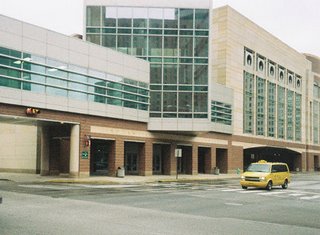
at the same time as TNNA.
Prior to this point, I had no exposure to "Irish" step dancing. I am putting "Irish" in quotation marks, because after viewing the participants, I am confident that no one in Ireland looks anything like these little Jon-Benets. The girls ranged in age from about six to sixteen. What was particularly eerie was the way they all conformed to some kind of dress code: lots of makeup, extremely shiny dresses with poufy skirts in gaudy combinations of red and green, cheesy tiaras, and hairstyles that involved the placement of blonde (always blonde) Shirley-Temple-like ringlets on the top of the skull, just above the forehead, so the ringlets cascade onto the face. UK residents, back me up: have you ever seen anyone in Ireland dressed like this?
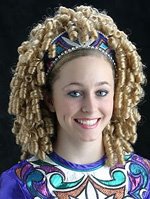
Photo from this purveyor of fine Irish step dancing wigs.
These girls were all over the hotel, the convention center and the adjoining mall. Some wore shower caps so as not to disturb their hairstyles. Some wore vinyl capes, the kind you wear at the beauty salon, so as not to mar their costumes. We were told that dresses for these events can cost as much as $1500 or more. We saw girls with customized zipper cases that provided extra room for the poufy skirts and zipped around them, suggesting that this is big business if custom-sized travel cases are being manufactured somewhere.
I don't mean to suggest that dance lessons, even some competitions, are a bad thing. I'm sure there are many girls who enjoy dance and who benefit greatly from the exercise, the grace, the discipline. What turned me off was a combination of the extremely bizarre, beauty-queen like stylizing of these girls, and what was obviously a pretty significant financial investment on the part of their parents -- the same kinds of things that bother me about pint-sized beauty pageants. I'm sure these talented girls would look just charming in their natural, youthful, unshellacked state doing these dances. But I digress. We were talking about the last day of TNNA.
By Sunday, my ass was dragging. The day broke bright and early -- well, rainy and early -- with an invitation-only fashion show sponsored by Westminster Fibers. You may recall that Westminster is the parent company of Rowan/RYC, Jaeger, Regia, Nashua Handknits, Schachenmayr, and Gedifra. We were given breakfast at a nearby hotel, then examined the most excellent goodie bags (much of which was in the swag photos from one of my previous posts). We then got to see a fashion show which showed, company by company, Westminster's designs for the fall.
Seeing this kind of fashion show -- which featured multiple garments from a single exhibitor (the TNNA fashion show limited entrants to 1 or 2 garments each) -- was much more instructive for me. I got a much clearer sense of what Westminster's vision of the fall was going to be, and since Rosie's stocks a lot of Westminster yarns, this is information which will be very helpful. (I'll do a separate post giving you some fall pictures and info about fall yarns.)
Then it was on to more exhibit-viewing, and some serious yarn-shopping. Desperation at the many things we hadn't covered but needed to energized us. We were reaching sensory overload, but still we pressed on. Random observations:
I, once again, was feeling that perhaps my mom was right and I had overextended myself a bit, so I excused myself for another quick lie-down.
Laura and I headed to the airport together (Lisa stayed on another night). We shared a cab with a lovely woman who -- despite her relative youth, and I mean no disrespect by that -- owned her own shop in Ontario. We compared notes on some things and then she dashed off to try to make her plane. Laura and I were left to watch the rainclouds approach. Our plane was overbooked and we considered for a brief moment taking the free ticket vouchers and staying over, but then we figured that would only require us to fly another time, so what kind of prize was that?
Our plane was some kind of balsa-wood child's toy called an Embrauer, with a mere three seats across, one on one side of the aisle, two on the other (gulp). Ironically, we were seated in the emergency exit aisle. The stewardess came to ask me if I was physically and mentally ready, willing and able to help evacuate the plane in the event of a euphemistically-described "emergency." She seemed somewhat taken aback at my "Hell, yeah!" while Laura delicately asked if this would require us to stay on board for any length of time after said emergency or if we could just hurl the door open and leap out (into the gaping maw of empty space).
Having notched back on the Atavan for fear of a DUI conviction, I found the ride home to be much more ... bumpy and anxiety-provoking. I was charmed, however, to see the skyline of my adopted city once we circled the airport. It was a great trip, but it was good to be home.
No, I haven't gone mad. It just so happened that an "Irish" step dancing competition was taking place in the Convention Center

at the same time as TNNA.
Prior to this point, I had no exposure to "Irish" step dancing. I am putting "Irish" in quotation marks, because after viewing the participants, I am confident that no one in Ireland looks anything like these little Jon-Benets. The girls ranged in age from about six to sixteen. What was particularly eerie was the way they all conformed to some kind of dress code: lots of makeup, extremely shiny dresses with poufy skirts in gaudy combinations of red and green, cheesy tiaras, and hairstyles that involved the placement of blonde (always blonde) Shirley-Temple-like ringlets on the top of the skull, just above the forehead, so the ringlets cascade onto the face. UK residents, back me up: have you ever seen anyone in Ireland dressed like this?

Photo from this purveyor of fine Irish step dancing wigs.
These girls were all over the hotel, the convention center and the adjoining mall. Some wore shower caps so as not to disturb their hairstyles. Some wore vinyl capes, the kind you wear at the beauty salon, so as not to mar their costumes. We were told that dresses for these events can cost as much as $1500 or more. We saw girls with customized zipper cases that provided extra room for the poufy skirts and zipped around them, suggesting that this is big business if custom-sized travel cases are being manufactured somewhere.
I don't mean to suggest that dance lessons, even some competitions, are a bad thing. I'm sure there are many girls who enjoy dance and who benefit greatly from the exercise, the grace, the discipline. What turned me off was a combination of the extremely bizarre, beauty-queen like stylizing of these girls, and what was obviously a pretty significant financial investment on the part of their parents -- the same kinds of things that bother me about pint-sized beauty pageants. I'm sure these talented girls would look just charming in their natural, youthful, unshellacked state doing these dances. But I digress. We were talking about the last day of TNNA.
By Sunday, my ass was dragging. The day broke bright and early -- well, rainy and early -- with an invitation-only fashion show sponsored by Westminster Fibers. You may recall that Westminster is the parent company of Rowan/RYC, Jaeger, Regia, Nashua Handknits, Schachenmayr, and Gedifra. We were given breakfast at a nearby hotel, then examined the most excellent goodie bags (much of which was in the swag photos from one of my previous posts). We then got to see a fashion show which showed, company by company, Westminster's designs for the fall.
Seeing this kind of fashion show -- which featured multiple garments from a single exhibitor (the TNNA fashion show limited entrants to 1 or 2 garments each) -- was much more instructive for me. I got a much clearer sense of what Westminster's vision of the fall was going to be, and since Rosie's stocks a lot of Westminster yarns, this is information which will be very helpful. (I'll do a separate post giving you some fall pictures and info about fall yarns.)
Then it was on to more exhibit-viewing, and some serious yarn-shopping. Desperation at the many things we hadn't covered but needed to energized us. We were reaching sensory overload, but still we pressed on. Random observations:
- The name "Hooker's Nook" might not be my first choice for a shop, even if I specialized in crochet.
- Regia is pronounced, let me put the issue to rest once and for all, "Ray-Gee-A" with a hard "G" as in "gallop."
- Kristin Nicholas, who designs for Nashua Handknits, has an interesting blog which you might want to check out.
- Lucy Neatby was carrying the most hilarious bag that looked like a chicken. She named it (Ernest maybe? but I could be wrong).
- I saw a grown woman dressed like a watermelon. Yep, a watermelon-themed sweater, fuschia with black seeds on it, ribbing in a stripe of white then green. (She was not in the Rowan fashion show, needless to say.)
- Overheard: "She was looking for 100 blue-and-white kazoos for a wedding reception."
- Did I tell you how much I loved meeting Véronik Avery? So much so that I spelled her name wrong in my last post. (sheesh)
I, once again, was feeling that perhaps my mom was right and I had overextended myself a bit, so I excused myself for another quick lie-down.
Laura and I headed to the airport together (Lisa stayed on another night). We shared a cab with a lovely woman who -- despite her relative youth, and I mean no disrespect by that -- owned her own shop in Ontario. We compared notes on some things and then she dashed off to try to make her plane. Laura and I were left to watch the rainclouds approach. Our plane was overbooked and we considered for a brief moment taking the free ticket vouchers and staying over, but then we figured that would only require us to fly another time, so what kind of prize was that?
Our plane was some kind of balsa-wood child's toy called an Embrauer, with a mere three seats across, one on one side of the aisle, two on the other (gulp). Ironically, we were seated in the emergency exit aisle. The stewardess came to ask me if I was physically and mentally ready, willing and able to help evacuate the plane in the event of a euphemistically-described "emergency." She seemed somewhat taken aback at my "Hell, yeah!" while Laura delicately asked if this would require us to stay on board for any length of time after said emergency or if we could just hurl the door open and leap out (into the gaping maw of empty space).
Having notched back on the Atavan for fear of a DUI conviction, I found the ride home to be much more ... bumpy and anxiety-provoking. I was charmed, however, to see the skyline of my adopted city once we circled the airport. It was a great trip, but it was good to be home.
Thursday, June 22, 2006
I came, I kvelled, I conquered: Saturday
Imagine a very large convention center. Imagine it filled with booths of yarn, every kind of yarn that is made and sold by every big yarn distributor -- and many small ones -- in America. Imagine artful displays of colors, baskets of new yarns to be released this fall, sample garments, sneak peeks of patterns and books, more gadgets than you ever could think of use for. Imagine walking all day and still not seeing all the booths. Imagine not being able to buy any of the tempting yarns you're seeing but having to wait until fall to get your hands on them. Now you're starting to get a feel for what TNNA was like.
TNNA is not only yarn, knitting and crochet. It also includes other kinds of fiber art, and needlepoint and stitchery supplies were everywhere. (Hoo-boy, one look at the canvases depicting sad-eyed Southwestern children and three-dimensional Thanksgiving tableaux and samplers reading "I don't have hot flashes, I have power surges" [I didn't make that slogan up, either] and you quickly realize there's a whole 'nother world of fiber out there.) Even accounting for the fact that many of the booths were exhibiting supplies we don't need to stock, there was still an unbelievable array of items to peruse and fondle.
For this reason, it's hard to generalize about what's coming down the pike: it really depends on what you end up ordering. There did seem to be particular interest in luxury fibers, like cashmere and alpaca and silk, especially in blends; and handdyed yarns were also well-represented; other than that, I suspect that what you see in the fall will vary tremendously depending where you look. The sense I got for fall colors? Muted, rich and tweedy tones. Plums, woodland greens, bronze and brown shades, some tweed and heathers, some rich reds, a little bit of silvery pastels. Ruffles, empire waists, bell sleeves, that whole dandy-fop kind of thing seemed popular, along with styling touches reminiscent (God help us) of the 80s (big collars, modified cowls). Thankfully both the poncho/ponchette/capelet/shrug trend and the excessive use of novelty yarn trends appear to have bitten the dust.
Another bonus for the knit-geek like me was the ubiquitous presence of what I think of as the "kniterati." Famous designers, magazine editors, authors were everywhere. Trisha Malcolm, Adina Kline, Pam Allen, Melanie Falick, Rick Mondragon were some of the publishing folks I saw. Designers? Holy moly. I had real conversations with Debbie Bliss, Louisa Harding, Jo Sharp, Veronique Avery, Kristin Nicholas, Shannon Okey, Amy Singer and chatted with Norah Gaughan, Nicki Epstein, Linda Pratt, Edie Eckman, and probably more whom I'm forgetting. I fear that my gushing was excessive at times.
I gained new appreciation for how difficult it can be to stock one's yarn shop. When faced with the staggering array of temptations that TNNA offers, it's hard to stay focused on your particular shop and its needs. I daresay every shop owner has some sort of budget and figuring out how to avoid blowing it on a cool new, but not very sellable, yarn is really tough. Especially since the yarn-sellers are trying really hard to get you to place orders on the spot. Yarns I personally might find attractive may not be big sellers with a large cross-section of knitters; my willingness to work with, say, an organic yarn with real vegetable matter in it may be atypical, or my love of cool colors may not mesh with the customer base who loves warm tones. And there's always the practical issues. If you have fifteen yarns that knit at 5 stitches to the inch, do you really need the sixteenth? Maybe you really need to find a yarn that's aran weight and superwash, but you have to make sure the palette of colors offered is right (no good guy colors? no good gal colors? no good baby colors? no neutrals?). Maybe you just love that alpaca but your shop is located in Florida where really warm fibers like alpaca just don't do too well. And so on. The next time you're tempted to tell your LYS owner "You really should stock XYZ yarn," think about it a little bit. The decision how to parcel up a knitting shop's yarn-buying budget is not that different from your own personal decision what to spend your yarn budget on -- so many choices! so heartbreakingly impossible to bring them all home! so hard to know what yarns will perform well simply by looking at them in the ball! -- only the LYS owner has to please as many customers as possible, instead of only herself. Ouch.
This made for some serious yarn-shop business to attend to. In addition to fondling yarns and looking for new discoveries, and networking, and scaring all the nice designers, we had a list of things we needed to accomplish. There were certain yarns we wanted to see in person (in skein?), to feel them and see samples knit of them; there were certain palettes we wanted to see dyed up in whole skeins of yarns, instead of in one-inch cuttings on a color card; there were a few items we needed to find, comparison shopping and all. I had a few vendors that I wanted Lisa to see; she had more that she wanted Laura and I to see; and so on. And I keenly felt the pressure of trying to do right by Lisa: being supportive and helpful and worth taking along. I think we did okay, overall. We seemed to hit most of the items on our to-do list, and stumbled over a few pleasant surprises. And, although it is a bit of a cliche, we did have a great time doing it.
The icing on my Tastykake* was my encounter with a well-known designer, one whose designs I've always loved, who came up to me (!) and said that she reads this very blog. She proved it, too, by conversing knowledgeably about various details of my life. We had a wonderful conversation, and I walked away, certain that this was my warped version of Paradise and that seventy (or is it forty?) scantily clad men who were most definitely not virgins were about to escort me through the Pearly Gates and feed me Godiva hazlenut chocolates while I rolled around naked in a bed of Koigu.
*Note for non-Philadelphians: Tastykakes are locally-made cupcakes and snackcakes that are individually packaged. Kind of like Little Debbies, only good.
Wednesday, June 21, 2006
I came, I kvelled, I conquered: Friday
Okay, here's the full scoop on my TNNA experience. Or at least the first part of it.
I began my journey at an ungodly hour on Friday morning. Hastened out the door by a mopey, self-pitying kid -- his mother had the temerity to leave town for a whole weekend! -- I arrived at the airport early. I hadn't been to the Philly airport in years and was pleasantly surprised by all the changes that have taken place. Not the least of which is increased security. I was a bit chagrined to realize that security was so improved that I couldn't even get a lousy cup of coffee without my boarding pass, which Lisa was bringing with her.
My traveling companions, Lisa (owner of Rosie's) and Laura (fellow staff member; her wonderful alligator mittens pattern appears in the first Stitch N Bitch book), arrived and we proceeded to our gate. Lisa, who has a much more professional and tailored style of dressing than me, busted on me a little for traveling in my mom clothes, but my fresh-out-of-the-minivan look certainly got me through security quickly. I was the most pleasant person passing through the metal detector. I would gladly have stripped nekkid if I thought it would increase my personal security on the airplane. (Thankfully for my fellow passengers, this was not part of the new Homeland Security protocol.)
The plane ride to Indiana was really not so bad. Don't get me wrong; I don't want to fly anywhere again any time soon, but mellowed by an Atavan and buoyed by excitement at getting out of Dodge, the ride went pretty fast and was quite pleasant. Laura and I were momentarily concerned when we noticed that the pilot appeared to be about twelve years old; however, we caucused and quickly came to grips with the situation. Laura noted that pre-teens tend to be athletic and spry, and isn't that a good quality in a pilot? I offered up my personal observation that no one can handle complex electronic equipment -- cell phones, DVD players -- like my eight-year-old, so the pilot's youth would serve him well with the controls. Thus comforted, we returned to our game of "Spot the Air Marshal."
Our hotel was perfectly nice and roomy. All of the rooms overlooked a center atrium
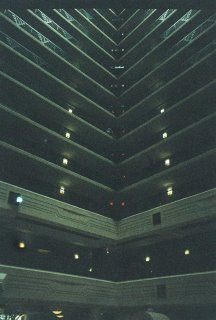
and although we saw this peculiarly-worded sign alerting us to construction,

we didn't hear any jackhammers. After a quickie lunch, I collapsed into the king-sized bed and snoozed while Lisa and Laura scoped out Mass Ave Knitting, a local yarn shop. They returned with high marks for the shop, which apparently had an unbelievably large selection of yarns.
One of the first fellow TNNA-ers I met just happened to be from a very small town -- we're talking pretty obscure -- just a stone's throw from where I grew up. (For the terminally curious. she's from Noxen, PA and I triumphed over, er, grew up in Wilkes-Barre.)
Friday night was the big TNNA Fashion Show. Or maybe I should say "Fashion" Show, as many of the items shown were neither fashionable nor garments, as far as I could tell. The Fashion Show consists of submissions from TNNA members, mainly from large yarn companies but also from some smaller producers and pattern designers. The entrants, and there were many of them, ran the gamut of handknitting. I saw novelty yarn extravaganzas, a set of traditional Norwegian ski sweaters, a gorgeous Koigu coat, a ball gown knitted in Kid Silk Haze, felted bags, sweaters galore, and even a skirt or two. It's really impossible to generalize about them, since they seemed to sample all sorts of styles and genres and certainly would appeal to vastly different knitting populations. On the one hand, you see a striking black and white car coat from Vogue; then you see a monstrosity that has pompoms clustered on the top of the sleeves and shoulders like ... well, I don't know what it was like, but it wasn't a very attractive look. There weren't many of them I could imagine making (I don't get invited to many balls, such that I need to knit full-length gowns that often) but it was interesting to see what's out there, and what some of the new yarns look like in a garment. Favorite quotes from the fashion show:
* "It will flatter all figure types" (hah! said variously about a tent-like garment with no shaping and the aforementioned Vogue car coat, which was styled with diamonds on the chest which would become parallellograms if anyone with a chest bigger than size 34 should wear it)
* "This turquoise and tangerine cocoon jacket...." [No good comes of a sentence that begins that way]
* "... can be worn as a scarf, a vest, a wrap or a toga..." [Airplane! anyone? I can make a hat, or a broach...)
We had dinner and returned to the hotel, plotting our strategy for the next day. I managed to knit some of this:
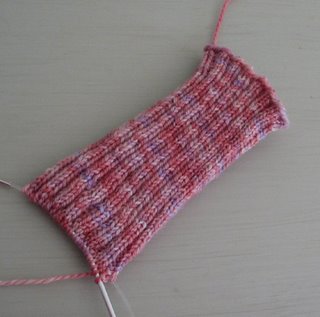
which is BBF's Grandma's Roses, the portion of the skein which got nasty and knotty and tangled when I tried to wind it, so I kept the shredded remnants for myself.
Although it had been a relatively light day TNNA-wise, I was already feeling the excitement of being in the company of numerous other knit-geeks who love yarn and knitting as much as I do.
I began my journey at an ungodly hour on Friday morning. Hastened out the door by a mopey, self-pitying kid -- his mother had the temerity to leave town for a whole weekend! -- I arrived at the airport early. I hadn't been to the Philly airport in years and was pleasantly surprised by all the changes that have taken place. Not the least of which is increased security. I was a bit chagrined to realize that security was so improved that I couldn't even get a lousy cup of coffee without my boarding pass, which Lisa was bringing with her.
My traveling companions, Lisa (owner of Rosie's) and Laura (fellow staff member; her wonderful alligator mittens pattern appears in the first Stitch N Bitch book), arrived and we proceeded to our gate. Lisa, who has a much more professional and tailored style of dressing than me, busted on me a little for traveling in my mom clothes, but my fresh-out-of-the-minivan look certainly got me through security quickly. I was the most pleasant person passing through the metal detector. I would gladly have stripped nekkid if I thought it would increase my personal security on the airplane. (Thankfully for my fellow passengers, this was not part of the new Homeland Security protocol.)
The plane ride to Indiana was really not so bad. Don't get me wrong; I don't want to fly anywhere again any time soon, but mellowed by an Atavan and buoyed by excitement at getting out of Dodge, the ride went pretty fast and was quite pleasant. Laura and I were momentarily concerned when we noticed that the pilot appeared to be about twelve years old; however, we caucused and quickly came to grips with the situation. Laura noted that pre-teens tend to be athletic and spry, and isn't that a good quality in a pilot? I offered up my personal observation that no one can handle complex electronic equipment -- cell phones, DVD players -- like my eight-year-old, so the pilot's youth would serve him well with the controls. Thus comforted, we returned to our game of "Spot the Air Marshal."
Our hotel was perfectly nice and roomy. All of the rooms overlooked a center atrium

and although we saw this peculiarly-worded sign alerting us to construction,

we didn't hear any jackhammers. After a quickie lunch, I collapsed into the king-sized bed and snoozed while Lisa and Laura scoped out Mass Ave Knitting, a local yarn shop. They returned with high marks for the shop, which apparently had an unbelievably large selection of yarns.
One of the first fellow TNNA-ers I met just happened to be from a very small town -- we're talking pretty obscure -- just a stone's throw from where I grew up. (For the terminally curious. she's from Noxen, PA and I triumphed over, er, grew up in Wilkes-Barre.)
Friday night was the big TNNA Fashion Show. Or maybe I should say "Fashion" Show, as many of the items shown were neither fashionable nor garments, as far as I could tell. The Fashion Show consists of submissions from TNNA members, mainly from large yarn companies but also from some smaller producers and pattern designers. The entrants, and there were many of them, ran the gamut of handknitting. I saw novelty yarn extravaganzas, a set of traditional Norwegian ski sweaters, a gorgeous Koigu coat, a ball gown knitted in Kid Silk Haze, felted bags, sweaters galore, and even a skirt or two. It's really impossible to generalize about them, since they seemed to sample all sorts of styles and genres and certainly would appeal to vastly different knitting populations. On the one hand, you see a striking black and white car coat from Vogue; then you see a monstrosity that has pompoms clustered on the top of the sleeves and shoulders like ... well, I don't know what it was like, but it wasn't a very attractive look. There weren't many of them I could imagine making (I don't get invited to many balls, such that I need to knit full-length gowns that often) but it was interesting to see what's out there, and what some of the new yarns look like in a garment. Favorite quotes from the fashion show:
* "It will flatter all figure types" (hah! said variously about a tent-like garment with no shaping and the aforementioned Vogue car coat, which was styled with diamonds on the chest which would become parallellograms if anyone with a chest bigger than size 34 should wear it)
* "This turquoise and tangerine cocoon jacket...." [No good comes of a sentence that begins that way]
* "... can be worn as a scarf, a vest, a wrap or a toga..." [Airplane! anyone? I can make a hat, or a broach...)
We had dinner and returned to the hotel, plotting our strategy for the next day. I managed to knit some of this:

which is BBF's Grandma's Roses, the portion of the skein which got nasty and knotty and tangled when I tried to wind it, so I kept the shredded remnants for myself.
Although it had been a relatively light day TNNA-wise, I was already feeling the excitement of being in the company of numerous other knit-geeks who love yarn and knitting as much as I do.
Tuesday, June 20, 2006
The Regressive Concept for a Book Award
goes to this charmer:

an ad for which I picked up at TNNA. Here's the publicity blurb:
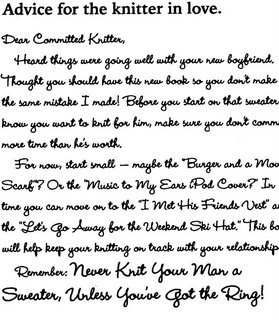
Like the patriarchy hasn't done enough?! They have to find a way to make our knitting all about them? To insert angst into a craft that ought to make knitters proud, not insecure? KnitGrrls of the world, unite! Knit whatever you want for whomever you want. And buy yourself your own damn ring if you want one that bad.

an ad for which I picked up at TNNA. Here's the publicity blurb:

Like the patriarchy hasn't done enough?! They have to find a way to make our knitting all about them? To insert angst into a craft that ought to make knitters proud, not insecure? KnitGrrls of the world, unite! Knit whatever you want for whomever you want. And buy yourself your own damn ring if you want one that bad.
Saturday, June 17, 2006
Swag
Brief entry today, but I had to thank my Dye-O-Rama swap buddy (sounds a bit more kinky than it is) for this, which arrived yesterday:
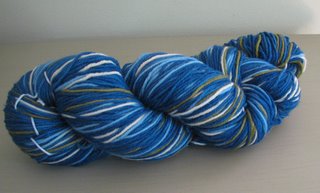
It's self-striping: how cool is that? After an unfortunate experience with a very long skein, some chair legs and an overactive toddler, I have not played around with self-striping, so this will be a real treat for me. Amy blogs here so I will be sure to add that one to my Bloglines. (She's working on a gorgeous Mermaid sweater, by the way.) If you're interested in dyeing, you should browse through Amy's archives; she's done some excellent posts about the process of planning out her yarn, including experiments with miniskeins, getting a board to wind the yarn around, and so on. A zillion thank-yous to Amy.
And while we're on the subject of swag, allow me to show you a few photos. (Perhaps the reason why I'm so exhausted and feverish this week is because I had to carry about twenty extra pounds of swag home with me from TNNA. Not that I'm complaining, mind you.)
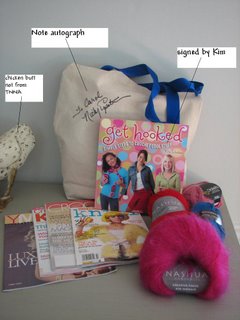
and this:
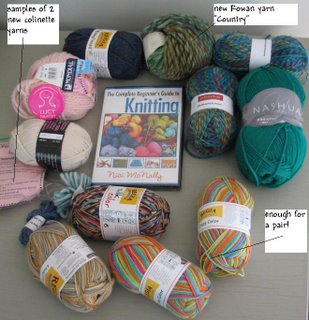
Would it be in poor taste to also show you these?
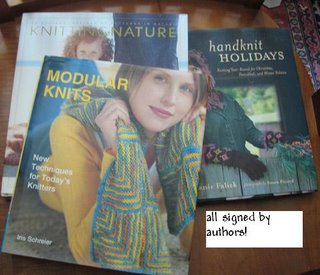
Please note, however, that Melissa Leapman's new book is NOT there, perhaps because even though we waited in line for quite some time (and did I mention I have Lyme Disease?), she ran out of books right before us. And -- get this -- her publicist refused to take my home address so she could mail a copy to me later. Hmph.
Melanie Falick, one of my longtime knitting idols, did not run out of books, however. She was signing copies of Handknit Holidays, and when it was my turn she peered at my nametag and said, "Your name sounds so familiar. Why?" Without thinking, I replied "Probably because you personally rejected an item I designed for this very book!" She tried to recover, saying, "Was my rejection letter nice? People say I write nice rejection letters." [Nice try, Mel. Isn't "nice rejection letter" a wee bit oxymoronic? "My fiancee sent me a 'Dear John' letter, but I really didn't mind that she shat on my heart and broke our engagement because it was so nice!"]
Why am I starting to feel like the Kathy Griffin of TNNA?
Oh Geez, did I leave you hanging all week:
Answer to Monday's Reader Challenge:
Friday night: black-and-white tweed jacket, pastel sweater, black shoes of undeterminate ilk, dark pants, watch with something on face
Saturday: Kureyon vest, brown collared shirt, beige clogs, white jeans, yellow/turquoise handbag
Sunday: grey clogs, black pants with applique, white collared shirt, yellow/turquoise handbag
Off to take a huge nap before Tom gets back with the kids.

It's self-striping: how cool is that? After an unfortunate experience with a very long skein, some chair legs and an overactive toddler, I have not played around with self-striping, so this will be a real treat for me. Amy blogs here so I will be sure to add that one to my Bloglines. (She's working on a gorgeous Mermaid sweater, by the way.) If you're interested in dyeing, you should browse through Amy's archives; she's done some excellent posts about the process of planning out her yarn, including experiments with miniskeins, getting a board to wind the yarn around, and so on. A zillion thank-yous to Amy.
And while we're on the subject of swag, allow me to show you a few photos. (Perhaps the reason why I'm so exhausted and feverish this week is because I had to carry about twenty extra pounds of swag home with me from TNNA. Not that I'm complaining, mind you.)

and this:

Would it be in poor taste to also show you these?

Please note, however, that Melissa Leapman's new book is NOT there, perhaps because even though we waited in line for quite some time (and did I mention I have Lyme Disease?), she ran out of books right before us. And -- get this -- her publicist refused to take my home address so she could mail a copy to me later. Hmph.
Melanie Falick, one of my longtime knitting idols, did not run out of books, however. She was signing copies of Handknit Holidays, and when it was my turn she peered at my nametag and said, "Your name sounds so familiar. Why?" Without thinking, I replied "Probably because you personally rejected an item I designed for this very book!" She tried to recover, saying, "Was my rejection letter nice? People say I write nice rejection letters." [Nice try, Mel. Isn't "nice rejection letter" a wee bit oxymoronic? "My fiancee sent me a 'Dear John' letter, but I really didn't mind that she shat on my heart and broke our engagement because it was so nice!"]
Why am I starting to feel like the Kathy Griffin of TNNA?
Oh Geez, did I leave you hanging all week:
Answer to Monday's Reader Challenge:
Friday night: black-and-white tweed jacket, pastel sweater, black shoes of undeterminate ilk, dark pants, watch with something on face
Saturday: Kureyon vest, brown collared shirt, beige clogs, white jeans, yellow/turquoise handbag
Sunday: grey clogs, black pants with applique, white collared shirt, yellow/turquoise handbag
Off to take a huge nap before Tom gets back with the kids.
Wednesday, June 14, 2006
Feast your eyes

This is some of the stuff I'm in the process of listing on Etsy. I must confess to feeling, well, pretty much like crap. So look at the pretty yarn and I'll post again as soon as I can.
Tuesday, June 13, 2006
Bliss-ful
One of my long-time knitting icons has been Debbie Bliss. The very first knitting book I purchased when I returned to the craft years ago was one of her very first books, New Baby Knits. I remember paging through the book longingly, wondering if I'd ever be good enough to make the garments inside (and wondering if I'd someday have kids to wear them). I was struck by the classic lines and charm of her designs; they weren't the overwrought, excessively twee sweaters I'd had as my stereotype of handknit baby sweaters. As time has gone on, I've remained a Debbie Bliss fan. I love her sensibility, her palette, her clean lines, and, of course, her yarn line. Am I gushing?
Well, if I'm gushing to you guys, imagine how I gushed when I got to meet Debbie Bliss herself. She was unbelievably down-to-earth, charming and warm. I started subtly, by saying "I love you!" to her and she responded immediately by saying "And I know I could grow to love you, too!" Huge points for the quick rejoinder. We had a lovely chat and although I fear I may have kvelled a bit too much, I did remember to get in a plug for schematics and clear photographs of the designs in all future books. (Heh.) Best of all, I left with this:

It says, "Lovely to meet you, Carol. Without you, I am nothing. Best wishes, Debbie Bliss."
It was at that moment that I began to suspect that my plane had gone down and I was in heaven.
Coming soon: Another incident with a top designer (whose initials are V.A.) leaves me certain that I am in paradise; answers to yesterday's readers' challenge...
Monday, June 12, 2006
Reader Challenge
Okay, I'm back, and while I catch my breath and try to sort out the sensory overload I experienced in Indianapolis, I will leave you with this Reader Challenge, based on my own personal observations, as I recall them:
The following list of items were worn by Rick Mondragon this weekend at TNNA. Can you figure out what his three outfits looked like? Hint: one item was worn two days. Tomorrow I shall describe the actual outfits and you can compare your predictions with the reality. Extra points if you can guess which outfit was which day (Friday evening, Saturday and Sunday).
Have at it, dear ones! I missed you.
The following list of items were worn by Rick Mondragon this weekend at TNNA. Can you figure out what his three outfits looked like? Hint: one item was worn two days. Tomorrow I shall describe the actual outfits and you can compare your predictions with the reality. Extra points if you can guess which outfit was which day (Friday evening, Saturday and Sunday).
- 1 pr. tooled leather clogs with pointy toes, gray (imagine cowboy boots without the back or high leg)
- 1 pr. tooled leather clogs with pointy toes, beige (ditto)
- 1 pr black pointy-toed shoes of indeterminate style (what can I say? I was tired. I have Lyme disease, you know.)
- white or cream-colored jeans
- pastel sweater top (I think pink but I might be wrong on that; see Lyme disease comment above)
- turquoise and raincoat-yellow square shoulder bag (some might say "purse," but not I, since Go Knit In Your Hat is wont to take the high road at all times. Besides, who says men can't carry purses?)
- white collared shirt
- black-and-white tweed jacket (if I were cruel, I'd add that it was ill-fitting. Good thing I'm not.)
- black jeans with Asian-influenced dragon or snake style motif appliqued down one leg
- brown collared shirt
- Kureyon vest made with vertical stripes made using different balls intarsia-style
- 1 pr dark slacks
- watch with some kind of drawing or figure on the face (couldn't get close enough to see without violating the restraining order)
Have at it, dear ones! I missed you.
Wednesday, June 07, 2006
Pre-TNNA Update
Let's look at my list of things to do before leaving for TNNA on Friday:
Pack novelty yarn poncho and froufrou scarf - check
Wash track suit with appliqued top and matching pants - check
Find bathing costume from the 20s that covers as much of me as possible for use in hotel jacuzzi - check
Trip to bank to secure $50 in singles for stuffing in Rick Mondragon's G-string at wildass Knit-N-Strip bash to follow convention fashion show - check
Pharmacy run for Advil and Chaser to remedy hangover that is sure to follow even one minute sip of alcohol-based drink - check
Watch "Fargo" to practice midwestern accent - check
Ponder why only clothes shopping choices are too young (e.g. muffin top/coin slot slut capris with skimpy camisole top) or too old (dowdy seersucker skirt with prim lace blouse) - check
Beg, borrow or steal antianxiety medication to supplement Atavan for plane flights - check
Pack pair of Depends in case I wet myself during patch of turbulence - check
Post on Knitlist to ask whether there are any good yarn shops in Indianapolis - check
Post on Knitlist to ask if you're allowed to bring knitting needles on airplane* - check
I guess I'm ready to go then. I will give you a full report on my return. By the way, just so you know, I am terrified of flying. Have been for years. Really rather anxious about that. Please don't put in the comments that statistically, flying is safer than driving. Tell that to Mohammed Atta.
*For my sweet, earnest readers (all two of you), I do know the current FAA policy for knitting needles. It's a joke, dears.
Restocking
In the meantime, please note that I have started restocking Black Bunny and there's a new crop of laceweights up. Apparently the new Interweave Knits has a pattern for an Icarus something or other that people are using 100g of laceweight for; I've got several 100g skeins listed and a couple more on the way. Meanwhile, I'm shipping lucky Courtney of Flagstaff, Arizona her free skein of sock yarn today. I really hope you like it, Courtney! I managed to do a few more batches of superwash sock yarn today, which should be up early next week. Don't give up on me: more yarn's a comin'.
Why I love my mailman even more than usual
He brought me two wonderful packages. Some mohair/wool to spin from Mindy's goat Morpheous (who's adorable) and a lovely skein of Fleece Artist sock yarn (which is one of the few kinds of sock yarn I did not have in my copious stash but have been coveting for a while) from Lars, who blogs here. I met Lars in New York a few weekends ago and as soon as I finish my blog post about the NY trip, you'll hear more about him. (He's a love.) And Mindy's my number-one Black Bunny supporter... when I get myself together I'll post some photos of her handspun made with Black Bunny roving. It's gorgeous and I'm highly envious of her spinning abilities. (Not to mention her goat.)
A big Philly "Yo!" to
reader Diane, who introduced herself to me at Rosie's last Saturday. We had a great chat and I enjoyed meeting you! Thanks for delurking. And Diane is your living proof that if you introduce yourself to me and say you read my blog, you'll make my day AND you'll find out that I'm really very, very nice in person.
Monday, June 05, 2006
No good deed goes unpunished
You have heard me before wax rhapsodic about the beauty of the Internet. Where else would you find such a treasure trove of free information on such a range of topics? And knitters, in particular, seem to be both plugged in to the 'net, and willing to share their hard-earned information with others. You can find all sorts of instructional sites, tips and tricks, and of course, a bonanza of free patterns.
Ah! The free patterns.
If you've been following any of my blog posts on copyright, you may recall reading that someone who creates a pattern owns the copyright on it, even if it's posted on the internet. You write it, you own it. A pattern may appear on Knitty or Magknits or Knancy Knitter's blog, just a few clicks away from your search engine, and you may print it out for free, and make your own version of the garment for free, but that doesn't mean that the creator of the pattern has given away her copyright rights or her copyright protection. And more to the point, it doesn't mean YOU can freely distribute or sell that pattern, in any form, without the permission of the copyright holder, i.e., the designer. It may be free for the taking (for your own personal knitting use), but it ain't free for the reselling.
Jenna, of the excellent Girl from Auntie website (it's more than just a blog), learned of a seller on Ebay who is selling -- for a pretty nominal sum -- "ebooks." Ebooks is a fancy name for PDF files. I've got nothing against PDF files; in fact, I think they are the wave of the future where knitting patterns are concerned. But I've got a lot against someone who sells ebooks full of stolen knitting patterns.
Yes, that's right, I used the word "stolen." Dictionary.com defines "steal" as "to take (the property of another) without right or permission." That's exactly what happened to Jenna, and many other knitting and crochet designers. Patterns which they designed and posted on the internet were downloaded and turned into PDF files, with the copyright notices conveniently deleted, and in some cases, alterations made (a Crystal Palace pattern was changed to require a generic type of yarn rather than their specific yarn). The patterns are being bundled and sold as ebooks, so that the designers -- who did not authorize or license their patterns to be used in this way -- aren't receiving any of the money made from the sale of these ebooks. That is theft of intellectual property.
You can read on Jenna's website the correspondence between her and the ebay seller. He claimed to have some kind of "resell rights," meaning, I think, that he bought the ebook content from others and since he bought it, he owns it. What a load of crap. You can't sell something you don't own. Consider this: If I walk over to your house, stand in front of it and pretend it's mine, and then accept $100,000 from the next passer-by for your house, can the passer-by claim that he owns your house now? He paid money for it, didn't he?
Of course not. And this ebay seller shouldn't hide behind his stupidity or his (alleged) ignorance of copyright law or probably more to the point, his intentional disregard of copyright law.
The knitting community benefits tremendously from the wealth of free patterns and other information that knitters load onto the web, most often for free, out of the goodness of their hearts. Let's not abuse their kindness by failing to respect copyright law.
Friday, June 02, 2006
Update
Thank you all for your kind words and wishes. I'm doing fine, mostly grappling with fatigue, so everything in our house is going quite a bit slower than usual. Including the laundry and the dishes. And, unfortunately, the dyeing. I'm also scheduled to go to TNNA, the big trade show for yarn shops and other needlearts professionals, next weekend, so I've got to rest up to be ready. (My mom asked me if maybe I oughtn't stay home from TNNA; my response was that I'll get more rest going away than I would staying at home.) I expect to give you a full report and lots of dish when I get back.
In the meantime, feast your eyes on a great photo of Nick, acting as spokesmodel for a quickie pattern that just went up in this month's MagKnits. Knit in Black Bunny worsted weight yarn, natch.
Have a great weekend, everyone, and if you're waiting for an answer to an email, or a skein of yarn, please be patient with me...
Wednesday, May 31, 2006
Prognosis: Positive
Today I learned that I have Lyme Disease. Don't worry; this blog isn't going to turn into Pityparty.blogspot.com nor am I going to publish pictures of my bull's-eye rash. [Especially since it covers part of my left breast.] I was bitten by a tick about three weeks ago, but didn't recognize it as such: I thought I was brushing off a fuzzy or piece of dirt. It wasn't until I developed a rash that kept expanding, and didn't respond to ordinary measures like hydrocortisone cream that I made the connection. So I may be taking it a little easy the next few weeks. I've got thirty days of antibiotics and I hope that will take care of this. If I post a little less often, well, I hope y'all will get over it.
In other news... yesterday was the local Memorial Day parade. You may have figured out by now that I have a streak of corny a mile long inside me, and I love these old-fashioned holiday parades. My oldest marched with the Little League,

in between a bus full of [insert current politically correct word for retarded here] Boy Scouts and the local historical society. Check out the covered wagon; pretty cool, eh?

And don't forget the handy-dandy Minuteman, while you're at it.

Of course, after half an hour of standing in the sun waiting to march, my kid's patience was at a low ebb and we bailed a little ways into it, as soon as we saw Tom and the twins and Grandpop at the side of the road.

We sat with them and watched the giant watering can floats (on display, for some inexplicable reason, at a local arboretum)

and admired cute tailless doggies

and the antique cars driven by equally antique veterans. (I bonded with a guy who flew B-17s, proudly telling him my great-uncle flew in one, too.) We snickered meanly at the guy who marched in the parade with a pink CareBears backpack:

I even got to marvel at the attire of some fourteen-year-olds, whose asses were covered, barely, by no more than six inches of fabric in their Daisy Duke shorts. What were their mothers thinking?
Sunday, May 28, 2006
Meet Great-Uncle Francis
This is my great-uncle who, like 68.45 percent of the men in my family, is named Francis.

I've never met him, at least not since I was old enough to remember, and although he is the brother of my paternal grandfather (and boy, does he look like my grandfather), my dad hasn't spoken to him in years. I learned about Francis when I started researching my family's genealogy. Nothing like doing a Google search and coming up with a long-lost relative, particularly with an unusual ethnic name like mine, where you don't get a lot of hits.
My great-uncle Francis grew up in northeastern Pennsylvania, son of a coal miner, and ended up in the Army during World War II, like so many men of his generation. A member of the 303rd Bomb Group, he flew missions as part of the crew of a B-17 bomber. My father, who was a child at the time, vividly remembers that the plane's insignia had Bug Bunny on it (which is kind of odd, since I've always loved Bugs Bunny). My dad was right:

This is a photo of the nose art from the plane Francis flew on.
On January 23, 1943, Francis' plane took off on a mission, flying -- along with twenty other B-17s -- from England to an area over France. Their targets were a port at Lorien and the U-boat pens near Brest. Before they could complete the mission, forty-odd enemy fighters appeared and opened fire. At the same time, more American planes, from a different bomb group, appeared over my great-uncle's squad, aiming for the same set of targets at Lorien and Brest. In the confusion and fire, five aircraft went down. My great-uncle's plane, named "Susfu," was one of them.
Two of the Susfu's crew were killed when the plane went down; two evaded capture by the occupying Germans; and the remainder, including my great-uncle, were able to avoid capture temporarily. Family lore says that Francis was sheltered by a local French family, but later someone informed on them. The head of the family was shot and my great-uncle was captured. Francis ended up in a Nazi stalag as a prisoner-of-war until the war ended, two years later.
I know very little about what kind of person my great-uncle is, but I know what it's like to be twenty years old and I can't imagine -- at that age or any age -- stepping up to the plate in a situation like WWII: adjusting to military life, learning how to serve as crew on a bomber jet, going abroad to fly missions over enemy country, the terror and adrenaline that he must have felt when his plane took enemy fire, what thoughts went through his head when he parachuted out over a France occupied by Nazis. I can't imagine surviving on the run, or the guilt he must have felt when the man who sheltered him was shot. I can't imagine being held prisoner in a stalag (although I suspect it wasn't anything like Hogan's Heroes) and then the disbelief and joy of liberation.
Tomorrow is Memorial Day, the day in which we are supposed to remember those men and women who have served our country throughout the years. So even though I've never my great-uncle Francis, and even though my father describes him as a crazy old bastard (his words), I respect Francis for helping to protect our country as he did and I thank him for all the sacrifices he made while doing it.
If you don't have a family member or friend serving in the military, but would like to reach out to a serviceperson stationed abroad, I urge you to visit AnySoldier.com. It's a grass-roots organization that provides contact information for Americans in all branches of the military so that ordinary citizens like you and I can send care packages. The website is cleverly set up to allow the soldiers to make specific requests and to post updates and photographs. You can search the profiles by keyword; I like to send packages to soldiers that share my kids' first names, or who are from the Philadelphia area. The most touching part is the number of soldiers who ask for things not for themselves, or even for those in their platoon or company, but for the impoverished citizens of the countries (particularly Iraq and Afghanistan) in which they are stationed. Please don't think you have to be a gung-ho military person or that you must agree with our government's decision to invade Iraq to participate; God knows I don't but when I look at these photos I am struck by how young these kids are, and how hellish their service must be.
Happy Memorial Day to you all.

Especially you, Francis.
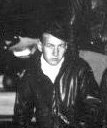
I've never met him, at least not since I was old enough to remember, and although he is the brother of my paternal grandfather (and boy, does he look like my grandfather), my dad hasn't spoken to him in years. I learned about Francis when I started researching my family's genealogy. Nothing like doing a Google search and coming up with a long-lost relative, particularly with an unusual ethnic name like mine, where you don't get a lot of hits.
My great-uncle Francis grew up in northeastern Pennsylvania, son of a coal miner, and ended up in the Army during World War II, like so many men of his generation. A member of the 303rd Bomb Group, he flew missions as part of the crew of a B-17 bomber. My father, who was a child at the time, vividly remembers that the plane's insignia had Bug Bunny on it (which is kind of odd, since I've always loved Bugs Bunny). My dad was right:

This is a photo of the nose art from the plane Francis flew on.
On January 23, 1943, Francis' plane took off on a mission, flying -- along with twenty other B-17s -- from England to an area over France. Their targets were a port at Lorien and the U-boat pens near Brest. Before they could complete the mission, forty-odd enemy fighters appeared and opened fire. At the same time, more American planes, from a different bomb group, appeared over my great-uncle's squad, aiming for the same set of targets at Lorien and Brest. In the confusion and fire, five aircraft went down. My great-uncle's plane, named "Susfu," was one of them.
Two of the Susfu's crew were killed when the plane went down; two evaded capture by the occupying Germans; and the remainder, including my great-uncle, were able to avoid capture temporarily. Family lore says that Francis was sheltered by a local French family, but later someone informed on them. The head of the family was shot and my great-uncle was captured. Francis ended up in a Nazi stalag as a prisoner-of-war until the war ended, two years later.
I know very little about what kind of person my great-uncle is, but I know what it's like to be twenty years old and I can't imagine -- at that age or any age -- stepping up to the plate in a situation like WWII: adjusting to military life, learning how to serve as crew on a bomber jet, going abroad to fly missions over enemy country, the terror and adrenaline that he must have felt when his plane took enemy fire, what thoughts went through his head when he parachuted out over a France occupied by Nazis. I can't imagine surviving on the run, or the guilt he must have felt when the man who sheltered him was shot. I can't imagine being held prisoner in a stalag (although I suspect it wasn't anything like Hogan's Heroes) and then the disbelief and joy of liberation.
Tomorrow is Memorial Day, the day in which we are supposed to remember those men and women who have served our country throughout the years. So even though I've never my great-uncle Francis, and even though my father describes him as a crazy old bastard (his words), I respect Francis for helping to protect our country as he did and I thank him for all the sacrifices he made while doing it.
If you don't have a family member or friend serving in the military, but would like to reach out to a serviceperson stationed abroad, I urge you to visit AnySoldier.com. It's a grass-roots organization that provides contact information for Americans in all branches of the military so that ordinary citizens like you and I can send care packages. The website is cleverly set up to allow the soldiers to make specific requests and to post updates and photographs. You can search the profiles by keyword; I like to send packages to soldiers that share my kids' first names, or who are from the Philadelphia area. The most touching part is the number of soldiers who ask for things not for themselves, or even for those in their platoon or company, but for the impoverished citizens of the countries (particularly Iraq and Afghanistan) in which they are stationed. Please don't think you have to be a gung-ho military person or that you must agree with our government's decision to invade Iraq to participate; God knows I don't but when I look at these photos I am struck by how young these kids are, and how hellish their service must be.
Happy Memorial Day to you all.

Especially you, Francis.
Friday, May 26, 2006
Thursday, May 25, 2006
Smells like teen spirit
He's starting to get awfully big and gangly. His room is a mess: toys and bedding strewn all over. He eats constantly but never seems to put on weight. His attitude, quite frankly, is getting more than a little surly. When you hug him, you can almost hear him think, "Leave me alone, already!" And his, erm, odor is starting to get downright pungent.
It's official: he's turning into a teenager before our very eyes.
What's that?
Oh, no, not James! I was talking about Charcoal. Or "A.J. Soprano Bunny," as Tom has taken to calling him.
Fortunately, there is an easy remedy for teenage bunny hormonal overload. In about a week and a half, Charcoal will be making a trip to the vet for a little snip and tuck. I highly recommend that Tony and Carmela do the same.
Farklempt: (Yiddish) choked up; emotionally overwhelmed
The other day, I was farklempt when I received this in the mail:

It's a set of handmade stitch markers that read "Black Bunny Fibers." It came in a lovely envelope with an even lovelier card from the AmpuTeeHee. I have always been secretly envious when bloggers like Joe talk about the cool things their readers send them. I am envious no more! Instead, I am grateful and farklempt.
Monday, May 22, 2006
Save the sheep!
Sheep are common, everyday animals, especially in the lives of knitters. We are inundated with images of sheep and we notice them everywhere. We go to fiber festivals and watch them being sheared and we purchase their yarn and fleece. Even a simple drive on a country road and we look for the sheep who bring us so much pleasure with their wool. So it seems odd to talk about sheep being rare or endangered.

But farming has changed over the last hundred years. Instead of being primarily local, farming has become national and even global. Gone are the days when your wool (or your milk or your apples or your chicken) came from the farmer down the road. Agriculture is dominated by large conglomerations and corporations who have shifted focus to producing a limited number of breeds, breeds designed for maximum production. Other breeds are being left to die out and, possibly, disappear forever.
I found out about rare sheep breeds when Spin-Off magazine did an article a few years back about endangered breeds, and why the loss of fiber from those breeds was a loss for spinners (and knitters) everywhere.* The American Livestock Breeds Conservancy is a nonprofit organization that aims to preserve unique livestock breeds -- not only sheep breeds, but also cows and pigs and goats and even bunnies. As the ALBC puts it, these breeds are "part of our national heritage and represent a unique piece of the earth's bio-diversity. The loss of these breeds would impoverish agriculture and diminish the human spirit. We have inherited a rich variety of livestock breeds. For the sake of future generations we must work together to safeguard these treasures." On a more practical level, our food supply is at risk when we narrow our agricultural production to a few breeds: just one germ that is particularly virulent in the cross-bred commercial species could spell disaster.
Among the most critically threatened breeds in North America are CVM/Romeldale, Gulf Coast, Hog Island and Santa Cruz sheep. (See? you probably never heard of at least one of those breeds, did you?) The "threatened" category includes Cotswold, Jacob, Karakul, Leicester Longwool, Navajo-Churro and St. Croix breeds. Dorset Horn, Lincoln, Oxford and Tunis on are the "watch" list, and -- gratifyingly -- several breeds have made it to "recovering" status: Shetland, Clun Forest, Barbados Blackbelly, Katahdin, Shropshire, Black Welsh Mountain, Southdown and Wiltshire Horn.
Spinners have more opportunities to work with different and unusual sheep breeds: in fact, one of the most common questions newbie spinners ask (and I've been there myself) is what kind of wool is good for a beginner to spin with. (In case you, too, are wondering, breeds with longer fibers like Corriedale, Blue-Faced Leicester, Coopworth, Lincoln and Romney are good starter fibers.) For knitters, it can be a little harder to find these yarns already spun and ready to knit, and if you do, they are likely to be undyed. (Berroco used to offer a line of breed-specific yarns -- there was a Wensleydale Longwool and a Blue-Faced Leicester, and you could easily buy a sweater's worth in a selection of colors -- but they've sinced discontinued that line.)
Hearing about these breeds got me interested in knitting different sorts of wool, from breeds of sheep with which I wasn't familiar. When I go to fiber festivals, I look for small farms and vendors producing fiber from these breeds. Now that I'm dyeing a lot, these yarns and rovings are especially fun and sometimes challenging, as their fresh-from-the-sheep nature and unique characteristics make them take dye differently than commercial yarns. While I waited for shipments of the commercial sock yarns you know and love, I had fun playing with these farm yarns, which I will list later today on Etsy:
Clun Forest sheep are now in the "recovering" class, meaning they have made progress and are no longer on the verge of extinction, although still not widespread. They have a fine wool with low luster and short fibers. They produce yarn that is lofty and elastic. These batches gave muted colors, with an almost stonewashed feel to them.

Dorset sheep are on Britain's vulnerable breed list) but are more popular in America. The yarn I used is organic Dorset from Britain. Dorset are one of the only major sheep breeds where both male and female sheep have horns.
Ryeland sheep are, like the Clun Forest, a breed which was more endangered in the past than now. They originate in Hertfordshire in Britain, on land on which rye grass was grown -- hence the name. They are placid sheep, with long-fiber wool that spins well. This yarn, also organic, feels sturdy and unbelievably elastic -- very sproing-y!
Cotswold wool -- on the U.S. endangered list -- has longer fibers, a bit of curl and is lustrous -- it's often used for doll hair. Hundreds of years ago, Cotswold wool was a major export in Britain; after a period in which the breed nearly died out, it's starting to be revived. Cotswold sheep are hardy and easy to herd, and have a gentle nature. This yarn reminded me of mohair a bit: it's sturdier than most commercial wools and has a bit of a halo from the longer hairs. It took the colors nicely and has a great luster.

Perendales are the result of crossing Romney sheep with Cheviots. They are very popular in New Zealand, and are kept to produce wool and meat. Their wool is springy and elastic and holds its shape well. I have read that there are only 5 known Perendale flocks in the U.S. at the present time, which is a shame, because I really liked the feel of this Perendale as I worked with it and it took color beautifully.

If you're looking for a little bit of knitting adventure, or want to help save a piece of our ovine heritage, try one. These yarns may look and feel a little different from some of the processed merinos you're used to -- crunchier, sturdier -- but keep an open mind and be receptive to their unique beauty. In the meantime, a box of sock yarn has arrived chez Go-Knit-In-Your-Hat-Lady and is about to visit the dyepot...
*You can find Deborah Robson's article on Interweave's Save the Sheep project in her article "Rare Wools from Rare Sheep-Part Two: Why endangered sheep matter to spinners," Spin-Off 23, no. 1 (Spring 1999).
Saturday, May 20, 2006
Oh, the painful irony of it all
"My most important job is to defend the homeland, to protect innocent Americans from the deaths of the killers." -- GWB
"First thing that Medicare has done is it says that if you're -- when you join Medicare, you get preventative screenings. Put in Texas terms, in order to solve something, you got to diagnose it." -- GWB
"Our enemies are innovative and resourceful, and so are we. They never stop thinking about new ways to harm our country and our people, and neither do we." -- GWB
"It's in our country's interests to find those who would do harm to us and get them out of harm's way." -- GWB
"And so, in my State of the -- my State of the Union -- or state -- my speech to the -- nation, whatever you wanna call it, speech to the nation -- I asked Americans to give 4,000 years -- 4,000 hours over the next -- of the rest of your life -- of service to America. That's what I asked. I said 2 -- 4,000 hours." -- GWB
"We got an issue in America. Too many good docs are gettin' out of business. Too many OB/GYNs aren't able to practice their -- their love with women all across this country." -- GWB
"There's an old saying in Tennessee -- I know it's in Texas, probably in Tennessee -- that says, fool me once -- shame on -- shame on you. You fool me, you can't get fooled again." -- GWB
Yesterday George W. Bush expressed his belief that immigrants to the United States ought to speak proper English. "What the president has said all along is that he wants to make sure that people who become American citizens have a command of the English language," Snow said. "It's as simple as that." Bush expressed no opinion on whether there would be an amnesty program for himself.
Friday, May 19, 2006
Needle Primer
A reader asked if I would talk about knitting needles. At first, I wasn't quite sure what there was to say on the subject, but once I thought about it a little while, I was able to come up with something. Let me know if this hits the spot, those of you with needle-related questions.
Applying the analytical approach that so many of you have apparently come to know and love (shucks), it seems to me there are two aspects of needles to talk about. The first is the form of needle: straight, double-pointed, or circular. The second is what they're made of: wood, metal, plastic or something else. But either way, the most important thing about needles is what YOU like.
Structure
When you mention knitting needles to the uninitiated, the most common image is that of straight needles: two sticks, each with one pointy end and one end with a stopper of some kind. You can knit most things on straight needles. You knit back and forth, turning the work at the end of a row. The stitches start out on the needle you hold in your left hand, and as you manipulate them, end up on the needle in your right hand; then you turn the work, put it in the left hand, and start again. Because you're working back and forth (imagine a piece of paper), you have a right side (meaning the side that will face out when you wear it) and a wrong side (the side the will go next to your skin and not be seen).
Circular needles and double-pointed needles basically do the same thing: they allow you to knit in a circle instead of back-and-forth in a straight line. Actually, they allow you to knit spirally; imagine the cardboard tube inside the paper towel roll and the way the cardboard spirals around, and you'll have the best vision of how knitting "circularly" works.* You, clever ones, immediately see the advantages: knitting a tube allows you to make things like hats and socks and sleeves without sewing a seam. There are some knitters who firmly believe that since the human body is made up of rounded pieces, like arms and torsos, that garments knit in the round will fit better than garments knit flat and pieced together. But even the most industrious knitter has to acknowledge the beauty of avoiding seam sewing; not only is it faster, but you avoid the ridge that even the most skillfully-sewn seam will produce.
The second advantage is that you are always working the right side of the knitting. If you want to make a hat in stockinette stitch, and you are using straight needles, not only will you have to sew the seam to form the tube, you will also have to knit across the right side and purl back across the wrong side. However, if you are knitting circularly, you will only have to knit; you need never purl to produce stockinette stitch. Purling tends to be a little less intuitive a motion for most people and slower, so many knitters like to eliminate purling as much as possible. If you have inconsistencies in the way you knit, you may find your knit rows are snugger and a slightly tighter gauge than your purl rows, and knitting stockinette stitch circularly eliminates this. [Conversely, to get garter stitch while knitting circularly, you must knit a row then purl a row. But most knitters use stockinette more frequently than garter stitch anyway.] There is an excellent minitutorial on how to convert back-and-forth/straight needle patterns to knitting circularly in one of the Barbara Walker treasuries, in the introductory material. Worth a look.
Knitting circularly is one of those things that just amazes me with its cleverness and ingenuity. If you try to knit in the round with two straight needles, you quickly see how trying to fashion a tube out of two parallel straight lines ain't gonna work.

Double-pointed needles add one or two sides, turning parallel lines into a triangle or square. (Some people knit with 4 dpns, others with 5.) You divide up the stitches amongst your 3 (or 4) dpns, setting one aside to be the working needle. Then you work around the tube by knitting the stitches from one of the legs of the triangle (square) onto the working needle; the working needle becomes a leg of the triangle (square) and you use the newly-empty needle as working needle, on and on, around and around.
Now if you're me, for I'm not terribly adept at dpns, you forget to keep incorporating the newly-empty needle, absent-mindedly dropping it to the floor or in your lap, and pretty quickly you end up with all your stitches, twisted and gasping on two dpns. Pretty easy to fix: just redivide the stitches among 3 (4) dpns and continue.
Dpns have the advantage of being excellent for small circumferences: skinny tubes like sleeve cuffs or preemie hats or socks. They are not so great for large circumferences; while dpns come in various lengths, unless you live in the Shetland Islands, it isn't so easy to find really long ones, so if you're trying to knit a wide tube, you're out of luck unless you keep adding more and more sets, which would get ridiculous fast, especially considering how much circular needles have developed.
Circular needles are all one piece and consist of two pointy needles, a couple of inches long, connected by a cable. The size of the pointy sticks varies just like straight needles and the length of the cable varies, too. That's why you describe circular needles as "size 8 (US) circulars with a 16-inch cable." They're more intuitive to work with: you can see the circle shape right away, and you just keep on going around and around and around, without worrying about incorporating a working needle. It helps greatly to put a marker of some sort at the end/beginning of each round so you know where you've started.
Circular needles have the opposite advantage of dpns: they are good for knitting big wide tubes, but poop out when knitting skinny ones. Most knitters believe that a 16-inch circular needle -- which will knit, roughly, 16 to 24-odd inch circumferences, and if you stretch the stitches a little, you might be able to create a 14- or 15-inch circumference -- is about the smallest size cable one can work comfortably. They do make circular needles with a 12-inch cable, but they are painful to work with. Unless you have hands of steel, you'll probably agree that working more than a few rounds on a 12-inch circular is a one-way ticket to carpal tunnel. Which means that if you want to knit smaller tubes, you have to either switch to dpns or add in a second circular (more on this later). Circulars are great at knitting large circumferences, though; get yourself a long cable -- maybe 40-inch -- and you could knit a very wide tube (how about a knitted sleeping bag?).
The other advantage of circulars is that they help distribute a large number of stitches over a wide cable, making it easier and more comfortable to knit big projects like afghans. Instead of trying to shove 450 stitches onto one 14-inch straight needle and then holding it in your left hand, you can distribute them out over a 36-inch cable and hold only some of them on the needles. Easier on your hands to hold, easier to balance on your lap.
You can knit back-and-forth on either dpns or circulars if you like. With dpns, you just have to be aware that both ends of the needles are pointy, so if you have a lot of stitches they may slide off one end. If you get stuck without one straight needle, you can put a point protector or some other stopper on one end of a dpn and use it like a straight needle. You can knit back and forth on a circular needle, too, basically by pretending the cable isn't there; just turn it at the end of a row like you'd turn straight needles. This is one of those questions that seems to baffle newly-minted knitters; they don't see right away that it's possible to knit back-and-forth on circular needles.
*The fact that you are never completing the circle, but rather working spirally, is why you get a blip when switching colors to knit stripes in the round. This is commonly known as a "jog" and there are various techniques which are supposedly enable you to camouflage it. Google it.
Materials
Needles come in all different substances, plain and fancy. There are wood needles (all kinds of wood, too, from bamboo to ebony to rosewood); plastic needles; metal needles; casein needles; and so on. Conventional wisdom attributes certain characteristics to certain kinds of needles. Addi Turbos are plated with nickel to make them very slick and fast. Some beginners find they are too slippery to be comfortable; knitters with a need for speed swear by them as the fastest (maybe Lily Chin, a.k.a. World's Fastest Knitter, will leave a comment giving us her expert opinion on the issue?). Bamboo and other wood needles are reputed to be somewhat slower, the theory being that the fiber sticks a little to the wood or meets a bit of resistance. Plastic is light and middle of the road when it comes to speed. Casein (made of milk protein) has a feel all its own. Regular Inox needles have a Teflon coating that I find is moderate: not too fast, not too sticky. Over time, you may develop strong preferences or you may be one of those knitters who doesn't notice or care.
And this brings me to the critical thing to consider in needles: what you like. There's nothing inherently better about one kind over another so long as it works for you. Try a bunch of kinds out and see what you like.
One thing to consider when looking at needles is how sharp the tip is. Some needle tips are blunter than others. If you knit a lot of lace, or anything involving a lot of decreases, it helps to have a tapered tip to slip under stitches more easily. I've heard the Bryspun needles are good for this. Sometimes wood needles can get worn down at the tip or develop splinters; you can try sandpaper to smooth them out.
Another important consideration is what the cable is made of (plastic can kink if it's not good quality) and how smooth the join -- where the needle ends are joined to the cable -- is. If you are doing something involving a lot of sliding back and forth over the join, like knitting I-cord (if you don't know what that is, Google it), you will find a big difference between Addi Turbos (the smoothest join, IMHO) and cheaper brands; rough joins can catch your yarn or tug on the stitches and make it harder to slide them, substantially raising the aggravation factor.
Fancy stuff
All kind of artisan-like needles are coming on to the market. You can buy very serviceable needles made of plastic or bamboo for under five bucks; if you've got cash to burn, you can splurge on gorgeous Lantern Moon needles in various fancy woods with different shaped tips, for around twenty bucks a pair. One of my favorite needles are a wooden pair I got at a long-ago Stitches; they were made by Peace Fleece and have red painted balls on the end. I've even seen articles about knitting needles that light up so you can knit while you're in the movies. (Nope, I'm not making that up.)
One of the best developments in needle technology is the improvement in the quality of circular needles. Year ago, circular needles were pretty crappy; the cables tended to kink up and get permanent bends in them (you sometimes hear knitters talking about soaking the cables in hot water to smooth out the kinks) and the joins were rough. But with the invention of the Addi Turbo -- with metal cables and super-smooth joins -- circular needles entered a new era. Consequently, enterprising knitters came up with more ways to use the circulars. The most popular is the two-circular needle method, sometimes called the "Socks Soar" method after the booklet "Socks Soar on Circular Needles" by Cat Bordhi. (However, purists will note that this method was described in Interweave Knits before "Socks Soar," and as one might expect with a craft as old as knitting, skills tend to be rediscovered rather than invented.) A tutorial on knitting with two circulars is way beyond what I can do for you, but there are excellent ones out there. The gist of it is dividing your stitches in half, and putting half on one circular needle and half on the other; you then work the needles in turn as you go around. This allows you to do very small circumferences without switching to dpns.
Another popular method is called "the Magic Loop," after a booklet by Bev Galeskas and Sarah Hauschka, and involves using a circular with a really long cable, then pulling a big loop of cable through periodically as you work around. Again, Google this and you'll find tutorials. And again, this is designed to let you work small circumferences, ones that are smaller than the length of your cable, without switching over to dpns. As someone who is a tremendous spazz with dpns, I have benefited greatly from these alternative methods for knitting circularly.
Finally, it is worth mentioning the sets of interchangeable needles, like the Denise sets. The needles and cables are, as the name suggests, interchangeable; you can unscrew the needle tips from the cable. You can screw different sized tips onto different length cables, and thus if you carry the little case around with you, you'll always have the right sized needle. I have friends who swear by these; I've never found them appealing. To each his or her own.
And please
...don't fill up the Comments section with testimonials as to how you prefer one method over another. No one here cares which one you use, so long as you use it happily and well. And we're not going to get into a "I use only double-points" snobbery thing, either. Use what works and what you like, and don't waste any time patting yourself on the back about it.
Subscribe to:
Posts (Atom)


